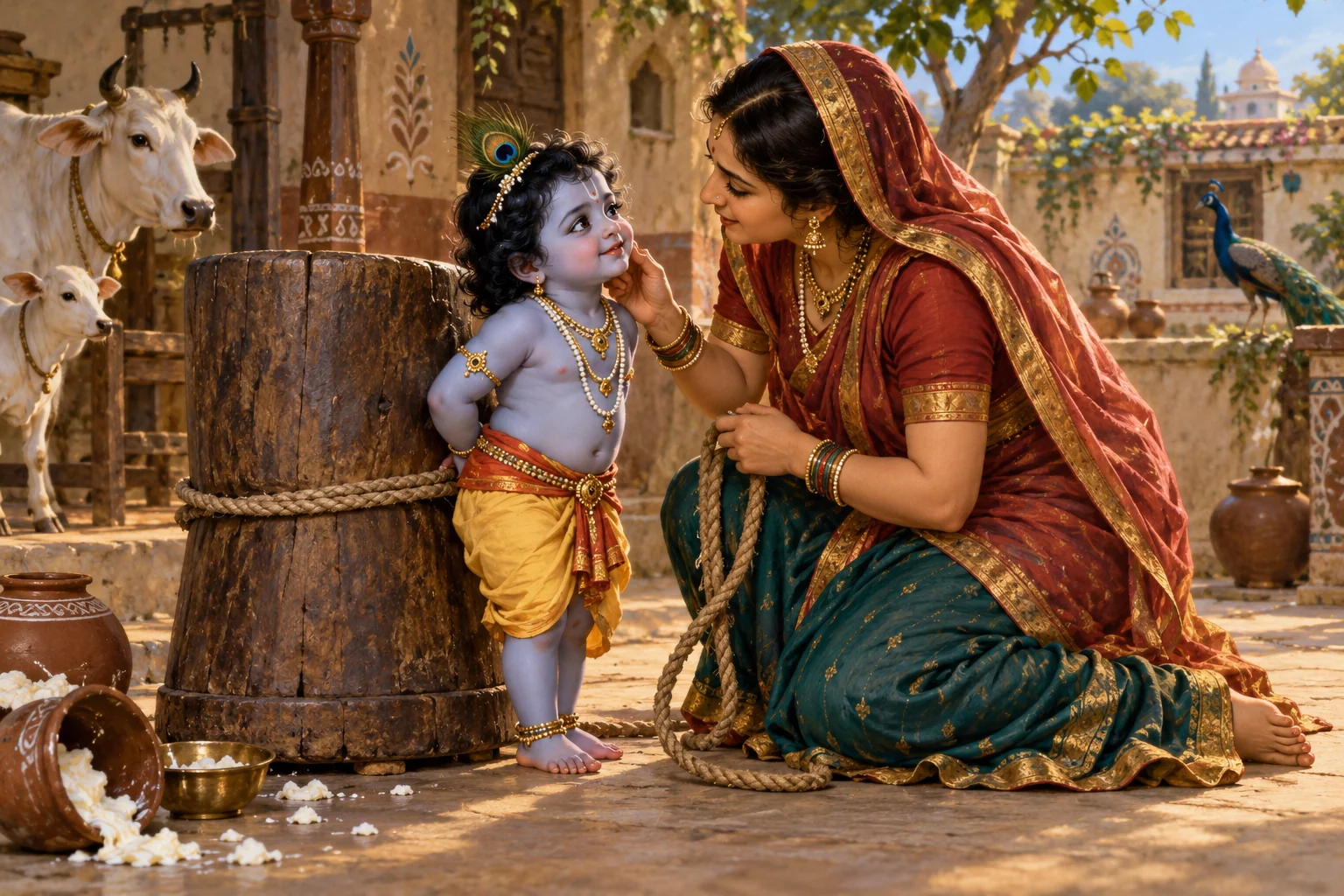
A child sits in his mother’s lap, yet he is also the divine figure in whom the mystery of creation rests. In the chapter “Yashoda Prem” of Dr. Rajesh
Read essay →7 October 2026 · Dr. Rajesh Takyar
The Tiger Transformed by Compassion

How quickly we judge a living being by its past actions. It is easy to regard someone who was once violent as forever violent, and easier still to keep our distance. But can we also recognize a real change in that being? In the chapter “The Tiger’s Redemption” of Dr. Rajesh Takyar’s Madhavshiv, an encounter between Mother Gauri and a tiger raises precisely this difficult question. The story reveals the beauty of compassion while inviting us to consider action, responsibility, and trust in someone who has sought refuge.
A Change in the Forest of Austerity
At the beginning of the story, Mother Parvati completes her severe austerities. From the dark covering she has cast off emerges the radiant Kaushiki. Brahma accepts her for the gods’ purpose, and a lion is appointed as her mount. A great task in the protection of the world has been accomplished. Yet after this divine event, the Mother turns her attention to a creature in her forest retreat whom few would dare keep close: a tiger. The first moving aspect of the story is that, amid a vast undertaking, she remembers a small and personal bond.
The tiger had once approached the Mother as though she were its prey. Its beginning was violent; the book does not hide this. But its conduct changed in her presence. While she performed austerities, it remained near the retreat and protected her from violent animals and wicked beings. Its mind no longer turned toward anyone else. Staying near the Mother and serving her became its joy. The journey from violence to service is recognized through sustained conduct, not through a sudden declaration of good intentions.
When do we trust that someone has changed? When their new actions show consistency. The tiger in the book does not merely claim to have changed. Its days and nights provide evidence. Mother Gauri has observed it under her protection for a long time, so she can speak for its present character. This remains worth understanding today: words of remorse may matter, but safe and trustworthy relationships are formed through changed behavior.
The One the Mother Called Her Own
Mother Gauri speaks openly to Brahma about the tiger. She says that it has remained near her for a long time, protected her, and now fixed its mind upon her. She wants it to accompany her, have a place in her inner household, and receive an honored place among Lord Shiva’s attendants with his blessing. She even wants it to go ahead of her companions. She is doing more than tolerating a frightening animal. She has accepted it as one under her care.
There is great tenderness in that acceptance. Others may continue to identify the tiger by its former nature, but the Mother recognizes it by its conduct today. She regards its protection and welfare as dear to her. Giving someone a new place does not erase the past; it may give the good direction now visible in that person a chance to grow. We must preserve this distinction as we read the tiger’s story. Compassion is not blind trust. It is seeing the whole person—or, here, the whole living being—with open eyes.
Imagine the forest retreat: on one side, the radiance born of austerity; on the other, an animal made peaceful in the Mother’s presence. To her, these are not opposing events. The emergence of power to protect the world and concern for one dependent creature both belong to the same motherly care. The story gently reminds us not to overlook small, living concerns in the midst of great religious events.
Brahma’s Difficult Question
Brahma smiles at the Mother’s compassion, but he knows the tiger’s earlier history. He says that it was not once an ordinary wild animal but a cruel, shape-shifting nocturnal being. It had afflicted cows, Brahmins, and ascetics, taken lives, and acted according to its violent disposition. These deeds are grave. The book does not reduce them to a minor mistake or a misunderstanding. Brahma therefore asks whether such grace toward it is right. What becomes of the consequences of its deeds? What about the suffering it caused others?
At this point the story refuses easy consolation. If we simply say that love wipes everything away, the victims’ experience may go unheard. If we see only the old offenses, we turn away from the possibility of genuine change. Brahma’s question does not weaken compassion; it makes compassion serious. Before the Mother stands not just a beloved dependent, but the full difficulty of its actions.
Mother Gauri listens. She does not invent a false story in its defense or dismiss Brahma’s account as untrue. She accepts that its past may have been as he says, that it may have sinned and hurt others. This is the strength of her compassion. Mercy offered without accepting the truth often breaks down quickly. Even while facing the truth, the Mother does not abandon the present character of one under her care.
The Meaning of Refuge
The Mother’s answer is the heart of the story: the tiger has now come to her for refuge; she cannot cast it away solely because of its former deeds. Its mind is now fixed upon her. It is her dependent. In her words, refuge means more than temporary safety. It carries the responsibility of standing by someone. To continue calling a being that has faithfully left its violent path only by its old name would also deny its change.
A caution is necessary here. This divine episode cannot be applied without thought to every human relationship today. When a person has been violent, the safety of others, justice, and boundaries are real concerns. Mother Gauri’s decision belongs to the context of her insight and power and the tiger’s changed behavior. What we can take into daily life is the need to make room for both accountability and change. Protect others while retaining the ability to recognize genuine reform.
If someone asks forgiveness after wrongdoing, do not decide on words alone. Look at whether the person recognizes the wrong, whether their conduct has changed, and whether that change endures. If trust is to return, let it return gradually and safely. Compassion does not require exposing ourselves to needless danger. Yet when a change has clearly taken hold, it is not fair to imprison someone forever in their past.
A New Identity
Brahma is pleased when he hears the Mother. He explains that he raised his question after seeing the old deeds without fully knowing the tiger’s present devotion. When the Mother herself attests to its steady mind, he sees a path for grace. Notice that the episode does not unfold like an automatic result of a rule. First comes a question, then evidence, and then a changed view. Brahma himself revises his judgment in light of new information.
There is a lovely humility in this sequence. However wise we are, we may see only part of another life. Brahma knew the past; the Mother had witnessed the present. Together, their knowledge makes the tiger’s story more complete. In human life, too, an old mistake may be clear to us while months of struggle and improvement remain unknown. Our judgment may rest on incomplete information. Listening, asking, and considering new evidence are parts of discernment.
The Mother says she will take the tiger with her. The scene is more than a bright moment of reward; it announces a changed identity. A being once feared now accompanies her as one under her care. It may not receive a new name in words, but its place has changed. It is not hidden behind the Mother; the book says it walks at the very front when they depart. That image stays with the reader.
Farewell to the Forest Retreat
Mother Gauri then meets her parents, Himavan and Mena. Seeing their daughter after a long separation fills their hearts with joy. She bows to them, tells them that her austerities have succeeded, and consoles them. Longing to see Lord Shiva, she then moves on. As she looks at the forest retreat, the falling flowers and calls of birds seem to bid her farewell. The book portrays her departure with a sense that nature itself is moved.
The tiger walks ahead of her at this farewell, while her companions accompany her. Kaushiki has appeared, the path to protecting the world has opened, and a being with a violent past now finds a new life under the Mother’s protection. The outcome is more than the redemption of one animal. The power born of austerity is working in the wider world and within a single dependent creature. The Mother’s light spreads in every direction, yet her compassion remains with the tiger walking beside her.
Sometimes we search for spiritual life only in lofty ideas. Here is a tangible form of it: recognizing the changing heart of someone for whom our presence has become a support, and giving that being an appropriate place. In Mother Gauri’s vision, austerity and affection are not separate. Power appears not only in overcoming evil but also in caring for a changed being. This balance makes the chapter of Madhavshiv distinctive.
What the Story Illuminates in Our Lives
After reading the story, it helps to look around us. Do we continue to define someone by one old incident? Do we ignore a good change because changing the image in our own minds is difficult? On the other hand, do we forget the safety of those previously harmed in the name of compassion? Respecting the story means keeping both questions in view.
There is another side to self-examination. If we have hurt someone, do we merely want forgiveness, or do we also have the patience to change our behavior? The tiger’s new place was connected to its service and steady devotion. We too must make our actions, more than our words, our answer. A little better conduct each day, responsibility for what we have done, and respect for others’ boundaries can allow trust to be born again.
And if a genuinely changed person stands before us, meeting that person need not mean denying old wounds. It means seeing the whole truth and then making a wise decision. Sometimes a relationship can be rebuilt; sometimes distance must remain. In either case, justice and compassion can coexist without nurturing bitterness. The greatness of Mother Gauri’s episode lies in showing a heart that knows the past, sees the present, and does not close off the possibility of a future.
Remember the final scene of departure: the forest retreat recedes, flowers fall, the Mother moves toward Shiva, and the once-violent tiger walks in front. Its former deeds have not been erased, nor should the lessons of those deeds be forgotten. Yet it is no longer only the name of its past. It is moving in a new direction. Perhaps this is compassion at its most beautiful: facing the truth and recognizing the direction in which a life is genuinely changing.
Was this essay helpful?