I am a writer and I love writing on spirituality. It is not that I am an analyst of this, but it is because whenever you think, read or write on spirituality, you ge
Read essay →29 September 2026 · Dr. Rajesh Takyar
Introduction to the Shrimad Bhagavad Gita: Where Are We Going?

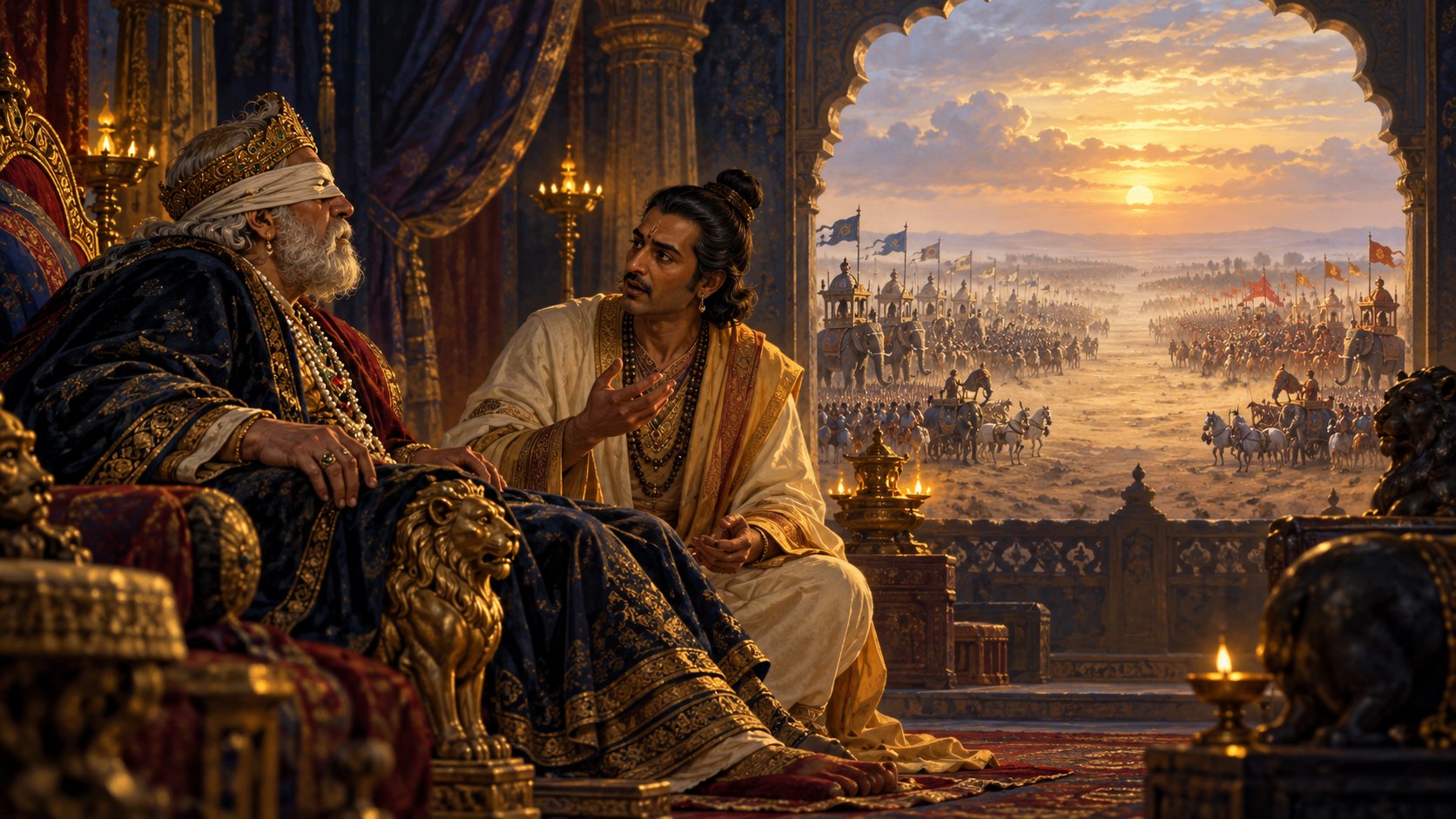
Have you ever found yourself standing in front of a decision, where there are people on both sides and no path seems easy? The mind knows that something has to be done, but the hands do not move forward. Srimad Bhagavad Gita begins with this human pause. Arjun faces war in Kurukshetra; Within them there is attachment to relationships, questions of duty and fear of consequences. He talks to Shri Krishna, asks questions and then learns to listen.
The first insistence of my book 'Shrimad Bhagavad Gita - Part 1: Where to Go?' is that Arjuna should not be seen only as a warrior in an ancient war. When a person gets confused about choosing the right path in his home, work or society, a Kurukshetra can be formed within him too. This is how Geeta communicates with humans.
In my first part, I have considered Geeta as a meaningful text for the entire humanity. Shri Krishna's dialogue with Arjun is for me also a dialogue with the mind which is asking for direction. Therefore, my endeavor is to make the language of the shlokas so simple while reading them with devotion that even a person engaged in daily responsibilities can recognize his questions in them.
Why is it important to understand the context of Geeta?
Shrimad Bhagwad Geeta is a dialogue between Shri Krishna and Arjun in Bhishma Parva of Mahabharata. The prevalent text has eighteen chapters and seven hundred verses. Without leaving the background of war, it should also be seen that the dialogue starts from a distressed mind. Arjun first explains his difficulty; Only after that Shri Krishna explains to them. Even while writing 'Mahabharata of Kurukshetra', my emphasis has been on this background: without knowing the situation, any answer may seem incomplete.
The first chapter is called 'Arjun Vishad Yoga'. Melancholy means such deep anxiety that clouds the conscience. The reader can go on from here with his own questions: What should I look for if I have two difficult duties before me? How much is attachment and how much responsibility in my decision? Reading Geeta begins with questions, not ready slogans.
Who will teach decision making?
The question for the second part of my series is, 'Who will teach decision making?' Many readers, especially householders and youth, find the language of scripture difficult. Therefore, in this series, an attempt is made to keep together the original Sanskrit words, their simple meaning, context and my commentary. My aim is not to pass judgment on any reader, but to teach him to see clearly enough to recognize his duty.
Arjuna's dialogue also teaches us that reverence and questioning can go together. They do not hide their illusions. Even in your own life, when anxiety about the future increases, it is useful to first clarify the question: What am I afraid of doing? Am I worried about the outcome, or have I just failed to understand my duty? When read in this way, Gita does not remain a text distant from life.
Karma and results: Hands in work, mind in equanimity
In Chapter 2, Verse 47 of Gita, there is talk of concentrating on actions and not being attached to the results. In the same verse it has also been said to stay away from inaction. In my third part ‘Karma aur Phal’, this question comes again and again: Can the responsibilities of family, society or work be abandoned in the name of spirituality? In my interpretation of this part, the answer is – running away from duty is not karmayoga.
Suppose a student studies diligently, or a person takes care of his family with full attention. The result is important; But if results become the sole basis of his identity and peace, then fear or ego can engulf him. The equanimity of verse 2.48 shows the direction to protect the mind from both pride on success and despair on failure. Do the work with complete honesty; Gradually loosen the grip of the fruit.
Bhakti in everyday practice
Gita does not discuss only karma. It also contains knowledge, practice of mind and devotion. The twelfth part of my series seeks to understand devotion not just by the number of prayers, but by behavior: Can we have compassion for others? Can hatred and ego be reduced? Can we remember God while doing our work? The person living at home can also follow these questions.
This is my interpretation derived from my faith and study. Every chapter and verse of Gita has its own context; Reading it and seeing different commentaries can further enrich the reader's understanding. Even in my books, I consider my comment not the last word, but an attempt.
Where to start?
First read Chapter 1 to understand Arjun's situation, then go to the dialogue in Chapter 2. Choose a verse; See the Sanskrit word, its simple meaning and its context. Then add an honest question from your life. Even if the answer is not found immediately, reading was not in vain. If the question becomes more clear, then the dialogue between Arjun and Shri Krishna has progressed within you too. Introduction to Geeta For me, it is not just telling the name or verse number of a book. It is to recognize the moment when the mind asks, 'Where to go?' and then learns to take the next step with the help of duty, discretion, action and devotion.
Introducing Geeta for me is not just telling the name or verse number of a book. It is recognizing the moment when the mind asks, 'Where to go?' and then learning to take the next step with the help of duty, discretion, action and devotion.
Was this essay helpful?