17 October 2026 · Dr. Rajesh Takyar
The Tender Shoot of Devotion
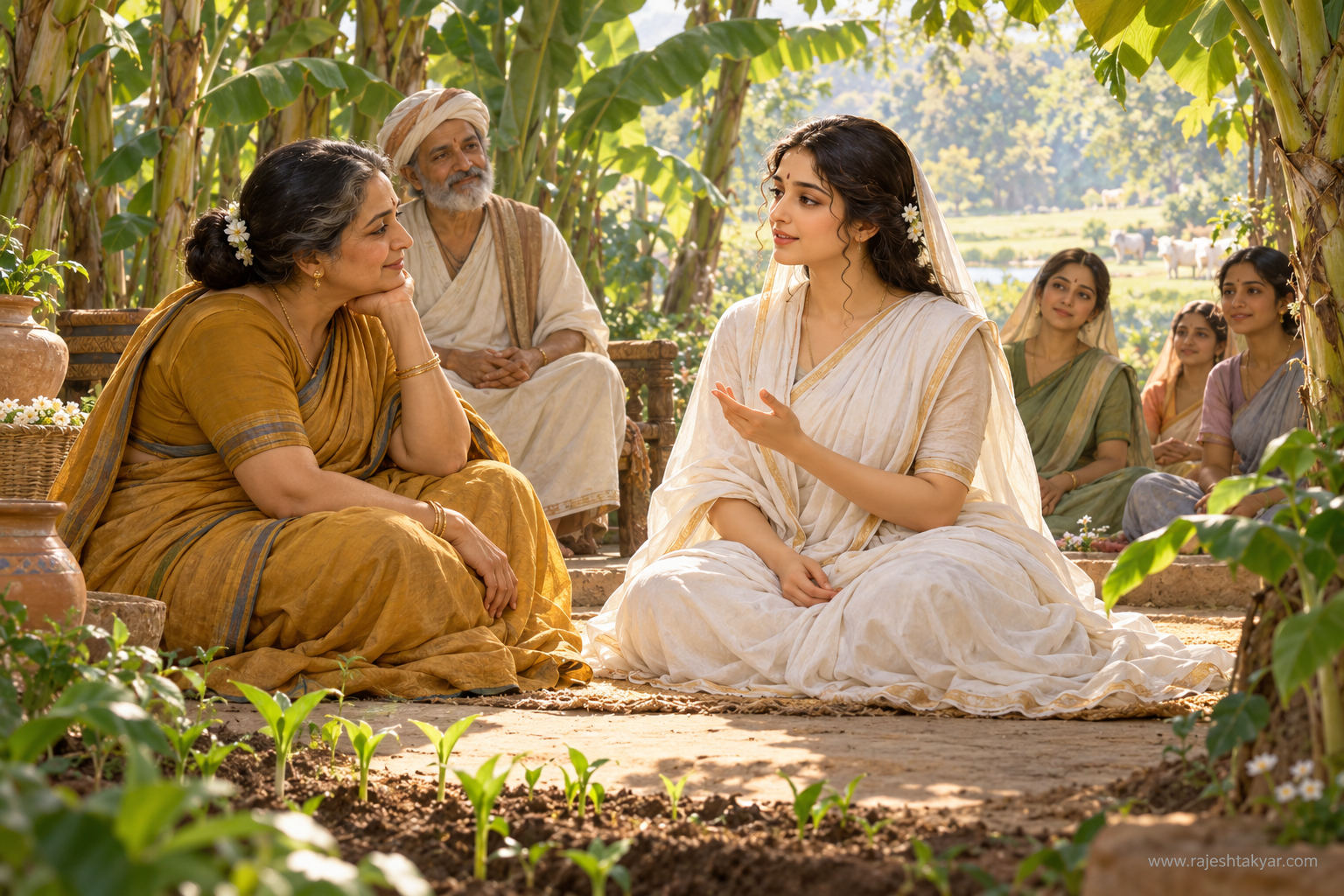
Yashoda’s question
A moment of devotion can awaken much within us, but that awakening also needs care. Love arises, our eyes grow moist, and remembrance of God becomes natural. Does this mean our journey is complete? The conversation between Shri Radha and Mother Yashoda brings me face to face with this question. Here, devotion does not appear as something distant. It reveals its meaning within relationships where affection already exists. The question is how open our vision remains within that affection, and how deeply we recognise the true nature of the one we love.
The episode begins in Dwarka. The auspicious ceremonies of Rukmini’s wedding have concluded. Nanda and Yashoda come to their two sons, Krishna and Balarama. Yashoda asks Shri Krishna about the path to her deliverance. She says that he has given knowledge to Nanda and asks him to show her grace as well. There is a mother’s love in this appeal, but not merely a mother’s claim. Yashoda recognises her own inner need. She seeks support that will take her beyond the fear of worldly existence. Krishna is her son, yet she does not hesitate to ask him for guidance.
I see in this scene a beautiful readiness to learn. Being close to someone does not mean knowing everything about them. Before Yashoda stands the same Krishna whom she has loved as her son, but her question seeks a deeper understanding of that familiarity. She does not settle into the assumption that no one could know the child of her household better than she does. Within her affection, the door to inquiry remains open. I consider this openness necessary in spiritual life as well. If love ceases to learn, its understanding may remain confined to what it already knows.
Shri Krishna indicates different forms of knowledge and explains the excellence of knowledge expressed as devotion. He then sends Yashoda to Radha. It is worth noticing that the path to an answer does not consist simply of remaining where she is. Yashoda must go further, listen, and receive. Her trust in Krishna takes her to Radha. Here I see devotion and humility together. A mind seeking knowledge can move forward when it releases the insistence that the answer must arrive only in the form and from the place it has already decided upon.
The humility of learning through love
Nanda and Yashoda reach the banana grove. Radha is deeply absorbed in remembering Krishna. She wears white, has set aside her ornaments, and has withdrawn her attention from the outer world. Her mind rests on Krishna’s lotus feet. Nanda and Yashoda are astonished by what they see. Yashoda sits beside her, introduces herself, and conveys the welcome news of Krishna. She asks Radha to be patient and to steady herself. The mother who has come to receive instruction first offers loving support to the Radha sitting before her.
The tenderness of this sequence matters greatly to me. Yashoda has come with a need of her own, yet she does not see only that need. She first notices Radha’s condition. Affection comes before insistence in her words. Hearing the news of Krishna, Radha regains her composure and honours Yashoda. Their conversation about devotion then begins. Knowledge does not descend here as a stern pronouncement. A space of respect forms between the person speaking and the person listening. When each acknowledges the other’s presence, words become more than information; they find a way to reach the heart.
Radha asks Yashoda to recognise Krishna’s divine nature as Brahman. The purpose of their conversation is not to erase her love for her son. Its depth lies in recognising God present in that very form. Merely calling someone mine does not contain their entire being within my description. Here, Yashoda’s motherhood is seen in a further light. The Krishna she knows as the child of her courtyard is also the supreme reality. Intimacy and divine greatness are present together. The vision of devotion does not narrow that intimacy; it offers an opportunity to recognise the vastness concealed within it.
While reading this conversation, I therefore examine the sense of possession and surrender within myself. Do I keep God only in the role of fulfilling my wishes, or do I open my understanding before him as well? Yashoda’s question and Radha’s words illuminate this difference. Love does not always mean holding firmly to our first conclusion. Sometimes that very love teaches us to listen more deeply. When respect for the one we call our own diminishes, affection itself remains incomplete. Radha’s instruction awakens a respect in which tenderness and recognition of the Divine remain together.
A tender shoot nourished by companionship
To explain devotion, Radha presents the beautiful image of a tender shoot. The tree of devotion grows through the company of devotees and gains strength when watered with the nectar of Hari’s stories. I want to pause over this image. A shoot holds the possibility of a tree, but possibility and full growth are not the same thing. We cannot say that because a shoot has appeared, it no longer requires care. In the same way, the first stirring of devotion within us is precious, yet it also calls for continuing attention. The feeling we wish to cultivate in life needs nourishment.
Here, that nourishment is named as spiritual companionship and the stories of Hari. Companionship becomes more than sitting near others; we must also notice the effect of the words to which we give space within our minds. Radha says that conversation which weakens devotion can dry out this shoot. The centre of her teaching is the protection of devotion within oneself. I do not wish to make this episode a basis for asserting superiority over another person. Examining the condition of our own mind is more demanding and more necessary. After a conversation, has remembrance deepened or become more distant? That is a question worth asking ourselves.
Speaking a great deal about devotion and finding companionship that strengthens devotion are not always the same experience. The measure offered by this episode is the growing shoot. The importance of words lies in the direction in which they lead the mind. If hearing the stories of Hari increases only my pride in having listened, while remembrance falls behind, I must examine the way I receive them. Radha’s indication is not towards increasing an outward display. She speaks of preserving the inward direction through which the mind returns to God and grows stronger within that relationship.
There is also hope within this image. Radha says that when the shoot begins to wither, good nourishment can help it grow again. It therefore does not seem right to treat the mind’s slackening as a final verdict. If remembrance has diminished, attention has scattered, or companionship has weakened devotion, we can recognise this and return to nourishment. There is room here for awareness rather than remaining in despair. I do not wish to measure my devotion only by a good experience in the past. It is equally necessary to notice what nourishment is available to it today. The shoot must be cared for in the present.
Remembering a relationship through the name
Radha asks Yashoda to remember eleven names of God: Rama, Narayana, Ananta, Mukunda, Madhusudana, Krishna, Keshava, Kamsari, Hari, Vaikuntha, and Vamana. She then unfolds their meanings. One aspect of this explanation is especially important to me. A name becomes more than a sound used in calling; it leads towards recognition of the one being called. When meaning accompanies remembrance, the mind gains a clearer awareness of its relationship. Yashoda is to worship God present in the form of her son. These names connect that intimacy with the vastness of the Divine.
The meaning of Narayana brings forward the sense of refuge. Ananta points towards the being whose limit cannot be found. Mukunda reveals the gift of liberation and devotional love. Listening to these meanings, I see Yashoda’s question opening further. At the beginning, she was asking for support to cross worldly existence. Now the identity of that very support is being disclosed through different names. When this recognition joins remembrance, the connection between word and feeling deepens. The name is being spoken, and the mind also remembers the refuge it signifies.
In explaining Madhusudana, the episode draws attention to the bonds of action and to actions which seem sweet at first but bring an inauspicious result in the end. I cannot leave this behind as merely the meaning of a word. What attracts the mind also deserves consideration in terms of its outcome. How far can it be right to turn away from the direction of our actions while engaged in devotional remembrance? If the name calls us towards God, it also opens a place for recognising our inner bondage. Remembrance and inward examination thus cease to be separate concerns; the need for both becomes apparent within the same relationship.
Radha then returns to the butter-stealing child whom Yashoda had bound in her home. He is that same infinite Lord whom even yogis and sages cannot bring under their control. Through this recollection, the conversation returns to the intimacy of motherhood. Yashoda’s love has not been lost while the greatness of God is being explained. I see here that wonder of devotion in which greatness does not become a reason for distance. A relationship of the heart is possible with the one who cannot be fully described. Name, recognition, and love deepen that relationship together, taking it beyond a limited idea of familiarity.
Awareness even after receiving a blessing
Throughout this conversation, one warning from Radha repeatedly makes me pause: do not become careless even after receiving Krishna’s blessing. Receiving grace does not give us a right to neglectfulness. A good state we have experienced is no substitute for continuing awareness. If, after an experience of devotion, we begin to disregard its nourishment, we forget the meaning of the tender shoot itself. Radha’s emphasis is on sustained remembrance. It shows that caring for what has been received is also part of spiritual practice. Recounting an experience of attainment is not enough; we must also examine the present direction of our mind.
Radha invites Yashoda to ask for a blessing. It is beautiful to see what Yashoda chooses. She wants unwavering devotion to Hari and the spirit of serving him. The fear and appeal for deliverance with which she began now unfold into a desire for steadiness in the relationship. She asks for devotion that will not waver. For me, this choice contains the essence of their conversation. When given an opportunity to ask, the mind reveals what it cherishes. Yashoda’s request shows that she regards the feeling which connects her to God as most precious. This is the profound fulfilment of her question.
At the end, Radha asks her to return to Vraj with Nanda and also indicates the interruption to her meditation. I find this ending worth remembering. The conversation has served its purpose; remembrance now has its own place. Keeping everything in discussion is not the only way to sustain it. What has been heard also needs to settle within the mind. Radha wishes to return to the meditation in which her mind rests in Krishna. The teaching of devotion and the lived experience of devotion are not separated here. Remembrance is at the centre of what has been said, and that same remembrance remains present in the quiet ending.
I rise from this episode carrying one question for myself: what is nourishing the tender shoot of devotion within me? Merely declaring its presence does not amount to caring for it. It needs respectful listening, remembrance of God, companionship that strengthens that remembrance, and awareness of the love already received. Yashoda goes out to learn, Radha explains with affection, and unwavering devotion is sought at the end. For me, the beauty of this journey is that it deepens love. The more tender the shoot of devotion, the more continuous our responsibility towards it must be.