27 October 2026 · Dr. Rajesh Takyar
Remembering God Amid Action
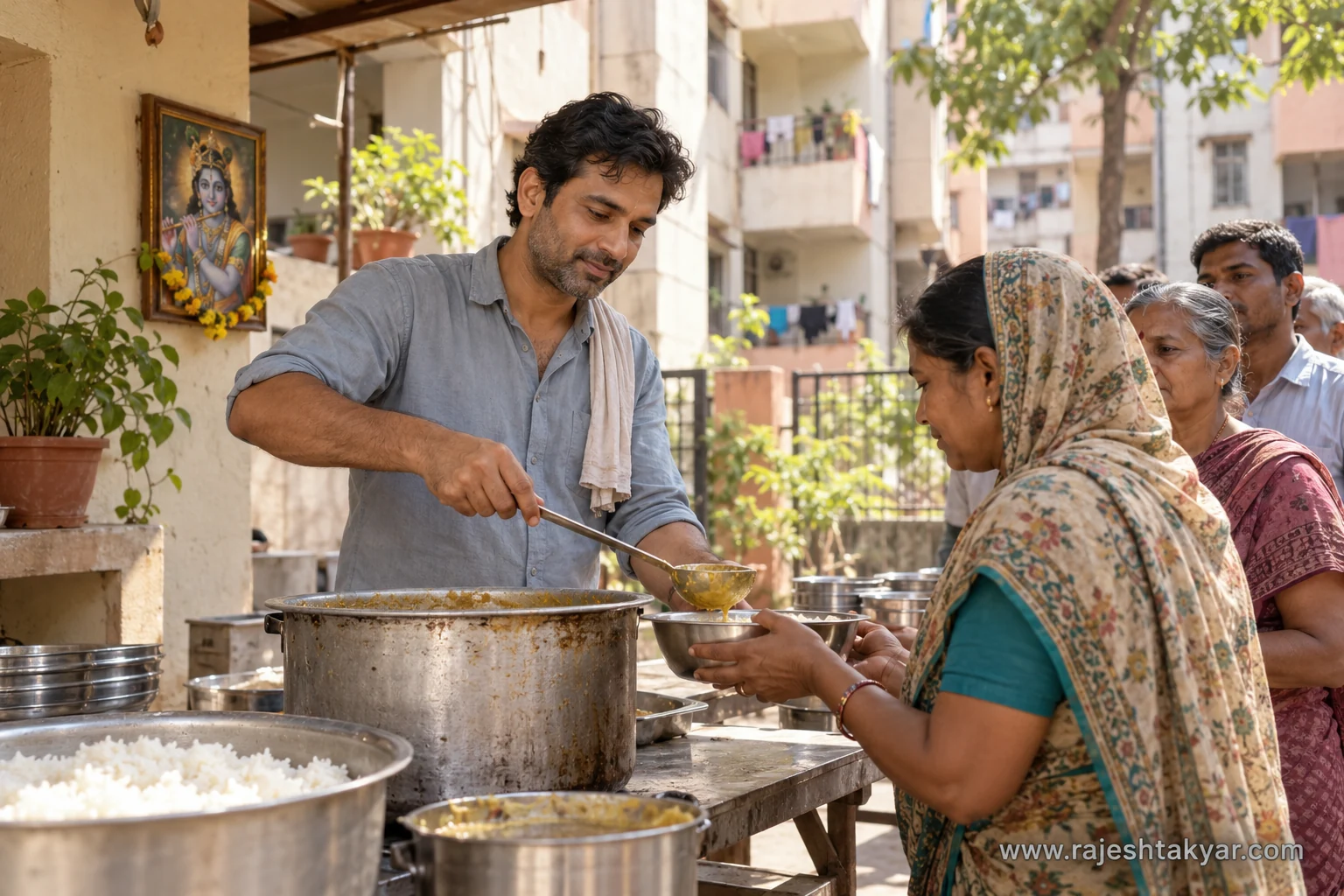
Looking at a life filled with home, work and responsibilities, many people think spirituality requires a separate time and a separate world. This passage from Part 8 offers a way to view the two together. कृष्ण asks Arjuna to act while maintaining remembrance. For us, the question becomes: how can we attend to the mind's direction and our intention while working?
The Inward Meaning of Remembrance
Remembrance does not mean merely uttering a name; it comes through experience. The word is simple, but its meaning is deep. To remember is also to become connected. When a person remembers someone dear, they do not merely imagine a face; they feel the emotion associated with that person. In the same way, one is to become connected with me. True remembrance brings emotional connection, mental concentration and inward experience together. Something recalled repeatedly becomes part of our consciousness. A musician plays an instrument every day. At first this requires effort, but gradually the fingers begin finding the notes naturally. In the same way, the mind of someone who practises remembrance at every moment gradually becomes steady. Within, the person discovers a quiet witness that says, 'I am present; my Bhagavan is near me.' This presence is remembrance. It is this practice that helps at the time of death. The body no longer supports us, the voice cannot speak and the breath slows. Yet if the mind has practised remembrance throughout life, it naturally rests in that same consciousness. Someone who has forgotten throughout life cannot summon remembrance at that moment. Begin remembering now: this is a way of living as well as an instruction. It does not, however, mean that a warrior should forget duty and turn away from battle when the time comes.
Why must remembrance and action be practised together? As I have explained before, some people think remembrance means leaving the world, sitting in the mountains or living apart from home and family. This understanding is mistaken. Remembrance and action complement one another. Life acquires meaning when remembrance is maintained while acting. Continue remembering while caring for family and making decisions; this, too, is the work of life. If a person keeps the awareness behind every action that 'I am doing this work honestly, and the consciousness working within me is a part of God,' that action becomes Karma Yoga. Work then becomes worship instead of a burden. A person can maintain remembrance in the midst of action. Hence the instruction: 'Fight, and remember me as well.' Do not abandon life's struggle, but do not lose yourself in it either. Strive, work and fulfil your dreams, while knowing within that you are an instrument and that the one who brings action about is another. With this feeling, remembrance and action flow together. When a person enters an activity wholeheartedly, the sense of 'I' within gradually begins to melt. This melting is the practice of remembrance. The moment of death comes to everyone. Some fear it, some try to put it off, and only a few accept it. A person who fears death is, in truth, unfamiliar with life. For someone who lives every moment with awareness, death becomes a doorway rather than a fear. At death, the body weakens and the senses cease functioning, but the consciousness burning within remains as it was during life. If that consciousness has been restless, fearful and attached, the same restlessness is carried forward at death. If a person has maintained remembrance throughout life, consciousness remains steady at that moment too. Remembrance is the fulfilment of life rather than merely preparation for death. When someone remembers throughout life—remaining aware, bringing love into action and keeping the mind peaceful—an inner light awakens. Death cannot extinguish that light because it rests upon the soul rather than the body. For someone who has lived each moment with attention, love and truth, death is a change of body. Just as one puts down the day's burden before sleep, one puts down the body's burden in death. Remembrance makes this transition natural.
Spiritual Practice Alongside Duty
Anyone who wishes can practise remembrance. It does not require an ashram or a guru; it requires honesty within. On waking, a person can first take a deep breath and say, 'I am alive; I am aware.' This small step changes the day's direction. Nothing else needs to be thought at that moment; simply say inwardly, 'I am present.' This pause lightens the mental burden and gradually brings steadiness. Bringing attention back from wherever it has gone is true attention. Before sleeping, look calmly at the day's events: when did I lose remembrance, and when did I regain it? This self-observation gradually changes life's direction. When speaking with someone, truly listen. When giving something, give from the heart. This love is a form of remembrance, and it brings inward change. When remembrance is maintained in every moment of life, several changes gradually take place. The mind becomes steady and is no longer angered by small matters. Decisions become clear because the mind is pure. Fear decreases because a sense of security arises within. Relationships become sweeter because others, too, are seen as part of the same consciousness. Fear of death ends because each moment of life has become meaningful. These changes cannot be seen by someone outside, but the practitioner feels them. The person knows that they are no longer as before: the mind is lighter, the heart more open and thoughts clearer. All this practice will then help at the final moment, making remembrance of me possible.
'तस्मात् सर्वेषु कालेषु माम् अनुस्मर' means that remembrance should continue at all times. Bhagavan asks us to remember him at every moment, rather than only at death. This continuous remembrance is the highest state of devotion: sustained repetition of the divine name, contemplation of God and self-surrender. The devotee's heart becomes an unbroken experience of Bhagavan's presence. In yoga, this is called the practice of remembrance, in which the mind continually rests in one contemplation. As a lamp's flame remains steady even in the wind, the practitioner's mind remains steady in remembrance of God amid the storms of the world.
'युध्य च' means that action must continue. भगवान् योगमाया therefore tells Arjuna to fight as well. Anyone can remember Bhagavan while carrying out their duty. Making action an offering to God, rather than fleeing from it, is Karma Yoga without desire for its fruits. Here, the person regards God, rather than the individual self, as the doer. This forms a bridge between spiritual life and practical conduct. Householders, workers and scholars can all maintain remembrance of God while performing their work.
Offering the Mind and Intellect
'मय्यर्पितमनोबुद्धिः' means that the mind and intellect should be offered. The mind is the field of feeling, while the intellect is the field in which thoughts are judged and decisions made. When both are offered to Bhagavan, life naturally becomes infused with yoga. In devotion, the mind and intellect have their respective work: allowing the mind to delight in Bhagavan's divine acts is devotion, while surrendering the intellect to Bhagavan's design is knowledge. When mind and intellect are offered, action becomes free from the ego of doership. 'I am not the doer; I am an instrument of God': this feeling turns a person's work into worship.
Preparing for a journey requires giving it time many days in advance. In the same spirit, one should give time to Bhagavan every day.
Pauses for Remembrance During the Day
Choose three occasions: when beginning work, before a difficult conversation and at the end of the day. Pause for a moment to observe what is happening in the mind. Recall your intention to work honestly. Prepare to listen to the other person during the conversation. In the evening, notice where you remained aware and where you forgot.
The purpose of this practice is to fulfil responsibilities with a clearer mind, rather than take time away from them. The value of remembrance becomes visible when patience grows in conduct, discernment in decisions and respect in relationships. In this way, a place for practice can be found amid work, and household life becomes a ground for spiritual practice.