11 October 2026 · Dr. Rajesh Takyar
From Renunciation Toward Liberation
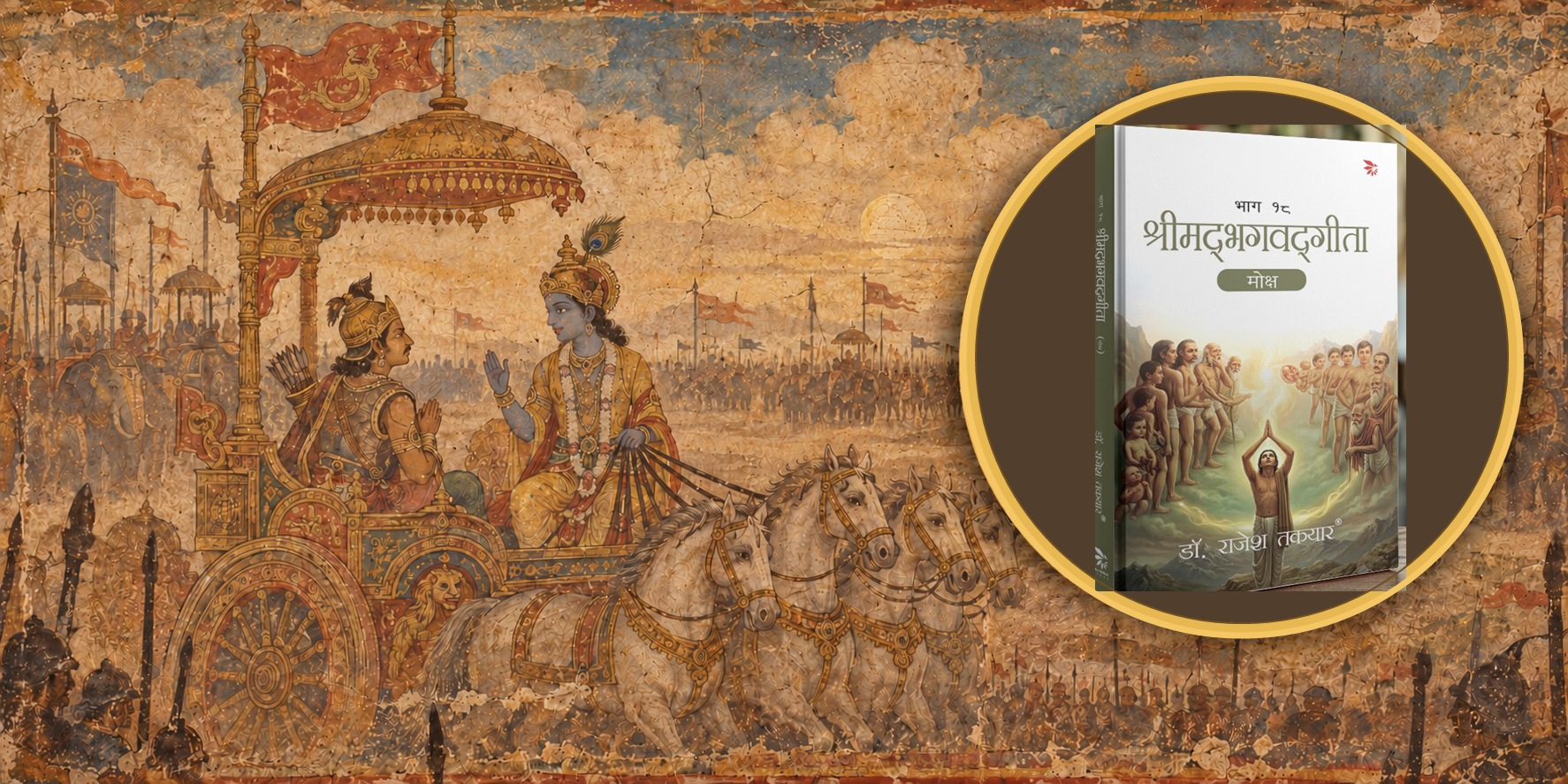
Arjuna asks Shri Krishna to explain separately the true meanings of renunciation and relinquishment. By now, many aspects of action, knowledge, devotion and self-restraint have been presented. Arjuna wants to know what must be given up among them and what must be retained in life.
Shri Krishna explains that giving up actions performed out of desire is called renunciation. Giving up the fruits of all actions is called relinquishment. It is not right to abandon purifying actions such as yajna, charity and austerity. They should be performed free from attachment and desire for results.
Relinquishment, too, is of three kinds. Abandoning one’s duty out of delusion is tamasic. Giving up action from fear of bodily discomfort is rajasic. Performing one’s duty with understanding while renouncing attachment and its fruits is sattvic relinquishment.
For an embodied person, it is not possible to give up every action completely. True relinquishment therefore becomes a practice within action. The person who has relinquished does not hate difficult work or cling to pleasant work. Commitment remains with duty.
Shri Krishna then describes five causes behind the accomplishment of action: the basis, the doer, the instruments, the various efforts and the divine factor. Many causes contribute to any result. Someone who considers oneself the sole doer has an incomplete understanding.
This discernment reduces ego. A person makes an effort but does not assume that the entire order is the result of personal power. This can lessen both pride in success and excessive despair in failure.
Shri Krishna explains the influence of the three qualities on knowledge, action and the doer. Sattvic knowledge sees one imperishable principle in many beings. Rajasic knowledge becomes more entangled in their differences. Tamasic knowledge is narrow and treats one incomplete idea as the whole truth.
Duty performed free from attachment, attraction and aversion is sattvic action. Action driven by results and ego is rajasic. Action undertaken without considering its consequences, harm or one’s own capacity is tamasic.
The doer, too, can be understood through the inner motive. A sattvic doer has patience and enthusiasm, with less hold of ego. The person maintains balance in success and failure. Intense craving for results or negligence can alter the direction of action.
The work of the intellect is to recognise duty and what is not duty, bondage and freedom, and what is right and wrong. Steadfastness is the strength to remain established in that discernment. Right commitment must accompany right understanding; stubbornly holding to something is not automatically virtuous.
Happiness, too, differs in kind. Some happiness seems difficult at first but brings pure joy in the end. Some tastes sweet immediately but later becomes a cause of sorrow. Some, in the name of happiness, immerses a person in laziness and delusion. Its value should therefore be understood not only from its beginning but also from its result.
Shri Krishna explains the importance of carrying out one’s duty according to one’s nature. Through action, a person can worship the Divine who pervades the entire universe. Even if one’s own duty has some shortcomings, understanding and performing it is better than outwardly imitating another’s path.
Every action can have some imperfection, just as fire is accompanied by smoke. Turning away from duty is not the solution. By letting go of attachment and purifying the intellect, one can make that very action a spiritual practice.
Shri Krishna goes on to speak of a purified intellect, self-discipline, moderation in food, meditation and detachment. As the hold of ego, pride in power, desire, anger and possessiveness diminishes, a person becomes peaceful within. Equanimity toward all beings and the path of supreme devotion then open.
He asks Arjuna to offer all actions to Him and keep the mind fixed on Him. The Divine dwells in the hearts of all beings. Taking refuge in Him, a person can find direction and peace even amid difficulty.
Shri Krishna then gives Arjuna the freedom to reflect. He says that the knowledge has been explained; now Arjuna should consider it fully and act as he sees fit. Arjuna must arrive at a decision through clear understanding.
In His final teaching, Shri Krishna calls for complete dedication. Fixing the mind on Him, devotion to Him and taking refuge in Him are at the heart of this dedication. He assures Arjuna that He will free him from sin and bondage and tells him not to grieve.
Shri Krishna then asks whether Arjuna listened with concentration and whether the delusion born of ignorance has disappeared. Arjuna replies that, through His grace, his delusion is destroyed, right understanding has returned and his doubts are gone. He is now steady and will act according to Shri Krishna’s words.
The teaching of liberation is completed through this transformation. At the beginning of the dialogue, Arjuna was surrounded by doubt and grief. At the end, his duty is clear and his mind is steady. Knowledge changed his vision, devotion gave him refuge, and relinquishment purified the direction of action. He is now ready to move forward with dedication and discernment. The author has expanded on this in his following book in 95,707 words. (Shrimad Bhagavad Gita — Part 18 — Liberation)