19 October 2026 · Dr. Rajesh Takyar
Devotion as the Boon
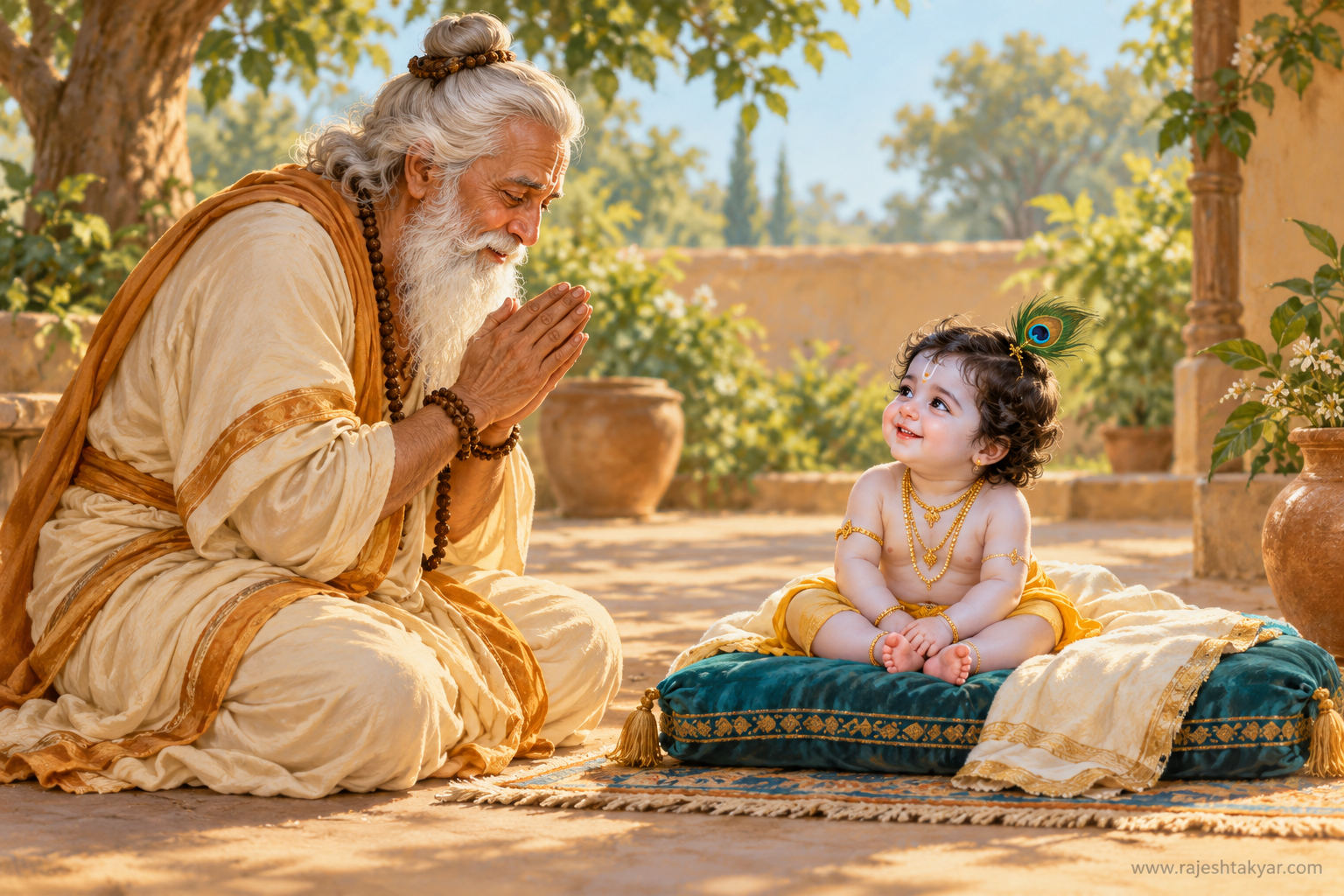
The Heart Revealed in Prayer
When we fold our hands before God, many desires arise within us. We wish for a difficulty to pass, unfinished work to be completed, happiness to remain in our home, and the future to appear secure. Amid these desires, I sometimes ask myself what I would seek first if all my prayers were heard. A brief episode involving the sage Garga and the child Krishna brings me to a pause before this question. Here is a prayer in which the one asking has already recognised the deepest longing of his heart.
Garga takes Krishna to a secluded place. His eyes fill with tears, his body thrills with devotion, and his hands are folded. Before him is a child, yet the sage recognises the Lord of the world in that child. The scene is tender in itself. A sage rich in knowledge and years bows before this infant form. Praise rises from his lips, and his heart prays for the opportunity to serve. He places his devotion at the Lord’s feet.
What I first notice in this prayer is clarity of heart. Garga knows before whom he stands and what he desires from him. His words contain no tangled request. He seeks unwavering devotion, service at the Lord’s feet, and remembrance that will always remain. Listening to his appeal, I wish to examine the direction of my own prayers. When the things for which I feel such urgency have been obtained, which relationship should remain alive within me?
The tears in the sage’s eyes bring this question closer. He speaks his appeal with his whole feeling. Here, feeling gives depth to words. Service is no distant idea for him; it is present in the way he bows, folds his hands, and asks for grace at this very moment. His prayer begins with the feeling he wishes to sustain throughout his life. The devotion for which he seeks a boon is already visible in his conduct.
Choosing Service Beyond Wealth
Garga tells Krishna that his father has given him much wealth, but that he has no desire for it. These words belong to a particular situation. He has received honour and wealth; now he opens his heart before the one he worships. At this moment, his longing is to serve. He chooses the boon in which his heart finds fulfilment. In his appeal, the account of what he has received recedes, and his relationship with the beloved Lord’s feet comes to the fore.
This choice helps me understand the depth of desire. The heart repeatedly asks for whatever it regards as its ultimate support. In Garga’s appeal, the longing to serve returns again and again. This repetition reveals the centre of his love. He wishes the Lord to make him a servant at his feet. Here is the wish to place his entire heart in the beloved’s service, a different movement from obtaining something and then remaining occupied with protecting it.
Bringing this story close to my own life, I pause over the word service. Service calls us to connect our time, attention, and conduct with a purpose we cherish. In Garga’s prayer, Krishna is its spiritual centre. The sage finds the meaning of his own existence in closeness to him. This gives his longing such a steady voice. He knows the direction of his love. He asks for grace to remain in that direction and sees the fulfilment of his life within it.
As I read this personal prayer of the sage, I feel the need to understand his inner feeling. It is his own heart speaking here. Reflecting on my circumstances, I can consider how much space for service remains amid concerns about wealth and comfort. How fully does respect for a relationship enter my conduct? How attentive am I to remembering the one I worship? Such questions connect prayer with the work of my day. Its words remain connected to my life.
Recognising Devotion Among Attainments
Garga’s prayer also mentions yogic powers, knowledge, immortality, the pleasures of heaven, and the desire for exalted positions. Before all these, he places his one wish: unwavering devotion. Reading this sequence carefully reveals the breadth of his choice. He has considered many kinds of attainment. Yet his heart asks for service at the Lord’s feet. In the presence of what he holds dearest, the brilliance of achievement cannot turn his prayer in another direction.
Even when the sage mentions different forms of liberation, he holds firmly to his longing for service. His feeling is that he has no desire even for an attainment in which he cannot serve the Lord. The intrinsic value of devotion becomes clear here. Closeness to the beloved gives meaning to his aspiration. Reading this episode, I find myself thinking how small the intimacy of a relationship becomes when its value is confined to the benefits it brings. Garga’s love seeks fulfilment in the one he worships.
Another part of his prayer touches me. He says that he received Krishna’s mantra from Shiva and that through its influence he gained the capacity to know and to see. Even after saying this, his hands remain folded. He asks for grace. The knowledge he has received does not remove his need for the relationship of service. I see humility in this feeling. Remembering all he has received brings him before his Lord with still greater reverence.
After understanding a subject, we may begin to feel complete within ourselves. Before Garga’s appeal, I can examine such a feeling in myself. Knowing and remaining steadfast in love each have their own depth. The sage prays to keep alive the relationship of service in which his knowledge also finds meaning. His words allow me to ask how far the understanding I possess makes my conduct humble and helps my remembrance remain steady.
In his praise, the sage connects the greatness of Brahma, Dharmadeva, Shesha, Shiva, Lakshmi, and other goddesses with service at Krishna’s feet. For him, the possibility of greatness is contained in service. He speaks of the earth sustaining everyone and producing food within this same feeling. The world of his prayer thus becomes expansive. Within it, service is connected with strength, sustaining, and nourishing. Amid this expansive vision, the sage finally asks for a small place for himself: that he too may become the Lord’s servant.
May Remembrance Always Remain
Garga does not make the desire to dwell in any particular realm the centre of his appeal. He wishes remembrance of the Lord’s feet to remain always. This longing reveals a continuity of relationship that reaches beyond place. His heart wishes to hold the presence dearest to him. He does not confine the one he worships to a single occasion in life. His prayer carries the same wish into the time ahead: may this direction of love endure, and may this stream of remembrance continue to flow.
Thinking about this continuity of remembrance, I recognise my own restlessness. In a deeply moving moment, the heart becomes closely connected; then other desires gather around it. Garga’s prayer shows me the value of that connected heart. The feeling of this moment is so dear to him that he asks for it to remain always. Seeking devotion as a boon also expresses a wish to preserve this tenderness of the heart. He knows how necessary the Lord’s grace is for him.
Having completed his appeal, Garga falls at Krishna’s feet. His eyes are full of tears. After this extensive petition, the Lord’s answer is very brief. Krishna, who loves his devotees, smiles and grants that the sage’s devotion will always remain. The answer accepts the very steadiness for which Garga has prayed. Prayer and boon meet in the same feeling. The beauty of their meeting lies in its simplicity: the devotee’s heart asks for what it loves, and the Lord accepts that love.
Remembering this boon, I wish to make room in my own prayer for steadfastness as well. May the reverence I experience today also appear in tomorrow’s conduct. May remembrance of the feet before which my heart has become humble today remain amid comfort and busyness. Garga’s story gives direction to such a prayer. Here, the joy of receiving lies in love continuing. After the boon, life goes forward with the same relationship the sage has placed at the centre of his heart.
Joy in Gokul’s Courtyard
The ending of this episode is especially dear to me. After Garga receives his boon, the story returns to Nanda and Yashoda’s home. They live joyfully, holding the child Krishna close to their hearts. Krishna and Balarama gradually grow. They try to stand by holding the cows’ tails and taking support from a wall. Their little words increase their parents’ happiness. Entering this simple domestic delight after the earnest prayer in seclusion makes the story deeply intimate.
Krishna begins to take a step or two and moves around the courtyard on his knees. Balarama is a little older; together, the two children delight everyone’s hearts. Here, love appears in watching, caring, and being together. The children’s growth is a celebration for the household. In this scene I see the same tenderness of attention that was present in Garga’s prayer. There was the appeal for service at the Lord’s feet; here is a family rejoicing at every small movement of the beloved child.
Reading these two scenes together brings devotion closer to me. On one side is the sage’s praise; on the other is the parents’ affection. A current of belonging to Krishna flows through both. The story’s joy unfolds in their companionship. A feeling connected with God also gathers our attention, our touch, and our happiness into itself. Seeing the child held close to Nanda and Yashoda’s hearts reveals a domestic and vividly living expression of that love.
Returning from this chapter, I wish to look for space in my own life for service and remembrance. When speaking of love, it feels necessary to look at its expression in conduct as well. How present is my heart for the one I revere? How much of my time and attention do I give to the relationship I call precious? Garga’s clear prayer and the joy of Gokul make these questions simple. Together, the scenes allow me to consider the direction of my heart alongside my actions.
At the end, the child Krishna’s smile and Garga’s folded hands remain together in memory. The sage asked his beloved for that in which his whole heart dwelt. He received the boon that his devotion would endure. The tenderness of this episode lies in that acceptance. May my own prayer reach the truest feeling within me, may the wish to serve find a place in my conduct, and may remembrance of the beloved remain. Garga’s boon helps me understand the value of steadfast love.