17 October 2026 · Dr. Rajesh Takyar
You or the Five
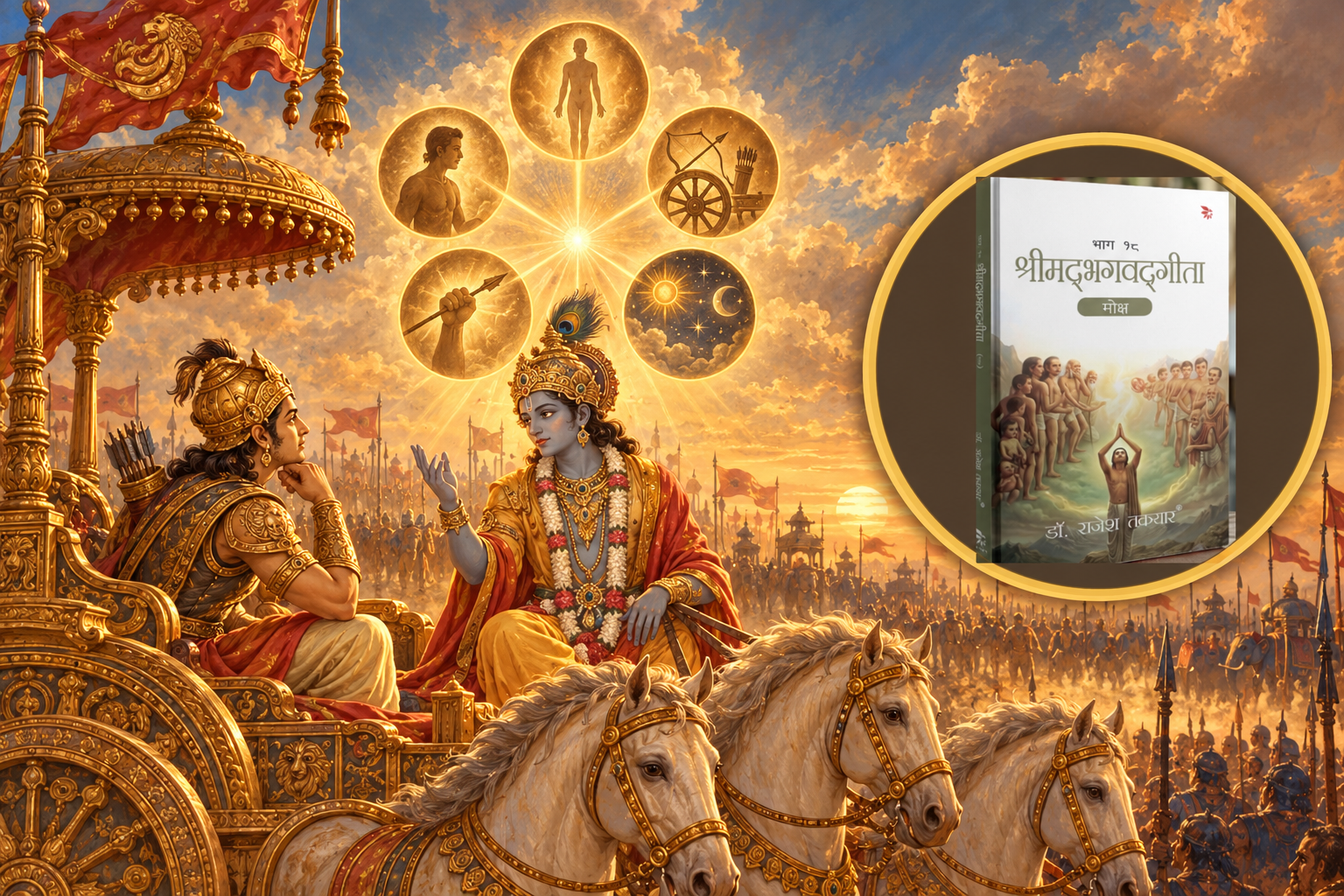
Our most common mistake about action is to attribute its entire outcome to ourselves alone. When the outcome is favourable, we say that it happened entirely through our own strength; when it is unfavourable, we assume that everything went wrong solely because of our own shortcomings. In Part 18 of the Shrimad Bhagavad Gita, Shri Krishna broadens this narrow view. He explains that five causes contribute to the accomplishment of every action.
पञ्चैतानि महाबाहो कारणानि निबोध मे ।
साङ्ख्ये कृतान्ते प्रोक्तानि सिद्धये सर्वकर्मणाम् ॥ १३ ॥
Do Not Limit Action to One Person
When a task is completed in life, the mind readily says, ‘I did this.’ Success brings pride into this statement, while an unfavourable outcome leads the same mind to blame itself. Shri Krishna offers a broader way of looking at action. He says that five causes contribute to the accomplishment of every action. Beginning in verse 13, Shri Krishna asks Arjuna to listen carefully to these causes. Only by considering all five together can we properly understand our work, its outcomes and our responsibility.
For me, the first message of this teaching is that we should remain attentive while acting, but should not regard the outcome solely as proof of our personal power. When I consider myself the complete cause of every action, I overlook the other four causes. Success can then increase my ego, while failure can needlessly break my spirit. Shri Krishna’s perspective gives us the discernment to avoid both states.
First: Adhishthana, the Basis of Action
The first cause is called adhishthana; here, it takes the form of the body. No action takes place in a vacuum; action needs a basis. It is through the body that we speak, that the hands work, and that the mind expresses its direction in action. This is why the body cannot be viewed separately from action.
Remembering this allows us to see the actual circumstances of our actions. The body’s presence, its capacity and its limitations all form part of the basis of action. In any task I begin, my body is not merely a spectator. It is the first basis of that action. Neglecting the body while acting therefore reflects an incomplete understanding of action.
Second: Karta, the Doer
The second cause is karta, the doer. The doer is the one who initiates an action, makes a decision and resolves to undertake it—in other words, you. A discussion of action is incomplete without the doer, because an action is initiated by someone. Yet Shri Krishna does not stop after naming the doer. He places the doer as only one of the five causes. This is what keeps the ego in check.
Third: Karana, the Instruments
These are the various instruments—in simple terms, the senses. The body is the basis, but instruments also play a role as action proceeds. Seeing, hearing, speaking, walking and expressing a thought: action does not take shape without these instruments. When the doer understands their role, the doer stops regarding themselves as the sole centre of power. Those who help you carry out an action are also instruments, whether they are members of your family or friends.
Fourth: The Various Efforts
Action is not accomplished through desire alone. Repeated effort, dedication and the direction of that effort are also involved. Even when the doer and the instruments remain the same, differences in effort can change the nature of the action. Merely forming a resolve therefore does not accomplish a task; effort must be put into action.
When we consider all these causes together, the matter becomes very simple. The doer forms a resolve, the instruments make action possible, and efforts move it forward. It is not right to give any one of these more or less importance and forget the rest. I am responsible for my effort, but the outcome of that effort does not arise from my wish alone.
This perspective also brings greater honesty to action. If I have not made the effort my duty requires, have not used my instruments properly, or have not remained attentive as the doer, I cannot use the teaching of the five causes to evade my shortcomings. While carrying out my duty, I can also examine whether my effort has remained limited to the beginning. The various efforts show that continuity has a place in action. If a direction is right, patiently continuing in it is also part of action. Yet this patience does not become a claim to control the result. The effort is mine; all five causes work together in the outcome.
Fifth: Daiva, or God
The fifth cause is daiva. This is the most essential. It has been described as daiva-paristhiti, the circumstances associated with the divine. This fifth cause asks us to look towards the wider order that does not operate solely according to our wishes. Our body, our decisions, our instruments and our efforts are involved in action; even so, the outcome is also connected with circumstances that we cannot keep entirely under our control.
Remembering daiva does not mean abandoning one’s own effort. On the contrary, a person can make that effort with a purer intention. They know that their sphere of action lies in doing the work and making the appropriate effort. Many causes are at work in the outcome. Therefore, success does not lead them to regard themselves alone as the greatest, and an obstacle does not lead them to pronounce their entire existence a failure.
For me, this understanding of daiva brings humility. Humility does not mean denying one’s ability. It means seeing that ability within its proper limits. Let me do what I can, use the instruments I have properly, and make the effort that is required. Then let me also accept that behind the outcome there is a cause that I cannot attribute solely to myself.
This acceptance maintains balance in life. When the result is favourable, gratitude and restraint remain. Even when the result is unfavourable, a person does not turn away from action, because they understand that their whole self was not the sole cause behind the outcome. In this way, daiva-paristhiti makes the karma yogi steadier, rather than inactive.
Right Action, Wrong Action and the Attachment to ‘I Alone’
Whether an action is right or wrong, all five causes are present in the process of action. Understanding action therefore does not end with looking at its result; we must also examine its causes. Action takes place through the body, speech and mind. Bodily action is visible outwardly, action through speech reaches others, and mental action gives direction within. When all three are inattentive, the direction of action can also become distorted. When they are connected with duty, action gains clarity. Verse 15 asks me to look at my action beyond the task performed, extending to the intention within it, the words spoken and the direction of the mind.
Ego does not mean only praising oneself loudly. Sometimes it appears as an inner insistence that everything happened because of me alone, or that if everything went wrong, it went wrong solely because of me. In both cases, the arrangement of the five causes of action disappears from view. Here, Shri Krishna gives us an opportunity to recognise that incomplete perspective.
Therefore, when I reflect on these verses, I must do more than remember five words. I must change my perspective. Being the doer means accepting my responsibility; considering myself the sole doer means forgetting the rest of the truth. When I understand this distinction, my love for action remains, while my ego’s attachment to its results can lessen. This understanding directs duty towards spiritual practice, instead of allowing it to become a burden.
In essence, while acting, we should understand the body as the basis, ourselves as the doer, the senses as the instruments, our sustained effort as the endeavour, and daiva as the fifth cause. Acting with this understanding preserves responsibility while reducing ego. I can carry out my part more attentively because I know that attentiveness does not mean considering myself the sole agent of everything.
This teaching of Shri Krishna is useful in both success and failure. When success comes, remembering all five causes can keep the mind calm. When an obstacle arises, we can examine our effort, learn from it, improve our instruments, and still avoid burying ourselves entirely under the weight of blame. The path of action then becomes more honest, more humble and steadier.
Source
Source: Dr. Rajesh Takyar®, Shrimad Bhagavad Gita — Part 18 — Moksha