20 November 2026 · Dr. Rajesh Takyar
A Borrowed Half-Hour
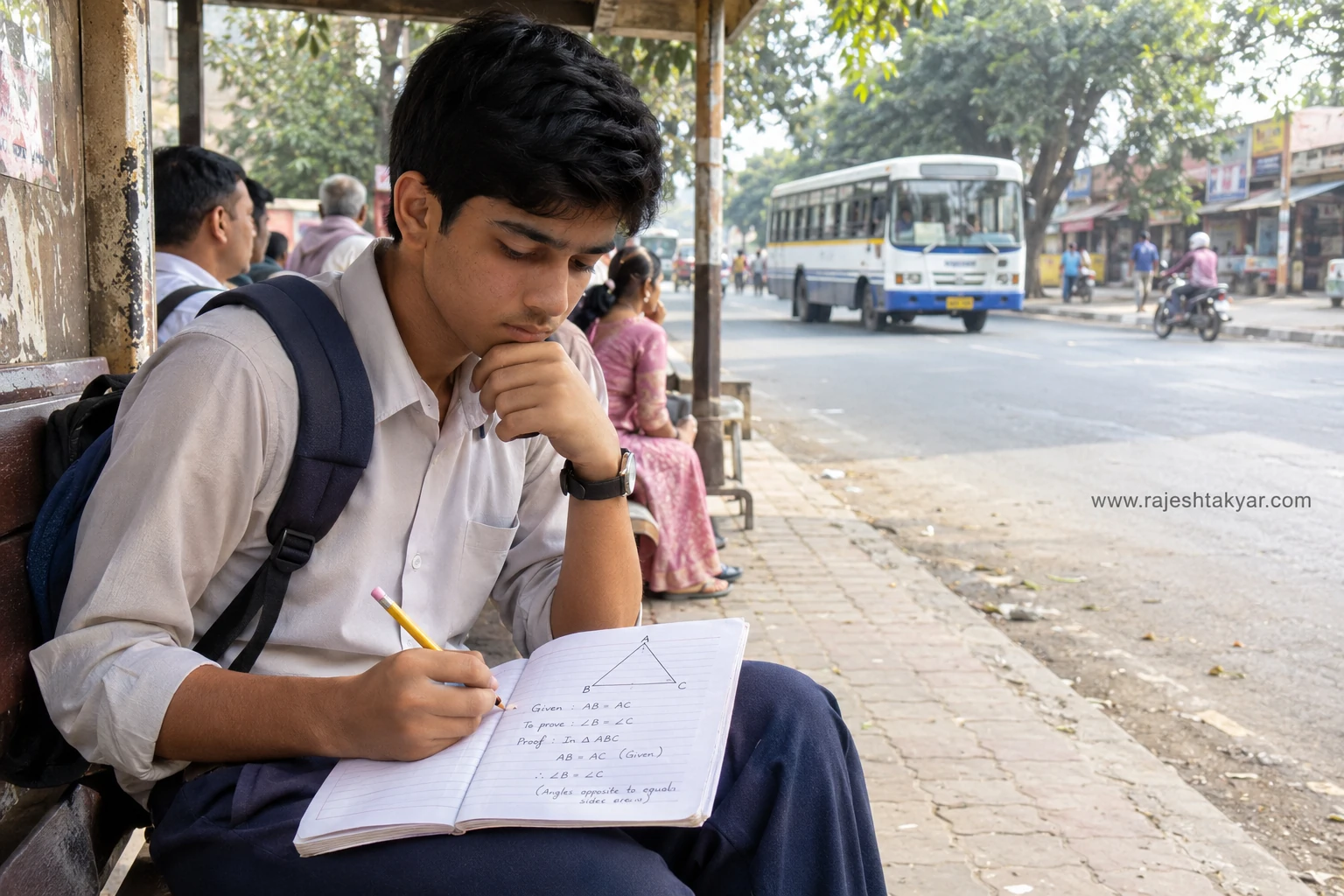
Missing the bus
When Neel missed his bus, he looked at his watch. The next one was half an hour away. He took out his geometry notebook. The problem on the open page had been sitting there for three days. Before he could tell whether he would solve it, something small happened. For the first time he could see where he was stuck. His diagram was right, but he had assumed two angles were equal without proving it. When he left home, half an hour had seemed too short to be of any use. Now he had a clear question to take to class. Sometimes using time well means being able to put your finger on what has been puzzling you.
Neel had another little routine before studying. He would take a stack of slips out of his notebook, sharpen his pencil carefully, write the date at the top and look at the clock. He honestly thought he had been studying for half an hour. One day his little sister turned the page and asked which problem he was doing today. There wasn't even a problem on the page. That day he learned something about preparation. You may enjoy clearing the way for your studies, but once the way is clear you still have to take the first step. The next evening he picked up his pencil as it was, wrote down the problem first and sharpened it when he needed to.
नियतं कुरु कर्म त्वं कर्म ज्यायो ह्यकर्मणः । शरीरयात्रापि च ते न प्रसिद्धयेदकर्मणः ॥ ८ ॥
“तू अपना निर्धारित कर्म कर, क्योंकि कर्म न करने की अपेक्षा कर्म करना श्रेष्ठ है। और कर्म न करने से तो तेरी शरीर-यात्रा भी नहीं चलेगी ।”
English translation of the author’s meaning Do the work assigned to you, for acting is better than doing nothing. Without action you could not even sustain your body.
According to Shrimad Bhagavad Gita, Part 3, verse 8:
The Lord instructs Arjuna to perform his prescribed duty. Acting is better than remaining inactive, because even sustaining the body is impossible without action. Food, clothing, a home, and social relationships all involve someone's labor.
The author explains prescribed action as one's proper responsibility. Supporting a family, serving parents, studying, protection, and social obligations are part of life. Abandoning them merely to sit quietly cannot be called spiritual progress. In these circumstances, Arjuna must face the duty consistent with his righteousness.
If a farmer abandons farming and says that nature will do everything by itself, his life and others' lives will be affected. Similarly, every person's actions have wider significance. Spiritual life and practical responsibility should not be separated. Instead of avoiding action, one should learn to perform it with truth, discernment, and surrender. Proper duty can become a foundation for personal growth as well as sustaining life.
A clear question also changes that otherwise empty half-hour. A student who comes home today after asking the teacher about the rule for angles won't need to hunt for five new videos tomorrow. Two drawings on one sheet will let the student see whether the rule works in both or only in the first. That is how a small piece of work today gives direction to tomorrow's effort.
Who is waiting?
His sister had asked him to return a library book. That was the first thing Neel did when he got home. He still loved mathematics just as much. Another student's name was on the waiting list for the book. When deciding how much time a task deserves, remember the person who can move forward once you have done your part. You needn't take on everybody's work. Give the responsibility you have already accepted a real place in your day.
According to Shrimad Bhagavad Gita, Part 3, verse 19:
Shri Krishna gives Arjuna the conclusion: relinquish attachment and continually perform your duty well. Such selfless action leads a person toward the highest state. What must be relinquished is the desire that binds one to results, not action itself.
The author draws particular attention to consistency. Duty is not performed only when one feels like it or sees personal benefit. Whatever is proper according to righteousness and responsibility should be completed faithfully and with a pure attitude.
The same task can be performed for self-interest, status, or outdoing others, or it can be performed with service and surrender. Even when the outward activity is identical, its inner spirit changes its effect. Arjuna is being told to rise above longing for victory and fear of defeat and face his righteous duty. This teaching calls not for taking action lightly, but for acting with complete dedication while relinquishing pride and the grip of results.
According to Shrimad Bhagavad Gita, Part 3, verse 20:
Shri Krishna gives the example of royal sages such as King Janaka. They attained perfection through karma yoga while fulfilling worldly responsibilities. Arjuna too should therefore act with society's good in mind, not merely his own advantage.
The author explains that self-knowledge and responsible living can go together. King Janaka maintained nonattachment without abandoning the administration of his kingdom. He was active in the world, but not bound by longing for results. This inspires those who seek spiritual progress while living within family and society.
Lokasangraha means sustaining society, bringing it together, and giving it the right direction. If a king, teacher, warrior, or householder abandons proper duty, others are affected too. Action therefore matters beyond individual spiritual practice. Selfless duty becomes an example for others. The message of this verse is that responsible action performed with service and surrender can become a path to both one's own progress and society's welfare.
In a house where several people go out in the morning, looking for the key can swallow the same five minutes every day. No one receives a public honour for putting it back in its place. Yet someone who does that has made the morning a little easier for five people. One measure of a job's importance is how much of the daily commotion quietly disappears when it is done well.
Listening to tiredness
That night he decided to finish the part of the exercise he had missed. Twice he read the same line without understanding the question. “Explain it to me in the morning,” his mother said. At breakfast he explained it without even opening his notebook. Young people can feel strangely guilty about resting. The hands of a clock can keep moving without your grasp of a subject growing any firmer. When a day leaves room for body and mind to recover, the work you have done has a chance to stay with you.
There is another way of accounting for time that a clock cannot show you. Two students are given the same lesson. One knows the words, while the other has to ask what half of them mean. If they compare page counts that evening, the second student may conclude that he is slow. Yet anyone who has really understood five unfamiliar words has opened five doors for tomorrow. When judging your day, count the difficulty nobody else can see. Give yourself time to learn what is new to you. Borrowing somebody else's pace won't make your understanding grow faster.
According to Shrimad Bhagavad Gita, Part 6, verse 16:
Shri Krishna says that yoga is not for one who eats excessively or does not eat at all, nor for one who sleeps excessively or continually stays awake. The author calls this the middle path of practice. Too much food can bring bodily heaviness, while excessive fasting can increase weakness and restlessness. Likewise, insufficient rest brings fatigue, and excessive sleep reduces life's activity. Tormenting the body for spiritual practice does not automatically become spiritual progress. Suitable food, adequate rest, and regular practice give the mind a foundation for steadiness. The author also applies this balance to life more broadly. Forgetting family duties through exclusive devotion to singing hymns, or abandoning self-reflection through total immersion in worldly work, are both incomplete. Harmony between work and rest, personal practice and social responsibility, is necessary. Yoga is not merely physical posture, but a way of life leading the soul toward the Supreme Being. Restraint aims not at a severe display, but at creating a balanced life where meditation and discernment can develop naturally.
युक्ताहारविहारस्य युक्तचेष्टस्य कर्मसु। युक्तस्वप्नावबोधस्य योगो भवति दुःखहा॥ १७ ॥
“जिस कर्मयोगी का भोजन और व्यवहार संतुलित है, जिसके कर्म संयमित हैं, जिसकी नींद और जागरण संतुलित हैं; उसके लिए योग दुःख का नाश करने वाला बनता है।”
English translation of the author’s meaning For the karma yogi who is balanced in food and daily conduct, measured in action, and balanced in sleep and waking, yoga brings suffering to an end.
According to Shrimad Bhagavad Gita, Part 6, verse 17:
For one whose food and recreation, efforts in work, and sleeping and waking are balanced, yoga becomes a remover of suffering. The author puts the preceding verse's middle path into daily discipline. Food should accord with need, recreation and routine should be restrained, and work should be dominated neither by laziness nor by overexertion that exhausts body and mind. Fulfilling responsibilities on time with dedication and surrender is balanced effort. Adequate rest and regular waking support concentration. Success in yoga depends not merely on the manner of sitting in meditation; the whole day's behavior prepares it. In an unbalanced life, the mind repeatedly moves toward unease and fatigue, while restraint increases steadiness. The author understands suffering as extending beyond bodily discomfort and points toward freedom from the pain of desires, mental unrest, and worldly bondage. Remaining balanced in pleasure and pain, the practitioner makes spiritual peace the goal. Discerning harmony of food, rest, activity, and duty turns yoga into a continuous path of life.
Try putting the time a meal and the journey home actually take into your schedule. You may discover you have tried to fit an hour and a half's worth of things into a single hour. If that makes you late, there is little point in blaming your character. Learn to give a task as much room as it takes.
Bringing attention back
The phone rang while he was working. He read the message and opened his notebook again. Where should he pick up the thread? He learned to leave a little mark beside his last line. It would remind him where to begin the next day. A student who also looks after a younger brother at home will soon find it discouraging to insist on two uninterrupted hours before starting to study. There is good sense in making a small arrangement that fits the life you actually lead.
According to Shrimad Bhagavad Gita, Part 18, verse 26:
A sattvic doer is free from attachment, does not display ego, possesses patience and enthusiasm, and remains steady in success and failure. Nonattachment is not indifference. Such a person attends to the quality of work and responsibility without demanding name, control or credit. Recognizing their ability, they make efforts and remain grateful for the support of other causes. Fortitude keeps them on the proper path through difficulty, and enthusiasm makes action alive. Enthusiasm without patience soon fades; patience without enthusiasm can make work burdensome. Both need balance. Do not make success our self-worth or abandon effort upon failure. A sattvic person reviews mistakes and improves means, decisions and efforts, but does not regard results as the final identity. Being undisturbed does not mean lacking emotions, but not letting outward events distort discernment. This is not a permanent title belonging to lineage, dress or position. Only by examining intentions in every circumstance can practitioners maintain responsible, humble and dedicated agency.
Saving time and learning something in the time you save are two different things. If the ten minutes saved by asking a question slip away in distractions, the notebook will still be empty. Instead of drawing up three columns, Neel wrote just two words at the back of his notebook, “Understood” and “Stuck”. With so little to write down, he actually kept the record.
Taking stock in the evening
The next time, the bus was on time. Instead of opening his book, Neel spoke with a former teacher who was sitting beside him along the way. Had he insisted on keeping his half-hour rule that day too, he might have missed a good conversation. Someone who values time needn't be a prisoner of the clock. In the evening, ask yourself whether you saw what was in front of you or spent the day tangled up in yesterday's list. Some days the answer will be a problem solved. On others it will be something you took the time to hear.
On a day off, Neel showed his timetable to his grandmother. It said he was free from six to seven that evening. “Does sitting with me on the roof count as part of that empty space?” she asked. For the first time he saw that time when no particular thought occupies the mind can also be given to a relationship. For half an hour he listened to stories about her old job. The next day, when the school assigned him to interview someone with experience, he had both questions and genuine curiosity. That evening would have been worthwhile even without the school assignment.
According to Shrimad Bhagavad Gita, Part 2, verse 47:
Your right is to perform action, not to its fruits. Do not make the desire for results the sole motive for action, and do not become attached to inaction either. Shri Krishna clarifies the relationship between effort, outcome, and responsibility. The author explains that relinquishing the fruits does not mean leaving work incomplete. Performing a task with full dedication, care, and concentration is our duty; making the outcome certain according to our wishes is not within our control. Helping while expecting a return, or viewing children merely as future support, adds self-interest to action. Fulfill your responsibility like the sun, which does not give light in expectation of praise. The book also describes the simple practice of offering the day's actions to God and examining them. This can increase reluctance to repeat wrongdoing and strengthen dedication to good action. The message is neither to flee effort nor become a slave to results. Honest action and surrender lead the mind toward balance and peace.
If tomorrow turns out quite differently from the day you planned, today's insight will still be of use. The ability to make a decision when circumstances change is what this practice gives you. An evening spent sitting beside a friend who is ill is well spent, even if you cross nothing off your list that day.