12 November 2026 · Dr. Rajesh Takyar
Nachiketa and the Knowledge of Death
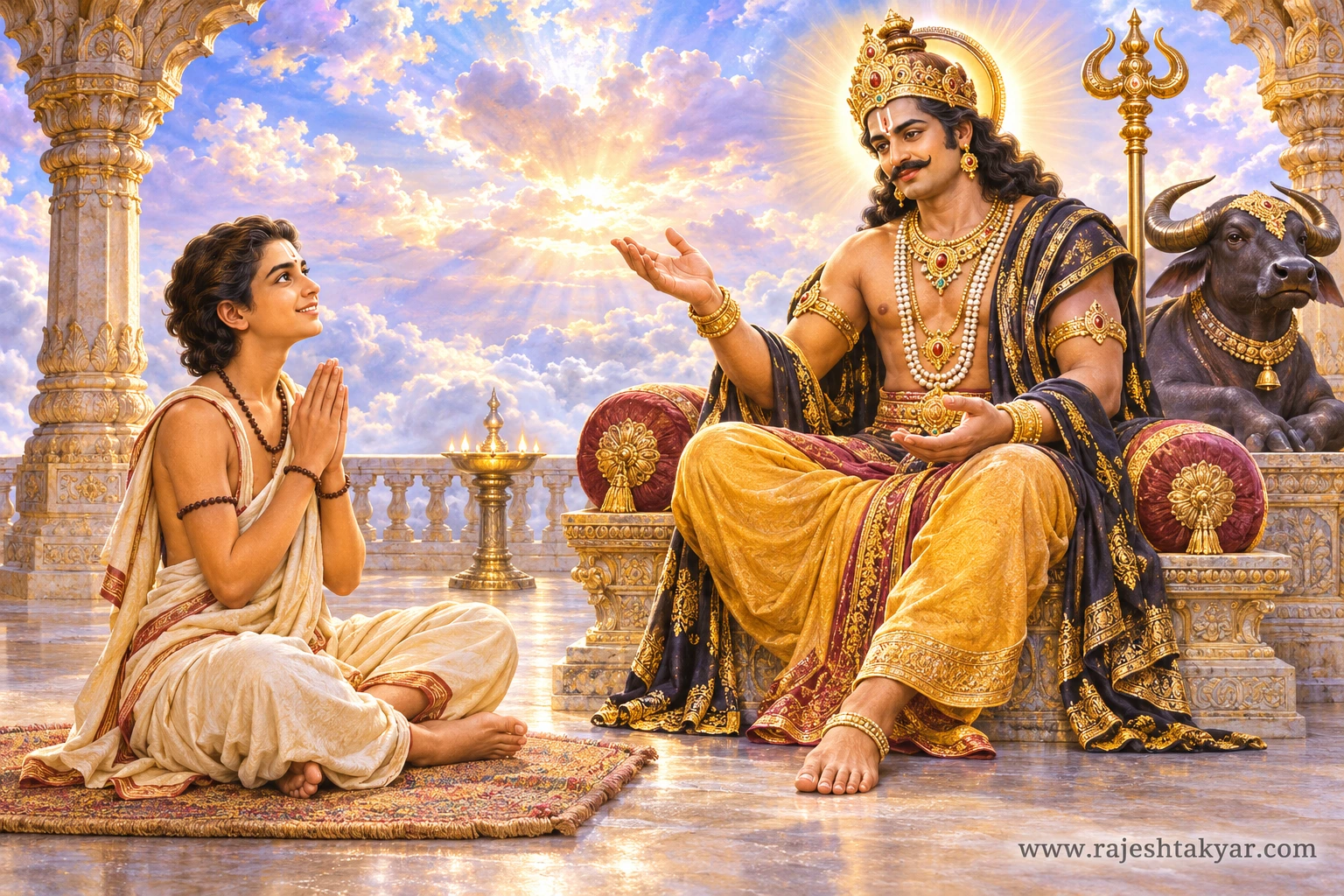
Knowledge of the soul came to Nachiketa before Arjuna. Nachiketa's story is mentioned in the Indian scripture, the Katha Upanishad. From childhood, he had a strong habit of asking questions. Whatever he saw, he insisted on understanding the reason behind it. He wanted to acquire all knowledge. In Nachiketa's eyes shone that same ancient, timeless inquiry.
Nachiketa: The Inquiry into Truth
The renowned sage Uddalaka, son of Maharshi Aruna, was regarded as a leading figure in sacrifice, charity and knowledge. Once, seeking the fruits of his actions, he resolved to perform a great sacrifice called Vishvajit in the forest. In this sacrifice, one had to give away everything. Uddalaka therefore decided to donate all his wealth.
That day, at the sacrificial ground, Nachiketa saw that the cows being given away were old. They could no longer give milk; even grazing enough to fill their stomachs was difficult. Their udders were dry, their eyes clouded, and their bones protruded. They were nearing death. These were cows whose milk had been drawn for the last time. Seeing all this, Nachiketa trembled inwardly. He thought, “Giving means offering the best; my mother tells me that charity should come from a pure heart. Then why only these worn-out cows? What kind of cows is Father giving away?”
Nachiketa's mind was in turmoil, but he asked his father in a composed voice, “Father, a gift should be useful to the person receiving it. Are these cows a proper gift?” Uddalaka ignored him the first time. Nachiketa spoke again: “Father, if you are giving everything away, I too am your wealth. Give me to someone worthy as well. Tell me, to whom will you give me?” Uddalaka frowned. A third time Nachiketa asked, “Father, to whom will you give me?” In a surge of anger, without thinking, Uddalaka blurted out, “I give you to Death!”
As soon as the words were spoken, the atmosphere seemed to stand still. The disciples were stunned. His father had spoken in anger, but the word was that of a sage. Nachiketa understood that he would have to set out to uphold the truth.
Nachiketa walked around the sacred fire, received the blessings of his elders and departed alone on his journey to the door of Death. It is said that even the gods open the way for one who walks the path of truth. He reached Yama's realm, but Yama was away. Three nights passed. Nachiketa remained at his door, fasting without food or water. There was no complaint, no restlessness; only quiet patience and an inquiry into truth in his heart.
The Mystery of Death
Yama returned after three days. His wife told him that a young Brahmin guest had arrived. Yama saw that the boy had been waiting as his guest for three nights. Deeply ashamed, he went to Nachiketa and said, “Revered Brahmin, you are my honoured guest. A guest is to be regarded as divine; I have made a mistake. I bow to you. I have committed a great wrong. Relieve me of this fault, so that I may fare well. You have remained hungry for three nights, so ask me for three boons of your choice in return for those nights. Ask for whatever you wish.”
A faint smile appeared on Nachiketa's face at Yama's words. He said, “Lord of Death, for my first boon I ask that my father Uddalaka of the Gautama lineage, who must be grieving after sending me to you in anger, may become calm. When I return home with your permission, may he receive me lovingly, and may his mind become clear and steady. May he recognise me as Nachiketa and speak to me with the same great affection as before.”
Yama said, “So be it. Knowing that you have escaped the jaws of death, your father will accept you lovingly through my influence. No bitterness will remain in his heart, and may he live long.”
“Now I ask you for my second boon,” Nachiketa said. “Lord, I know that those who reach this heavenly realm have no fear of death. All enjoy bliss there. But that heaven is not attained without knowing the science of fire. Teach me the mystery of that knowledge of fire—the sacrifice through which human actions are purified and the door to advancement opens. I wish to know it precisely so that I may work for the welfare of others.”
Yama replied gladly, “Nachiketa, I shall tell you about that knowledge which is deeply hidden in the cave of the wise person's understanding.” He then explained the complete method: how to construct the fire altar, which bricks to use, in what order, and with what intention, pronunciation and resolve they should be placed.
To test Nachiketa's memory and intelligence, Yama asked him to repeat everything he had heard. Nachiketa immediately recalled it and repeated it.
Hearing it all from Nachiketa, the great Yama smiled and said, “Excellent child, your memory is remarkable. I am very pleased to see your ability. From now on, this method of fire will be known as the Nachiketa Fire.”
That same ancient, timeless inquiry shone in Nachiketa's eyes. He said, “Lord, people say that something exists beyond death; others say that nothing does. Some say that the soul is immortal; others say that everything ends here. I wish to know the truth: what happens after death? What is the nature of the soul? Tell me your understanding. Grant me this as my third boon.”
Yama fell silent for a moment on hearing Nachiketa's question. It was no simple question. Inwardly admiring the boy's intelligence, he tried to put him off: “Nachiketa, this question puzzles even the gods. I have promised you three boons. Ask for another boon: long life, wealth, a kingdom, chariots, beautiful women—anything you wish. But do not ask this question about the nature of the soul.”
“Wealth exists today and may be gone tomorrow; youth is here now and will fade tomorrow. Chariots, seats, music—all are fleeting. All these are causes of sorrow.”
“I wish to know that truth which is beyond time and beyond death. I cannot withdraw my question.”
Shreya and Preya
Admiration shone in Yama's eyes. He said, “Worthy Nachiketa, you are rejecting dancing and singing, luxury, royal honours and long life, and choosing shreya rather than preya. Such discernment is very rare. Listen now. A human being stands between two paths: shreya, that which brings true welfare, and preya, that which is dear and pleasing. Preya seems close, shines and beckons; but after a short distance it exhausts and binds. Shreya seems difficult, but it brings freedom. You have chosen shreya, and that is why I am giving you this knowledge.” Then Yama's words began to flow as though someone had softly begun playing a divine, blissful veena in a deep forest.
“Nachiketa, this human body has not been given merely to experience the consequences of births. The Vedas speak of only two means of happiness. The first is shreya: to become free of every kind of sorrow forever and merge in the Supreme. The second is preya: to obtain wealth, women, comforts, houses, land, fame and honour, and seek a way to attain heaven. People keep striving in their own ways. Yet the human body is impermanent, the senses are restless and the mind wanders. None of these is the ‘I’. Consider a chariot. The body is the chariot, the senses its horses, the mind the reins, the intellect the charioteer, and the soul the master seated in it. When the charioteer is alert, the reins firm and the horses trained, the chariot carries its master safely to the destination. But if the reins are loose, the horses unruly and the charioteer inattentive, the chariot strays from its path. Disciplining the mind and senses is the means of reaching the soul.”
“Listen, Nachiketa. The soul is neither born nor does it die. No weapon can cut it, fire cannot burn it, water cannot wet it and wind cannot dry it. It is self-luminous and illuminates what is unlit. It needs no light from the sun, moon or fire. Where it is, the boundaries of ‘I’ and ‘mine’ disappear.”
Nachiketa listened with complete absorption. Yama continued, “Recognise the witness within you: that which sees every experience but is not itself bound by experiences. Eyes cannot see it, speech cannot grasp it and the intellect cannot measure it. But when the mind is clear, desires quiet and attention turned inward, it reveals itself, just as sunlight becomes visible of its own accord when the clouds move away.”
The Light of the Soul
Nachiketa said, “Lord, now I understand that death is not an end but a doorway. One who considers oneself the body is afraid; one who knows oneself as the soul becomes fearless. I should return now. My father must be waiting for me.”
When Nachiketa reached the ashram, his father stood anxiously at the door. Regret and love were mingled on his face. Seeing his son, he ran forward and embraced him. In a voice heavy with emotion, he said, “My son Nachiketa, forgive me. I deeply regret what I said in anger.”
Nachiketa smiled and replied, “Father, anger too is only a cloud: it comes, rains and disappears. The sun remains where it was. Come, sit down. I shall tell you the method of fire that I learned from Yama.”
Once a young man came to him. His eyes were bright, but his mind was troubled by conflict. He said to Nachiketa, “I have read a great deal, but there is no peace within me. What should I do?”
Nachiketa took him to a nearby river and asked, “Can you see the river flowing?”
The young man replied, “Yes.”
Nachiketa said, “Do not learn to stop the flow; learn to observe it. Think of the flow of thoughts as a river too. If you stop it, the dam will burst. Let it flow and remain only a witness. It will carry you to the ocean, where neither the waves nor the sea end, but the waves' pride dissolves.”
Gradually, Nachiketa's name became more than a story; he became an ideal—of inquiry, commitment and choice. He would answer every question. He taught that anyone, of any age or circumstance, who can ask with a sincere heart and choose shreya over preya may find even a teacher such as Yama opening the door for them.
The essence of Nachiketa's story is that life is not merely a collection of answers. Life is the courage to ask the right questions, the courage to make the right choice, and the discipline of remaining firm in that choice. For one who can do this, even Yama becomes a teacher, death reveals its mystery, and the soul, which always was, is and will be, reveals itself.