29 October 2026 · Dr. Rajesh Takyar
The Different Forms of Happiness
The First Taste of Happiness
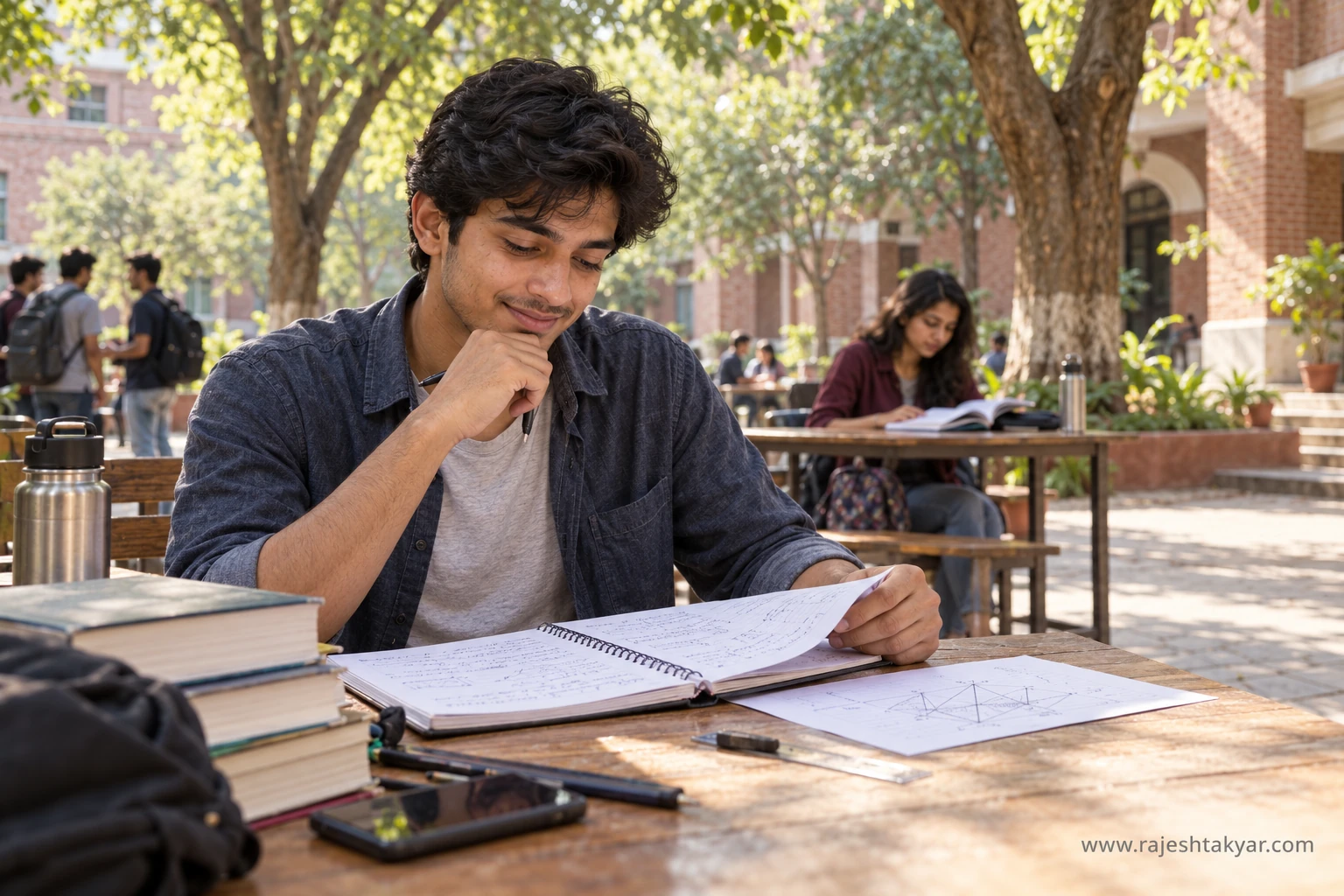
When a book on a difficult subject lies open before us and even the first line is unclear, we judge the book too quickly. It begins to feel burdensome. By contrast, time passes easily with something that requires little thought. The difference between these experiences is more than difficulty and ease. One invites us to develop something within ourselves; in the other, the attraction of the moment may be enough. The question is when we are judging happiness: at the beginning, along the way or afterwards?
In the Shrimad Bhagavad Gita, the understanding of happiness extends beyond its immediate experience. Some happiness appears difficult at first, yet brings inner gladness and clarity in the end. Conversely, an experience may initially be very sweet and later deepen restlessness and bondage. This distinction is not meant to remove joy from life. It invites us to look more carefully at what happens to us in the name of enjoyment. Taste and nourishment are not the same question.
We often favour the moment that offers less resistance. Practice exposes our shortcomings, which makes it uncomfortable. Repeated mistakes while learning a skill acquaint us with our limits. Easy entertainment need not put us through that examination. Yet encountering a limitation is not an act against ourselves. It tells us where learning should begin. If the first difficulty becomes our final verdict, we may lose the opportunity to reach the understanding that could eventually make the work enjoyable.
This need not be confined to examinations and employment. Expressing ourselves accurately, carrying out a responsibility with care, listening attentively and correcting a mistake also require practice. Their results are not always immediately visible. That does not diminish the value of the abilities they develop. In youth, when many paths are open, giving time to a useful ability is a quiet contribution to the life ahead. Its worth cannot be measured solely by the convenience it offers that day.
Interest Can Grow Through Learning
One beautiful aspect of practice is that it trains more than our hands or memory: it can change our relationship with a subject. Where we once saw only confusion, a pattern gradually becomes intelligible. The mind then needs less pushing from outside. One small connection understood can awaken curiosity about the next question. The Gita's account of finding enjoyment through practice draws attention to this possibility. Interest is not always something we receive fully formed.
Suppose a student struggles to understand the reasoning in a lesson. Memorising the answer is one possibility. Pausing to understand how one point connects with another involves a different kind of effort. The student may cover fewer pages at that moment, but becomes more deeply acquainted with the passage studied. The satisfaction here comes not merely from finishing a task but from truly understanding something. Such moments can change the habit of treating study as a burden imposed from outside.
The same applies to someone learning a job. At first, watching an experienced person's speed may make our own slowness uncomfortable. But if speed becomes our sole concern, we will miss the details of the work. Time spent understanding the method, recognising the tools and detecting errors becomes a foundation for greater competence. The resulting gladness need not announce itself loudly. It is as simple as finding that something confusing earlier is now clearer. This experience of development is also happiness.
Practice does not require cultivating harshness towards ourselves. Reviewing a method that is not improving our understanding can be part of practice too. Asking, reading again and recognising a weakness in our effort are not signs of failure. Enduring difficulty is meaningful when a direction for learning remains within it. This teaching does not make every pain a proof of excellence. What matters is effort that develops clarity and steadiness, rather than merely accumulating exhaustion.
After a Sweet Beginning
Some attractions give pleasure while they last, but their departure leaves a corresponding sense of lack. The mind wants the same experience again, and irritation may arise when another opportunity is unavailable. The Gita invites reflection on this binding aspect of pleasure arising from the contact between the senses and their objects. The problem is not simply that something is beautiful or pleasant. It deepens when we place the key to our happiness entirely in that experience.
A useful question about our enjoyment is therefore how we return from it. Am I more at ease with my work, or does it now seem even less appealing? Did the break refresh me, or has the desire for another break turned the rest of my time into a burden? This assessment is not for display before others. It helps us recognise our own experience. Even an activity that looks the same can have different consequences when approached with a different attitude and within different limits.
During the years of education and early working life, our attention seems divided among many directions. Every invitation carries a promise of immediate enjoyment. Preserving some room for necessary learning need not be a decision to distance ourselves from others. It can express respect for a capacity growing within us. Leaving some opportunities for later and first completing an unfinished task does not empty life of joy. It gives enjoyment a place alongside responsibility.
This choice cannot be made by watching the clock alone. The mind can scatter considerably in a short time, while a quiet conversation may sometimes bring useful clarity. The issue is therefore not a rigid classification of activities but an examination of attachment and its effects. It is reasonable to reconsider our relationship with enjoyment that repeatedly draws us away from responsibility. Rest that lets us return with attention has a different place. Discernment recognises this difference beyond outward appearances.
Rest and Avoidance
The Gita also discusses a form of happiness associated with sleep, inertia and negligence that obscures discernment both at the beginning and the end. This should not become a verdict against necessary sleep. The body needs its rest. The concern is the condition in which postponement itself is mistaken for relief. A task is ignored because examining it would require a decision. The immediate discomfort disappears, but the responsibility remains. This is not peace; it is looking away for a while.
Compassion is necessary when recognising this distinction in life. Calling another person lazy on seeing their tiredness is easy; understanding their actual circumstances may be harder. These teachings are first an invitation to examine our own direction. Am I genuinely resting, or avoiding a clear responsibility? I must answer that honestly for myself. Where help is needed, there need be no reluctance to accept it. Discernment cannot rightly be used to deepen contempt for ourselves or others.
Sometimes an unfinished task grows so large in our imagination that even beginning it seems distant. Instead of worrying about the whole journey, it may help to examine one intelligible part: a question in a lesson, a necessary preparation for work or a clear correction of an error. These are ordinary beginnings, not miraculous remedies. Their value is that they reconnect thought with action, replacing the relief of postponement with actual participation.
Care for our time does not mean extracting an achievement from every moment. A human being is not a calculating machine. Yet if the flow of the day retains some room for learning, understanding and honestly doing our share of work, its direction does not slip entirely beyond us. Perhaps a gentle reminder is enough for a young reader: the ability one hopes to possess needs some real space in one's days. A future held only in desire asks for help from the present.
The Gladness That Remains
The happiness that comes through practice does not always feel like a celebration. It may appear when a difficult point becomes clear, a task is completed properly or an old mistake is recognised. It requires no audience. Something has become more ordered within. Such satisfaction cannot therefore be measured solely by external praise. Even if nobody else hears about it, the connection between our effort and understanding remains real to us.
Sattvic happiness is connected with clarity of understanding and purity of the inner life. From this perspective, joy is more than the event of acquiring something; it is also the experience of becoming clearer and less bound within. The outward achievement of practice may be small, yet its influence can be deep if it develops patience, attention and interest in truth. We need neither dismiss a small achievement nor exaggerate every achievement. Its proper value lies in the change it helps form within us.
Difficulty alone does not prove that a task is right for us, just as ease alone does not make it worthless. Judgement becomes fuller when direction, purpose and consequences are considered together. In education or work, there should remain room to review our method and seek necessary guidance. This measure of happiness is an invitation to discernment, not a rigid formula. It asks whether the path we are following develops understanding and freedom, or dependence and confusion.
Our search for happiness may change if we ask more than what made time pass easily today. We can also notice what left peace within us when the day ended. The learning that clarified our vision a little, the responsibility we fulfilled and the effort to which we honestly gave ourselves may reveal their joy gradually. This possibility lies behind the initial difficulty of practice. Welcoming it into life requires no grand display, only a little room for our next meaningful attempt.