11 October 2026 · Dr. Rajesh Takyar
Radha’s Birth: From Goloka to Gokula
A question opens the account
In the chapter “Shri Radha Prakatya” of Dr. Rajesh Takyar’s book *Krishna ki Radha*, the narrative begins with a question. On Mount Kailash, Parvati asks Shiva when and how Radhika manifested. Shiva first remembers Krishna and, having received his permission, begins to answer. The book connects this episode with Chapter 48 of the Prakriti Khanda of the *Brahmavaivarta Purana*. It later also mentions Chapter 26 of the Vrindavan Khanda of the *Shri Garga Samhita*. From the beginning, the reader is thus reminded that Radha’s birth is not merely a record of date and place; it is an account of her divine nature within a devotional tradition.
It is best to read this as the book’s Purana-based devotional narrative, not as a historically verified biography. Its language and events explain how the tradition understands Radha’s spiritual identity. Alongside the question “Where was Radha born?” is another: in what form does the narrative recognize her?
The manifestation of two forms in Goloka
In the first account, Shiva tells Parvati that Shri Krishna was seated in his divine abode in the rasa-mandala of Goloka. Within that līlā, he manifested in two forms: Krishna as the right portion and Radhika as the left half. This is not a scene of an infant born to ordinary parents. It is a story of the loving differentiation of the supreme divine reality. Radha is not presented as an unrelated source, yet she appears with her own complete identity and glory.
The book then presents the episode from the Vrindavan Khanda separately. After describing creation and the making of Goloka, it says that a divine maiden appeared from Krishna’s left side. She ran to bring flowers and offered arghya at his feet. The book explains her name “Radha” within the story by saying that she ran toward Hari. It then describes the gopis appearing from Radha’s pores. This scene offers a poetic way of seeing Radha as the source of love and her companions as expressions of that love.
The two Goloka accounts share one central idea: Radha’s manifestation begins in divine love. In one, she appears as Krishna’s left portion; in the other, she comes forward as an independent divine maiden offering flowers to him. The narrative can be read as holding intimacy and individuality together. Radha is Krishna’s most beloved divine power, while her own presence, service, and love remain unmistakable.
The account of her arrival on earth
The chapter then moves from Goloka to the earthly līlā. The book tells of a līlā in which a curse from Sudama sets out that Radha will come to earth with her companions as a gopi and a daughter of the cowherd community. Krishna assures her that this līlā unfolds by his will. The story therefore does not leave the curse as punishment alone; it makes it part of a divine plan that brings the meeting of Radha and Krishna into the earthly world.
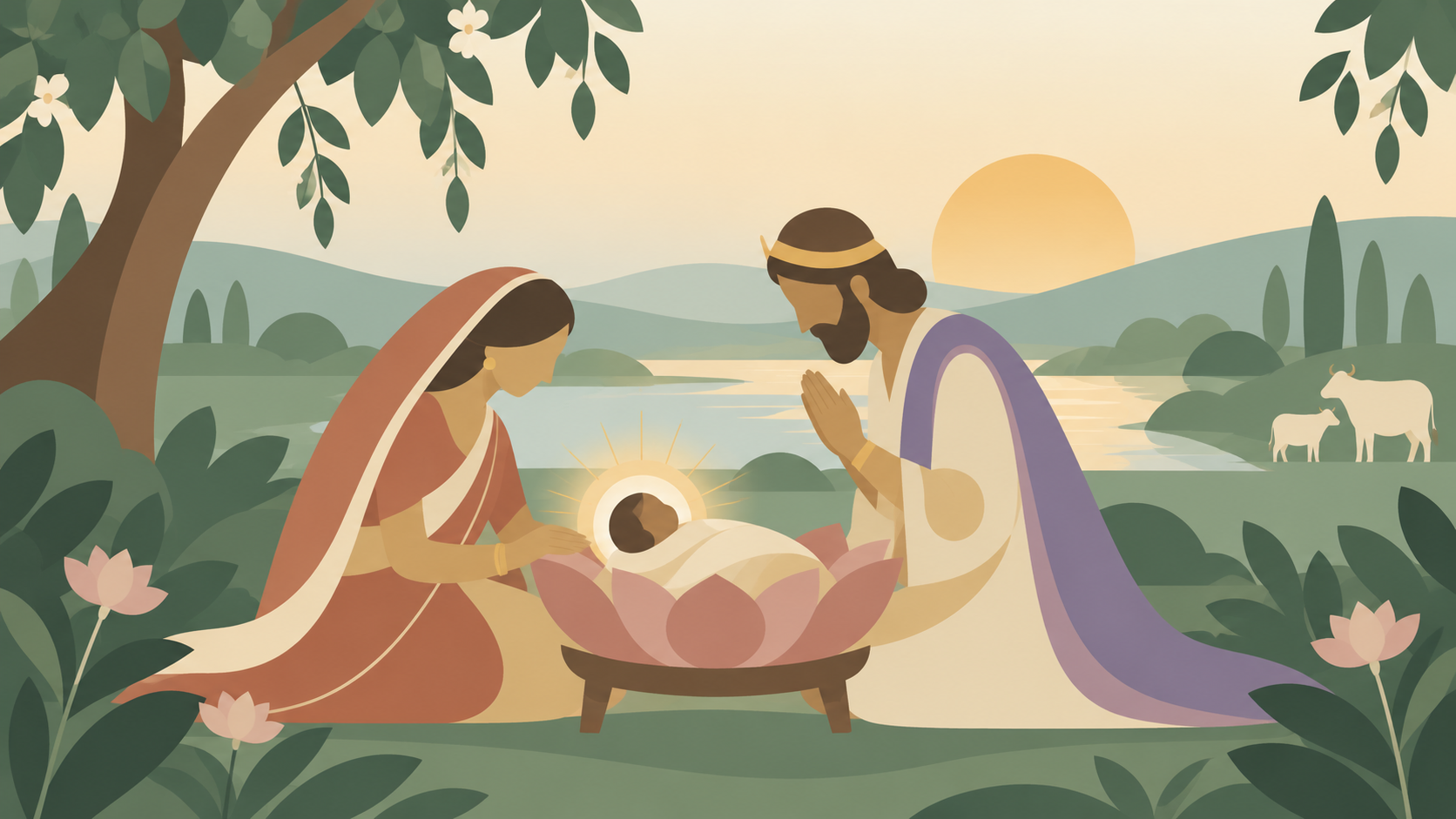
In this account of her earthly manifestation, Radha comes to Gokula in the land of Bharat during the Varaha kalpa and appears as the daughter of Vrishabhanu. The book calls her an “ayonija” goddess—that is, one who did not originate through the ordinary biological process of birth. Her mother is Kalavati, and her manifestation is described as arising through Vayugarbha under the influence of Yogamaya. This language cautions the reader against turning the account into an ordinary birth narrative. The names of parents give her a familiar place within a household, while the cause and nature of her birth remain supernatural.
The episode says little about her childhood. It moves directly to the statement that, after twelve years, her youth became manifest. A relationship with the Vaishya Raiyan is said to have been arranged, but Radha placed only her shadow in the house and disappeared herself; the marriage took place with that shadow. This detail belongs to the book’s vision of divine līlā. It should not be presented as a modern social biography or as an ordinary example of a marriage rite.
Distinct indications of place and tradition
The chapter “Prithvi Par Avataran” connects Radha’s earthly appearance with Gokula and the household of Vrishabhanu and Kalavati. In a separate passage about the name of Radha, the same book cites the *Shri Garga Samhita* and identifies the Nikunj temple on the Yamuna bank in Mathura as her birthplace. These indications do not appear in the same sentence, and their details are not identical. It would therefore be unfair to the source to erase one and declare the other to be the final, undisputed geography.
This article does not try to combine these traditional indications into a new location claim. It is enough to say that the book’s accounts of Radha’s earthly manifestation are framed differently in separate passages: one centers on Gokula and Vrishabhanu’s home, while another names the Yamuna bank in Mathura. They should be cited with their respective contexts. In devotional literature, multiple accounts of one divine figure may answer different questions—about nature, name, or the setting of a līlā.
Parents and divinity together
The mention of Vrishabhanu and Kalavati places Radha within the family world of Vraja. Their home is the setting through which her earthly līlā becomes intimate and imaginable. Yet the words “ayonija” and Yogamaya do not allow this relationship to be reduced to an ordinary biological genealogy. The narrative holds both ideas together: Radha is recognized as a daughter in a household, and her essential nature is understood as divine.
This dual perspective opens the language of devotional literature. Divinity does not remain a distant power in the sky; it comes close amid family, village, relationships, and remembrance. At the same time, it is not bound entirely by worldly rules. Radha’s arrival on earth brings into the narrative world the ideal of love that was shown in divine form in Goloka.
The explanation of her name reinforces this relationship. The book presents Radha as worshipping Krishna and Krishna as worshipping Radha. Love here is not one-sided worship, but mutual regard and attraction. Radha’s manifestation is therefore not an appendix to Krishna’s story. She is herself the presiding presence of love and a central figure in the līlā.
“Manifestation” and two senses of birth
The word “manifestation” in the chapter’s title offers a key to reading this account. In ordinary conversation, a question about birth usually concerns bodily origin, parents, and place. Here, the narrative first speaks of Radha’s divine form appearing in Goloka and then tells of her arrival on earth. These are not details at the same level. The first presents her eternal, divine nature; the second brings that nature into the family and landscape of Vraja. Before asking, “Where was Radha born?”, it is therefore necessary to ask whether the question concerns the līlā of Goloka or the earthly narrative.
This distinction is not meant to simplify the stories, but to hear them in the form in which the book presents them. If the spiritual account of Goloka is treated directly as a claim about a historical date of birth, the narrative’s symbols and purpose may be missed. If the earthly episode is dismissed as merely symbolic, the intimacy of the account of Vrishabhanu and Kalavati’s home is lost. Read together, the two levels show both a sign of divinity and a world of human relationships through which that divinity can be approached.
The difficult movement of curse, separation, and līlā
The episode before Radha’s arrival on earth is not an easy one. Radha’s anger, Sudama’s harsh words, and the curses spoken on both sides bring tension into the story. It would be too simple to confine the episode to a framework of punishment and fault. In the same passage, Krishna says that the līlā unfolds by his will and explains that Sudama will later come to earth as Shankhachuda. The reader sees the characters’ distress as well as the narrator’s wider vision, which connects events to a greater līlā.
This double register does not make human feeling meaningless. Radha’s anger, Sudama’s grief, and Krishna’s assurance all remain in the story. The idea of līlā does not say that separation was never experienced; it gives that separation a place within a wider narrative. A question about patience arises in devotional reading: is the separation visible in the moment the final meaning of a relationship? The chapter answers through its plot: after separation, the ground is prepared for meeting on earth and for the divine descent. A reader should still respect the difference between a sacred narrative and personal hardship before applying the episode to an individual life.
Home, village, and the nearness of divinity
The movement from Goloka to Gokula is more than a change of place. The divine presence is now connected with the home of Vrishabhanu and Kalavati, the community of Vraja, and the account of Krishna’s arrival on earth. Words such as “ayonija” and Yogamaya distinguish this manifestation from ordinary biological birth, while the parents’ names bring Radha close to a household. The book removes neither element: the supernatural remains, and familial language remains too.
With this combination, the devotional story is not only about a distant realm. Family and village are familiar forms through which readers understand affection, waiting, and relationship. Yet the narrative does not claim that Radha’s nature is exhausted by this social identity. The word “daughter” gives intimacy, while the account of divine manifestation carries that intimacy beyond ordinary limits. This is the language of a religious narrative; it should be considered in that context rather than turned, without distinction, into a modern biography or historical document.
The meaning of the birth narrative
If a reader asks how Radha is born according to the book, the answer needs care: in Goloka she appears as Krishna’s left portion in a divine manifestation; in the earthly līlā she is described as Vrishabhanu’s daughter and as an ayonija manifestation connected with Kalavati and Yogamaya. A separate passage about her name also mentions the Nikunj temple on the Yamuna bank. These statements arise from different narrative layers of the book; combining them as though they were a modern birth certificate would not reflect the source’s style.
Love is the spiritual center of these episodes. Radha’s manifestation in Goloka gives love a form; her arrival on earth brings that love close to life in Vraja. The word “ayonija” keeps her birth from being confined to bodily origin, while the names Vrishabhanu and Kalavati give the story an intimate family ground. Read together, these levels present Radha not only as Krishna’s beloved, but as an independent and living presence of love in the devotional tradition.
The account of Radha’s birth therefore does not end with the questions “where” and “from whom.” The book also invites the reader to consider how divinity becomes a close relationship, and how love takes form and enters the world. Reading the distinct episodes in their own contexts preserves both discernment and respect for this remarkable narrative.
Source reference: Dr. Rajesh Takyar, Krishna ki Radha, chapter “Shri Radha Prakatya”; the book cites Brahmavaivarta Purana, Prakriti Khanda, Chapter 48, and Shri Garga Samhita, Vrindavan Khanda, Chapter 26.