11 October 2026 · Dr. Rajesh Takyar
How Does True Knowledge Arise?
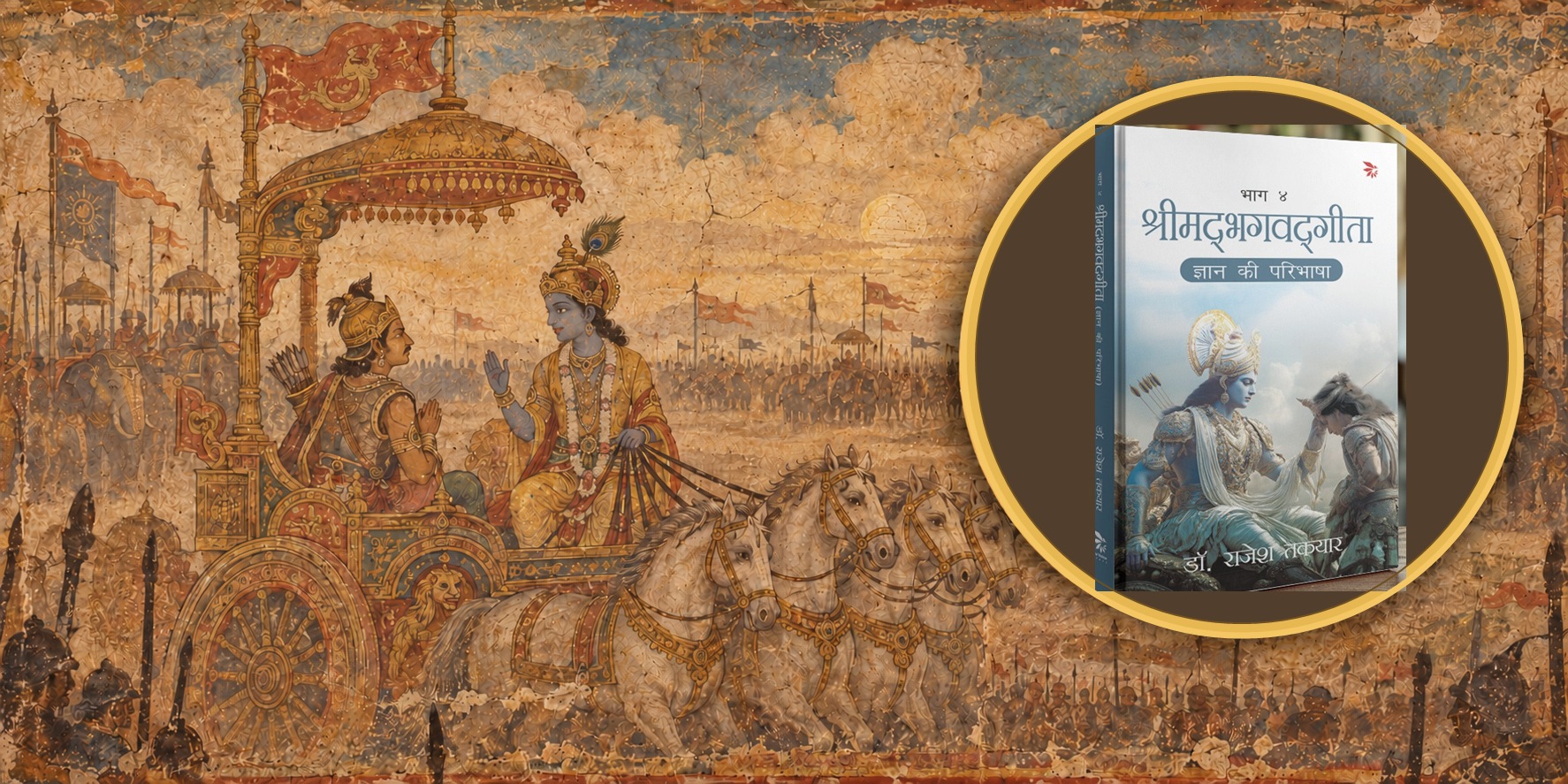
Arjuna asks Shri Krishna: His own birth is recent, while the Sun is very ancient. How, then, could He have taught this yoga to the Sun at the beginning?
The question arises because Shri Krishna has said that He taught this imperishable yoga first to the Sun. Manu learned it from the Sun, and Ikshvaku from Manu. Through this lineage the royal sages received the knowledge. Over a long period, however, its understanding faded. Now Shri Krishna is teaching the same ancient yoga to Arjuna because Arjuna is His devotee and friend.
In answer, Shri Krishna says that many births have passed for both Him and Arjuna. He knows them all, but Arjuna does not. Though unborn and imperishable, He brings Himself forth through His own divine power, keeping His nature under His control.
When dharma declines and unrighteousness grows, He manifests. He appears to protect the good, bring an end to evil and establish dharma. A person who understands the true divinity of His birth and actions reaches Him after leaving the body, freed from the cycle of rebirth.
Shri Krishna explains that many people have become purified through knowledge and discipline by freeing themselves from attachment, fear and anger, fixing their minds on Him and taking refuge in Him. He responds to each person in keeping with the way that person approaches Him. Knowledge, then, is connected with purification of the mind, dedication and one’s relationship with the Divine.
Shri Krishna returns to the subject of action. While explaining the order based on qualities and work, He describes His own freedom from attachment. Actions do not bind Him because He has no desire for their results. In earlier times, those who sought liberation acted with this understanding. Arjuna too must act, while understanding what makes action binding.
Even the wise, Shri Krishna says, can be confused about what action is and what inaction is. It is necessary to understand right action, recognise wrong action and know the truth of inaction. The nature of action is profound.
Someone may appear very active outwardly, yet inwardly be free from attachment to results and from the ego of being the doer. Another may sit quietly, while the mind remains absorbed in desires and imaginings. A person’s inner state therefore cannot be understood from outward activity alone.
Shri Krishna calls wise the person who sees inaction in action and action in inaction. Such a person understands which attitude turns action into bondage and which awareness allows one to act without being bound.
One whose actions are free from selfish desire, whose intellect is grounded in knowledge and who has let go of attachment to results is not bound even while acting. Such a person is content inwardly and does not connect work with private ownership or a hunger to accumulate. Actions performed in a spirit of dedication do not create bondage.
To explain this dedication, Shri Krishna presents a broad vision of yajna. The offering is Brahman, the material offered is Brahman, the sacred fire is Brahman, and the one who offers is also Brahman. A person established in this understanding sees the presence of the highest truth in action itself.
He then describes many forms of yajna. Some worship the divine powers; some discipline the senses or regulate their engagement with sense objects. Some perform yajna through material offerings, austerity, yoga practice, study of sacred texts or knowledge. Restraining the life-breaths and eating in a measured way are also forms of this discipline.
In each of these, a person disciplines and dedicates some power of life. The senses, mind, breath, resources and actions are directed toward a higher purpose.
Shri Krishna says that the yajna of knowledge is greater than an offering of material things, because all actions reach their fulfilment in knowledge. When the true purpose of action is understood, the way one acts changes as well.
But how is such knowledge gained?
Shri Krishna tells Arjuna to approach those who know the truth with humility, ask them questions and serve with a spirit of respect. Those who have seen the truth will teach him. Genuine curiosity and the humility to learn are both necessary. Arjuna himself is clarifying his confusion by asking questions.
This knowledge widens one’s vision. Shri Krishna says that after receiving it, Arjuna will no longer fall into the same delusion. He will see all beings in himself and then in Shri Krishna. Recognising the unity present within life loosens the hold of separation and confusion.
Shri Krishna also describes knowledge as a boat and as a fire. However burdened a person may be by wrongdoing, the boat of knowledge can carry that person across the difficulty. As a blazing fire consumes its fuel, the fire of knowledge burns away the bonds of action.
Knowledge therefore makes transformation possible. Actions performed in ignorance bind a person; recognising the truth gives a foundation for changing one’s awareness and the direction of one’s actions.
Shri Krishna says that nothing in this world purifies like knowledge. A person maturing in yoga gradually realises it within. Faith, dedication to spiritual practice and restraint of the senses lead toward knowledge. With knowledge comes supreme peace.
By contrast, a mind caught in ignorance and doubt cannot remain steady in any direction. Shri Krishna therefore asks Arjuna to cut through the doubt born of ignorance in his heart with the sword of knowledge and to rise, established in yoga.
Chapter Four shows knowledge by its effect: it changes delusion into clarity, attachment into dedication, and doubt into discerning action. Arjuna must gain the kind of knowledge by whose light he can recognise his duty and perform it without becoming bound. The author has expanded on this in his following book in 58,000 words. (Shrimad Bhagavad Gita — Part 4 — The Definition of Knowledge)