26 October 2026 · Dr. Rajesh Takyar
How Much Humanity Remains After Victory?
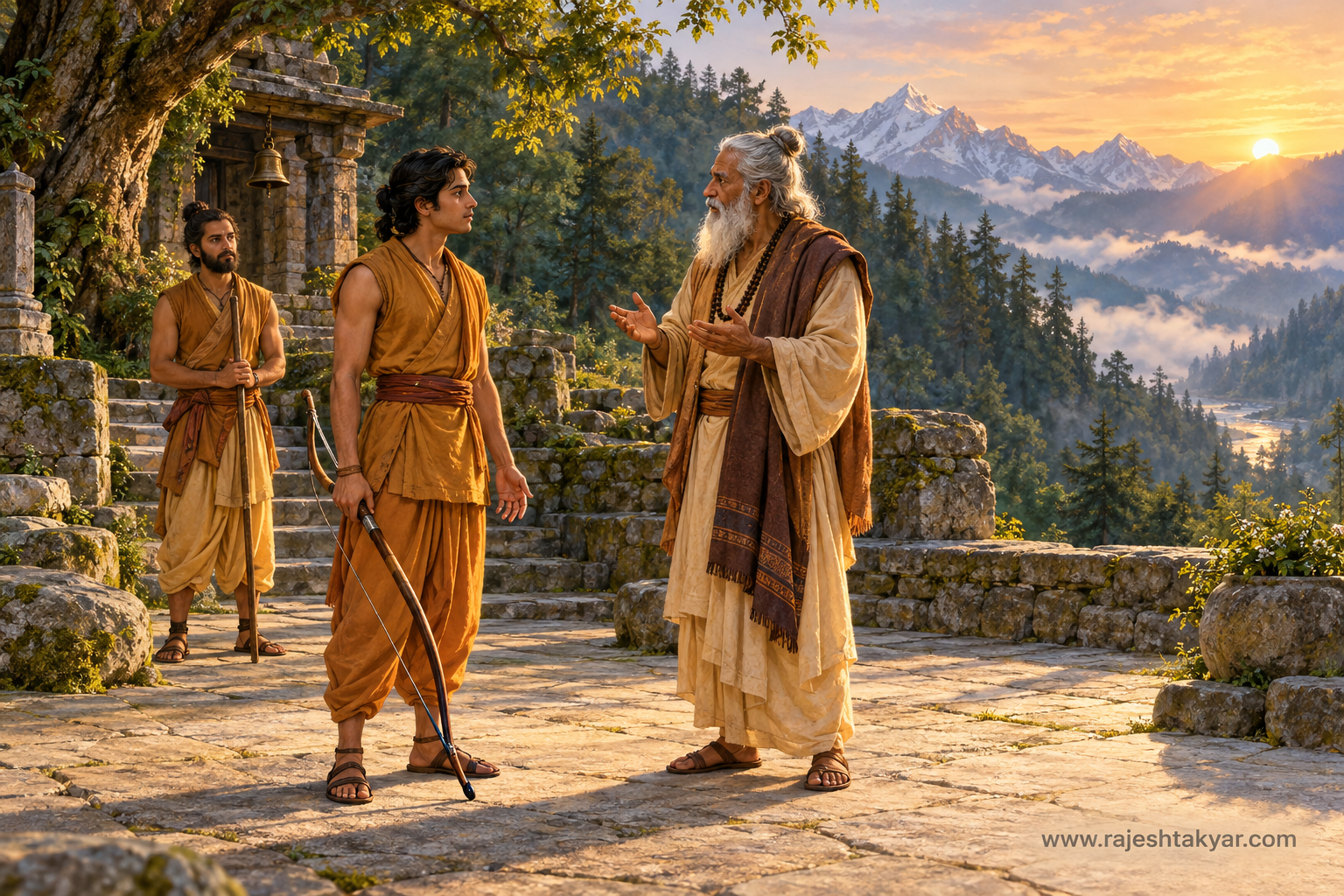
A Question Larger Than Victory
Winning a struggle is the result we can see. What changed within us on the way to that victory is a question we do not ask as readily. Did we become more understanding, or merely harder? Did we recognise our strength, or acquire a taste for overpowering someone else? Reading the two parts of Cockroach together brings this question of power and humanity before me. In the first part, it emerges amid Maya’s unease; in the second, Aryav’s education gives it a practical form.
Cockroach is a spiritual mystery novel. Its characters, imagined events and mythological inspirations should be understood within that literary context. I am not presenting an invented event as historical evidence. My concern is with the questions the story awakens in us. Maya’s fear, Ashwatthama’s measured answer and Aryav’s training are distinct episodes connected by one thread: strength becomes meaningful when it is accompanied by discernment and concern for another life.
In the first part’s episode about fear of oneself, Maya’s familiar world has changed. Baba’s presence once reassured her; his newly revealed identity and the company of immortal warriors now open a much larger responsibility before her. She has been told that she is Ulupi. Her past and the approaching struggle extend far beyond her small world. She cannot sleep that night. Her unease concerns more than an enemy she may face. She must question her own identity and ask who she really is.
It is then that she speaks with Ashwatthama. She wants to know what she was like as Ulupi, whether she fought, and whether she killed people. These are not displays of valour but the natural concerns of a human being. Ashwatthama replies: “The hardest thing in war is not whether you can defeat someone. The hard thing is how much of the human being remains within you after victory.” His words suddenly turn the discussion of winning inward.
Maya does not immediately claim to understand. She plainly says that she has not understood. I find her honesty significant. Sometimes the first response to a serious question is to acknowledge what we do not understand. Ashwatthama does not complete their conversation with a lengthy sermon either. That night’s question remains open in the story, and the reader can carry it forward: if sensitivity itself disappears after victory, what have we preserved? This question provides a way of reading the education described in the second part.
Capacity and Readiness Are Different
In the second part’s episode, A New Test, Aryav is undergoing training at Indragirishwar. Ulupi wants to hear about him, and Baba describes his studies and practice. His education is not confined to one field. Maharshi Vyasa teaches him to understand language and texts; Parashurama guides his physical and weapons training. Kripacharya and Vibhishana develop his understanding of responsibility and judgement. Strength is not left on its own in this arrangement. The growth of understanding alongside it is considered necessary.
The novel depicts certain abilities in Aryav as having increased after an extraordinary change in his life. His reactions become faster and his capacity to endure training changes. Yet displaying these abilities does not become the centre of his education. Parashurama’s first lesson is that the awakening of power and becoming fit to exercise it are different things. Aryav is therefore not permitted to show off his abilities. In the story, this restraint is part of his preparation, not opposition to his progress. New strength does not automatically bring the wisdom to use it.
Readiness here means more than declaring a right to act. It must become visible in practice, discipline and judgement. Being able to do something is one matter; deciding whether it should be done is another. The question of Aryav’s power consequently grows larger than his own enthusiasm. He must understand his body, the other person’s movements and the needs of the situation together. Someone who can refrain from displaying an ability can also acknowledge that there is still more to learn.
His studies with Vyasa bring the same patience into view. At first, Aryav struggles with Sanskrit words and pronunciation. He is taught basic words, roots and sentences before moving towards the meanings of verses. The book also makes his limitations clear: he has not yet become a scholar capable of reading every text independently. He has begun to understand some things and continues learning. This small detail gives education an honesty of its own: respect what has been learned without concealing what remains or claiming completeness.
Maya in the first part acknowledges her lack of understanding; Aryav in the second learns gradually. Both episodes lead me towards the same caution. A significant identity or special ability does not remove the need to learn. On the contrary, greater power can make the consequences of incomplete understanding greater too. Readiness therefore does not begin with an attractive declaration about oneself. It begins with how much I can listen, how carefully I can learn, and where I can recognise my limits and stop.
Judgement Before Weapons
Aryav’s initial practice uses wooden weapons. He learns balance, how to recognise another person’s movements, and how to read a stance before an attack. Learning not to use force unnecessarily belongs to the same training. That last lesson is not an ornamental moral instruction separate from the rest. Training would remain incomplete if he acquired the skill to read movement without the discernment to recognise necessity. Power must be exercised through an understanding of circumstances, not merely because an opportunity has appeared.
The distinction between his two tests makes this clearer. The first tests his physical and weapons practice. The second requires him to decide when to take up a weapon and when not to. He is described as passing both. The story thus examines bodily preparation and judgement separately. Success in one test does not automatically answer the question posed by the other. Good practice is necessary, but recognising the appropriate moment to use it is equally important.
Deciding not to take up a weapon is not an excuse to avoid training here. Aryav is undergoing demanding preparation and will be entrusted with an important task. To mistake restraint for inactivity would therefore miss the meaning of the episode. The question is how he will use his preparation once he is ready. Will his response be determined only by an impulse within him, or will he be able to see the situation before him? Discernment matters when strength is available but not every use of it is appropriate.
Baba later tells Ulupi that, on the path Aryav is entering, education does not mean avoiding danger; it means learning to make the right decision amid danger. This concerns the responsibility given to him in the novel, not an invitation to take unnecessary risks. Garuda is also said to be accompanying him. Training, guidance and support are all considered. Responsibility is not fulfilled by demanding courage and leaving a person alone. It also requires the work of making that person capable of judgement.
At this point, the first part’s question returns. The ability to win a war and the ability to remain human after winning are not the same measure. The latter requires restraints, questions and responsibilities during preparation itself. Rather than searching for sensitivity after a struggle has ended, it must be present while decisions are being made. Aryav’s second test gives this possibility a concrete form. His preparation includes both withholding action and acting; victory need not therefore be imagined solely as another person’s defeat.
Concern for Both
Ulupi is pleased to hear about Aryav’s training. She then asks Baba, with gentle humour, whether he has injured anyone. Baba asks whether she is concerned about Aryav or the person facing him. Her answer is: “Both.” This brief exchange makes the whole subject remarkably simple. It is natural to wish success for someone close to us. Here, however, concern for the other person standing before that success is not excluded from the conversation.
This answer does not provide a complete rule for conflict or treat every situation as identical. Its importance lies in the direction it offers. Hearing about the training, Ulupi does not merely ask how powerful Aryav has become. She also wants to know whether anyone has been hurt by that power. A mind that retains concern for both can see the human cost alongside the result. Completely separating someone else’s injury from one’s own happiness does not become acceptable here.
Ulupi’s affection is not concealed in this episode either. She remembers Aryav, hesitates to ask about him, and Baba recognises her hesitation. She wishes to meet him, yet listens to the news of his learning. Love and concern coexist within her. I see an important balance in this portrayal: preserving humanity does not mean making the heart emotionless. It is possible to care for someone dear while also remaining attentive to another person.
Maya in the first part is not a rigid embodiment of an ideal either. She is afraid, asks questions and feels unsettled about her identity. This sensitivity keeps her questions alive. If she felt only pride in her fighting skills, perhaps she would never ask whether she had killed people. Both parts of the story thus bring forward the need for responsible understanding alongside emotions, rather than their elimination. The human being within us also survives in questions we find uncomfortable to ask.
Responsibility Completes Victory
Kripacharya teaches Aryav the meaning of family, teachers, society and responsibility. This education relates to his life, since his own family world has almost entirely been left behind. Increasing someone’s ability is not enough; that person must also understand how their life connects with other lives. If power becomes merely a proof of one’s own existence, its purpose may remain narrow. Responsibility gives that power a relationship: the effect of my decision does not end with me.
Vibhishana’s teaching addresses the relationship between dharma and power. For whose benefit should strength be used? Is defeating an enemy the only victory, or is restraining one’s anger also a victory? Does faith in God mean leaving every result to God, or doing one’s work fully and then accepting the outcome? These questions take Aryav’s training inward. He asks questions about them too. Education does not make him merely obedient to commands; it leads him towards understanding the meaning of his actions.
The question of restraining anger does not deny a danger before him. It examines a force within him that can affect judgement. Similarly, accepting an outcome does not permit withdrawal from work, because it is preceded by the insistence on doing that work fully. The novel places these questions together. It would therefore be wrong to seize one sentence and abandon the remaining responsibility. Action, restraint and acceptance each have their own place in this education.
The question Ashwatthama leaves before Maya in the first part of Cockroach begins to find a direction through Aryav’s preparation in the second. Training the body, knowing one’s limits, refusing unnecessary displays of force, deciding at the appropriate moment and caring for both people can help preserve humanity. This is not a declaration of final victory, but a process of becoming ready. The story returns us from the result to preparation, because the understanding given a place within us beforehand is what will be available during a struggle.
For me, then, the central question emerging from these two parts is not simply who will defeat an adversary such as Cockroach. It is also what a person will preserve within while facing that opposition. If the purpose of strength is connected with responsibility, sensitivity need not be its weakness. And if the value of another life remains visible after winning, victory will not end as a single event. It may offer part of an answer to that difficult question: how much of the human being remains within us?