11 October 2026 · Dr. Rajesh Takyar
Who Am I—Body, Mind, or Witnessing Consciousness?
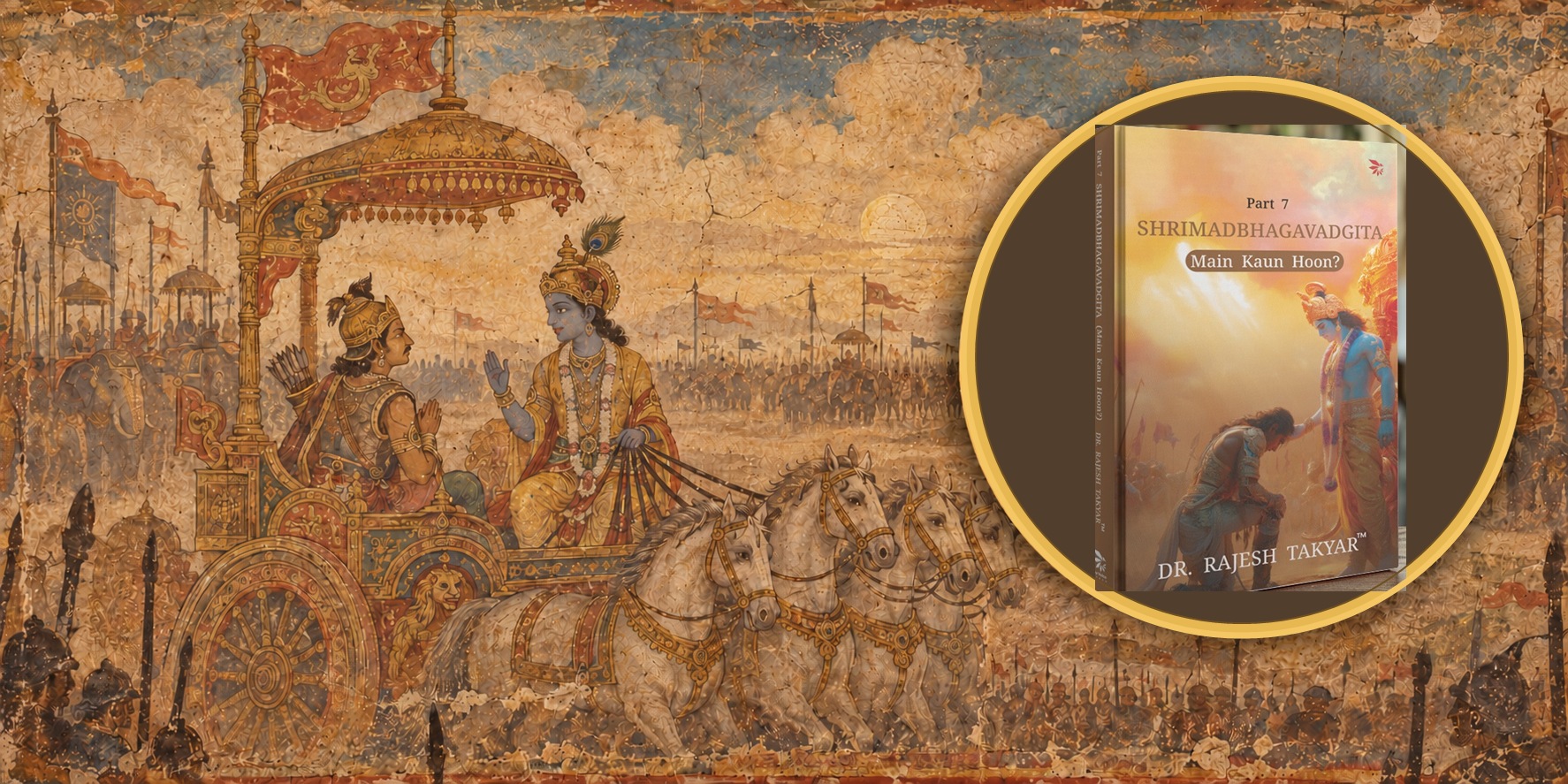
Shri Krishna tells Arjuna that by practising yoga with the mind fixed on Him and by taking refuge in Him, Arjuna can know His true nature. He is now going to explain a knowledge connected not only with thought but also with experience.
Hearing about a subject and recognising it through one’s own experience are different states. Shri Krishna guides Arjuna toward that recognition. Many wish to know the Supreme Truth, but few devote their lives to the practice required for it.
He describes two forms of His nature. Earth, water, fire, air, space, mind, intellect and ego are His eightfold material nature. Beyond these is His higher nature in the form of the living being, by which the world is sustained.
Thus both the objects we see in the world and the consciousness of life rest upon the Divine. Shri Krishna says that the entire universe has its origin and end in Him. There is no foundation higher than Him.
He gives the example of pearls strung on a thread. The pearls appear separate, but the thread that holds them together remains within the garland. In the same way, many forms appear in the world, yet they have one foundation.
Shri Krishna turns Arjuna’s attention to familiar aspects of life. He says that He is the taste in water, the light of the Sun and Moon, the pure fragrance of the earth, the brilliance of fire and the life in all beings.
The intelligence of the wise and the strength of the strong when free from desire and attachment also come from Him. Even desire that is not contrary to dharma has its foundation in Him. To recognise the Divine, one must look attentively at the essential qualities of life.
Still, people do not recognise this truth easily. The states arising from sattva, rajas and tamas exert their influence over them. They become so caught up in changing conditions that the imperishable foundation behind them slips from view.
Shri Krishna says that it is difficult to cross this maya woven from the three qualities. Those who take refuge in Him can cross it. Such refuge involves turning the direction of one’s mind and life toward the Divine.
He mentions four kinds of devotees. One seeks relief from suffering; another comes desiring an achievement; a third is eager to know the truth; and a fourth remains connected with Him through knowledge. All of them approach Him.
Among these, the devotion of the wise is special. For such a person, the Divine is no longer merely a means of fulfilling a desire. The Divine becomes the highest goal. Gradually, the truth settles within that Vasudeva is the foundation of all existence.
Worship motivated by desires yields results in keeping with those desires. But when the attainments themselves are limited in duration, the satisfaction they bring is limited too. Shri Krishna directs Arjuna’s attention toward a realisation that goes beyond perishable rewards.
When a person understands the Divine only within the limits of visible form, the unborn and imperishable nature is not known. Delusion born of desire and aversion veils one’s vision. Life becomes a matter of clinging to what suits us and continually pushing away what does not.
As this conflict diminishes, one’s commitment grows steady. A person begins to understand more clearly questions of life, death, action and the self. Thought moves beyond the convenience of a single moment.
This teaching leads Arjuna to recognise the unity present within the world. A vision scattered among separate objects gradually begins to see the one foundation from which everything arises, in which everything rests and to which a mind of dedication ultimately returns. The author has expanded on this in his following book in 66,800 words. (Shrimad Bhagavad Gita — Part 7 — Who Am I?)