11 October 2026 · Dr. Rajesh Takyar
The Field and Its Knower: Who Is Aware?
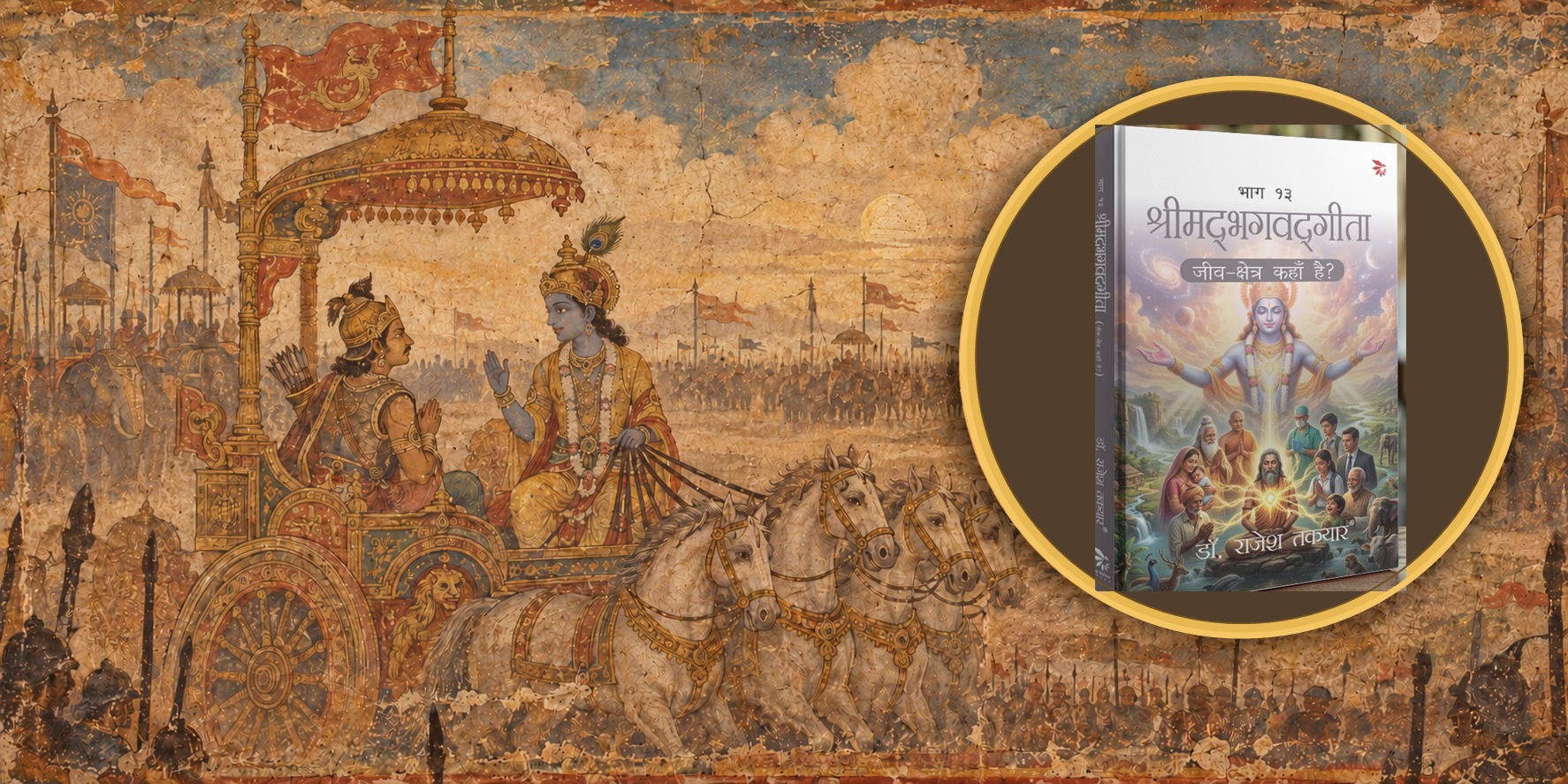
Shri Krishna explains to Arjuna the distinction between the body and the one who knows it. He calls the body the field and the one who knows this field the knower of the field. Recognising this distinction is an important step toward self-knowledge.
The body changes. The senses receive experiences. Desire, aversion, pleasure and pain arise in the mind. The intellect makes decisions. All these belong to the field of experience. A person becomes so closely identified with them that he begins to understand himself only as these changing states.
Shri Krishna leads Arjuna to ask: who is the one that knows all of this? It is necessary to know the nature of the one who recognises the body’s condition, the mind’s restlessness and the arrival and departure of pleasure and pain.
He says that the knower present in all fields should be understood as His own nature. Knowledge is therefore not limited to identifying one’s own body. It leads toward a wider conscious foundation present in all beings.
The field includes the five great elements, ego, intellect, mind, the senses and their objects. Desire and aversion, and the many changes that occur in the body, are also connected with this field. Understanding them helps a person avoid treating every passing state as the final truth of one’s being.
But thought alone is not enough for this knowledge. Shri Krishna names humility, absence of pretence, non-violence, forgiveness, simplicity, respect for the teacher, purity and self-discipline as qualities of knowledge.
A mind filled with ego wants to see truth in a way that suits itself. Humility makes one ready to learn. Forgiveness and simplicity lessen harshness. Restraint gives some freedom from the constant pull of sense objects.
Reflecting on the realities of birth, death, old age and illness is also part of this discernment. It helps a person recognise life’s instability. While living with family and relationships, loosening excessive attachment and remaining even-minded in pleasant and unpleasant situations become a practice.
Shri Krishna also values unwavering devotion and continuing interest in self-knowledge. When the mind finds some rest from external distractions and attractions, it can reflect on its real foundation.
The supreme truth to be known is within and outside all beings. It sustains everything and yet is free of attachment. Although it appears distinct among many beings, its essential nature is undivided.
It is called the light of all lights. It is not merely an object placed outside that the senses can grasp. Recognising it requires purity of the inner being and the vision of knowledge.
Shri Krishna also explains the distinction between nature and the conscious self. Change, qualities and activity belong to the domain of nature. The conscious self experiences pleasure and pain. Attachment to the qualities of nature becomes a cause of birth and bondage.
Some recognise this truth through meditation, some through knowledge, and some through karma yoga. Those who do not yet understand it fully can also progress by listening with faith and worshipping.
Equal vision becomes important once again. One who sees the imperishable Divine equally present in perishable bodies sees truly. Recognising the same foundation within diverse forms brings sensitivity and restraint to one’s conduct.
Shri Krishna offers the examples of space and the Sun. Space pervades everything yet remains unattached. One Sun illuminates many objects. In the same way, the principle of the self, present in the body, is not exhausted by its changes. This discernment between the field and its knower helps a person recognise the true self and the direction of liberation. The author has expanded on this in his following book in 60,968 words. (Shrimad Bhagavad Gita — Part 13 — The Field and Its Knower)