14 October 2026 · Dr. Rajesh Takyar
Meera’s Steadfast Love
Love as a Living Relationship
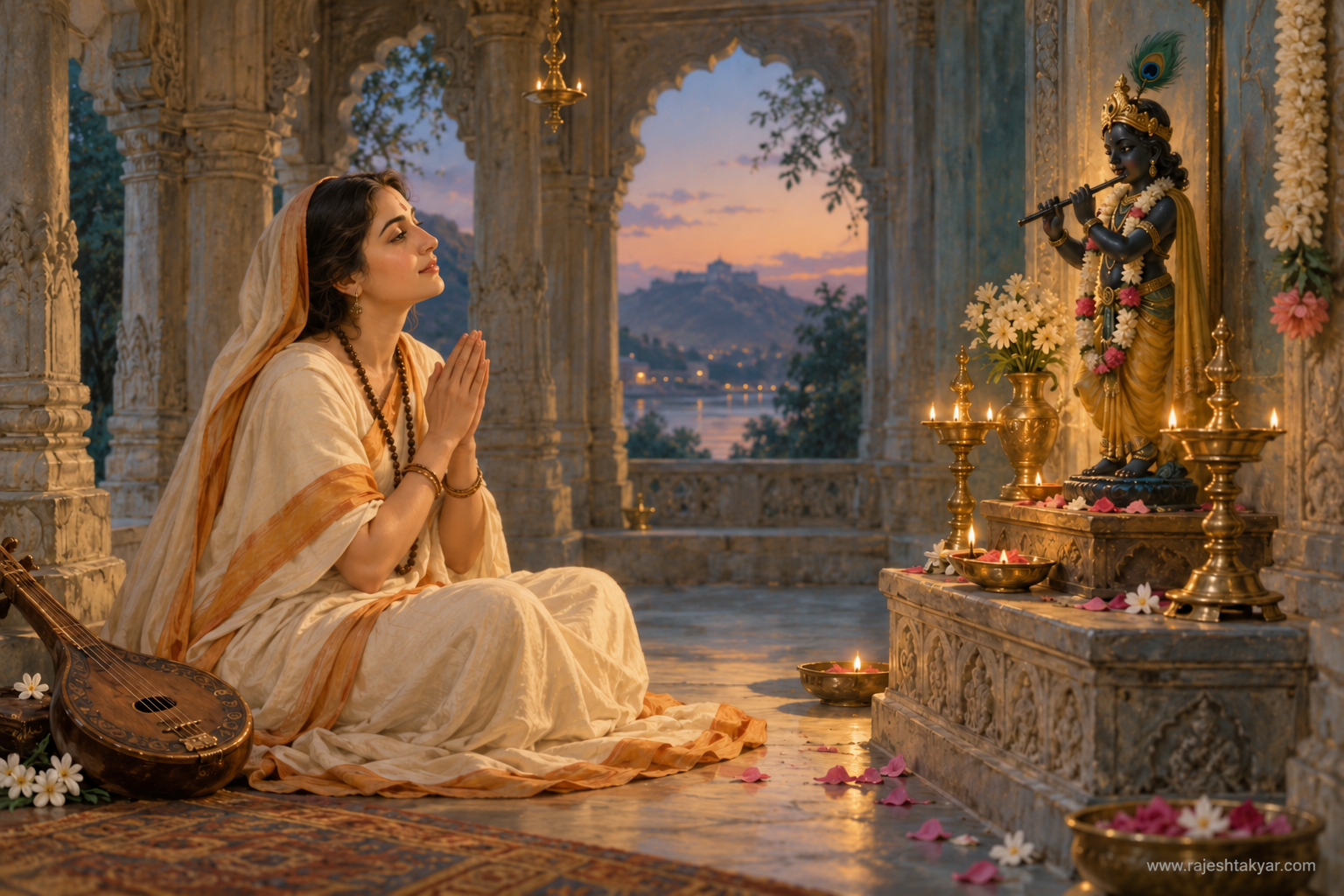
Krishna’s image stands before Meera. An observer may see an idol placed in a temple, but for Meera it is the presence of her beloved. This distinction opens a way to understand her love. Some scenes are perceived only by the eyes; some relationships enter the heart and give life its direction. Meera’s bond with Krishna is such a relationship. Reading this episode of her devotion, I pause first at this closeness. She does more than keep her deity at a distance and sing of his greatness. She sits before him, speaks to him and opens her heart in his presence.
Two accounts describe Meera’s childhood attachment to Krishna. In one, a holy man gives her an image of Krishna, which she accepts as her companion and beloved. In another, seeing a wedding procession, she asks her mother about her own bridegroom. Her mother points towards Krishna’s image. The child turns that gesture into a profound sense of belonging. The events in these accounts differ, but they share something essential: Meera recognises a relationship between Krishna and her own life. Before the image where another person might pause briefly, her heart finds a lasting refuge.
This closeness continues with her. When she leaves after her marriage, she takes that same image of Krishna along. Her surroundings, home and responsibilities change, yet her relationship with her beloved is not left behind. I see the continuity of her love in this small detail. Devotion becomes more than a feeling awakened occasionally at a celebration; it becomes a remembrance that accompanies her. Wherever Meera arrives, there is room for Krishna too. The new circumstances of her life give that relationship a new setting without bringing it to an end.
Making Room for Devotion
One detail in Meera’s account particularly draws my attention. She would finish her household work and then go to Krishna’s temple. There she worshipped, sang and danced. Reading this sequence reveals a natural form of devotion. Daily work and remembrance of her beloved appear together in her life. Her household tasks are completed before her feet carry her to the temple. Turning this episode solely into a story of withdrawal from the world would lose this small but important aspect. Meera fills the time available to her with the relationship she has accepted in her heart.
Her singing in the temple is more than a display of her voice. The account presents it as an outpouring of love before Krishna. An inward feeling becomes words, song or dance. This helps us understand that devotion does not always express itself in the same way. For Meera, being present before her deity does not mean suppressing what she feels. Her love finds a voice, and that voice connects her with her beloved. The devotion and surrender expressed in her compositions extend this inward relationship; they cannot be fully understood apart from her life.
Hearing someone’s song and understanding its intimacy can be different experiences. An observer hears the words; the singer may be calling to a beloved within them. Meera’s episode makes me pause over this distinction. Her singing is not presented as a means of obtaining people’s approval. She sings before Krishna’s image. The direction of her feeling is clear. In seeking to understand her devotion, it is therefore useful to notice whom it lives for. Her deity is the centre of her expression; the audience’s response does not take that place.
This also raises a question for our own lives. How much actual room do we give in our day to the relationship we call our deepest? Meera’s episode prescribes no fixed amount of time for anyone, but time and presence are both visible in her love. She goes beyond declaring inward reverence and actually reaches the temple. Having completed her work, she sits again before the same beloved. This continuity clarifies her surrender. What is precious within finds a place in life. Meera’s devotion reveals that place through her daily presence rather than a grand speech.
Outward Suspicion and Inward Faith
Not everyone around Meera understood her love in the same way. Opposition arose within the family, and her visits to the temple and conversations with Krishna were viewed suspiciously. The account also describes an accusation of a secret love affair. The same event acquires two very different meanings. Meera sits before her deity, while the accuser imagines a concealed relationship in that conversation. Inward devotion is presented as a reason for outward suspicion. This episode shows how incomplete it can be to judge the meaning of someone’s experience merely by watching from a distance.
When Meera is asked in the temple to bring her lover forward, she points towards Krishna. Her reply is, “He is sitting there, my Lord.” Her relationship is clear in that answer. She simply identifies the presence to whom she has been speaking. Her statement is brief, but a lifelong direction stands behind it. Those who have come looking for another person are shown her deity. Reading this moment, I see the intimate certainty within her devotion. She needs no new introduction to identify the refuge of her love.
This episode does not mean that anyone can declare every personal insistence to be devotion like Meera’s. A particular life, repeatedly expressing surrender to Krishna, is before us. Childhood affection, taking the image along, worship, song and conversation in the temple together give her statement its meaning. Separating one sentence from the rest of that life diminishes its depth. The strength of Meera’s answer lies in her continuity. Faced with an accusing question, she recognises the same beloved whom she accepted earlier. Her words and the direction of her practice remain aligned.
The pressure of other people’s judgments can unsettle a person inwardly. In Meera’s episode, that pressure is real: opposition becomes part of her life. Yet the account does not remain centred only on her opponents. It repeatedly returns to the relationship between Meera and Krishna. That is also a fitting direction for our reading. If we remember only accusation and conflict, we lose the love that gives this episode its significance. Understanding Meera means asking what faith sustained her presence before her beloved. Her inward relationship turns a scene filled with outward suspicion into an episode of devotion.
A Journey Through Difficulty
Meera’s path of devotion passes through hardship. The account describes harsh treatment and persecution. It tells of a basket intended to contain a snake yielding flower garlands and an image of Krishna, and of a bed of thorns becoming a bed of flowers. These episodes express grace towards the devotee. As we read them, we should notice the light they cast on Meera’s love. It would be inappropriate to turn these details into a promise of a particular miracle in every crisis. The account’s reassurance concerns devotion and grace in her life; it should not become a rule by which another person’s suffering is judged.
The same account goes on to state that Meera leaves Chittor when the persecution becomes unbearable. Her unbroken devotion therefore does not mean that her circumstances were never difficult. She changes her surroundings, going first to Merta and, finding no contentment there, towards Vrindavan. This journey brings real changes to her outward life while her love for Krishna continues inwardly. Here I see a distinction between steadfastness and remaining fixed in place. Maintaining a relationship with one’s beloved and holding every old circumstance unchanged are different things. In Meera’s journey, love remains steady while her dwelling places change.
Singing and dancing appear again as she travels from village to village. The love that found its voice in the temple now accompanies her along the road. Because of this continuity, her life cannot be confined to one location or event. Remembrance of Krishna travels with her. The journey becomes more than the covering of distance; it becomes another expression of the same relationship. This companionship matters in the account of her devotion. Wherever she goes, she carries her inward direction with her. Amid life’s uncertainty, this bond with her beloved connects her story into a whole.
The account presents her final years in Dwarka and her merging into the image of Dwarkadhish as a received belief. We should receive it in that form. Its feeling expresses the longing for complete union with the beloved. Yet we do not have to wait for this final scene to understand Meera’s devotion. Her closeness, daily remembrance, clear answer amid opposition and continuing journey through hardship have already revealed her surrender. We should not forget these smaller stages as we approach the concluding episode. Without them, union would remain merely an extraordinary event; with them, it takes the form of a lifelong love reaching its culmination.
The Continuity of Love
Meera gave her love a voice in songs and poems. Her life account describes these compositions as expressions of surrender to Krishna. Life and writing appear together here. The words return towards the relationship in which the heart is immersed. I attach particular importance to this aspect of her songs. Love does not remain hidden and inactive within; it finds expression. It also becomes a reminder of devotion for others. Her songs belong within her story because they voice the same feeling that appears in her actions, her journey and her conversations with her deity.
तात मात भ्रात बंधु, आपनो न कोई। छाड़ि दई कुल की कानि, कहा करिहै कोई॥ संतन ढिग बैठि-बैठि, लोक लाज खोई। अँसुवन जल सींचि-सींचि, प्रेम बेलि बोई॥
Returning from Meera’s life, I want to examine what my own remembrance depends upon. Does it appear only when life is convenient? Does my relationship with my deity change as soon as another person’s approval changes? These questions are not intended to belittle anyone’s devotion. They offer an opportunity to examine our relationship more honestly. Meera’s example places the depth of her life before us. Before copying its outward forms, we need to understand the closeness that remained behind every expression. The voice of her devotion is inseparable from the direction of her heart.
In the end, the same simple scene remains before me: Meera sits before her Krishna. Childhood faith, life’s responsibilities, songs, opposition and the journey now belong within that scene. Her answer, “my Lord,” becomes more than a form of address; it identifies the centre of her life. Meera’s love helps me understand what it means to give the beloved a real place in life. Remembrance, time and surrender keep that place alive. I do not wish to leave her story having merely praised her love. I want to look within and ask whether my life truly makes such room for the one I call beloved.