11 October 2026 · Dr. Rajesh Takyar
Acting While Remembering the Divine
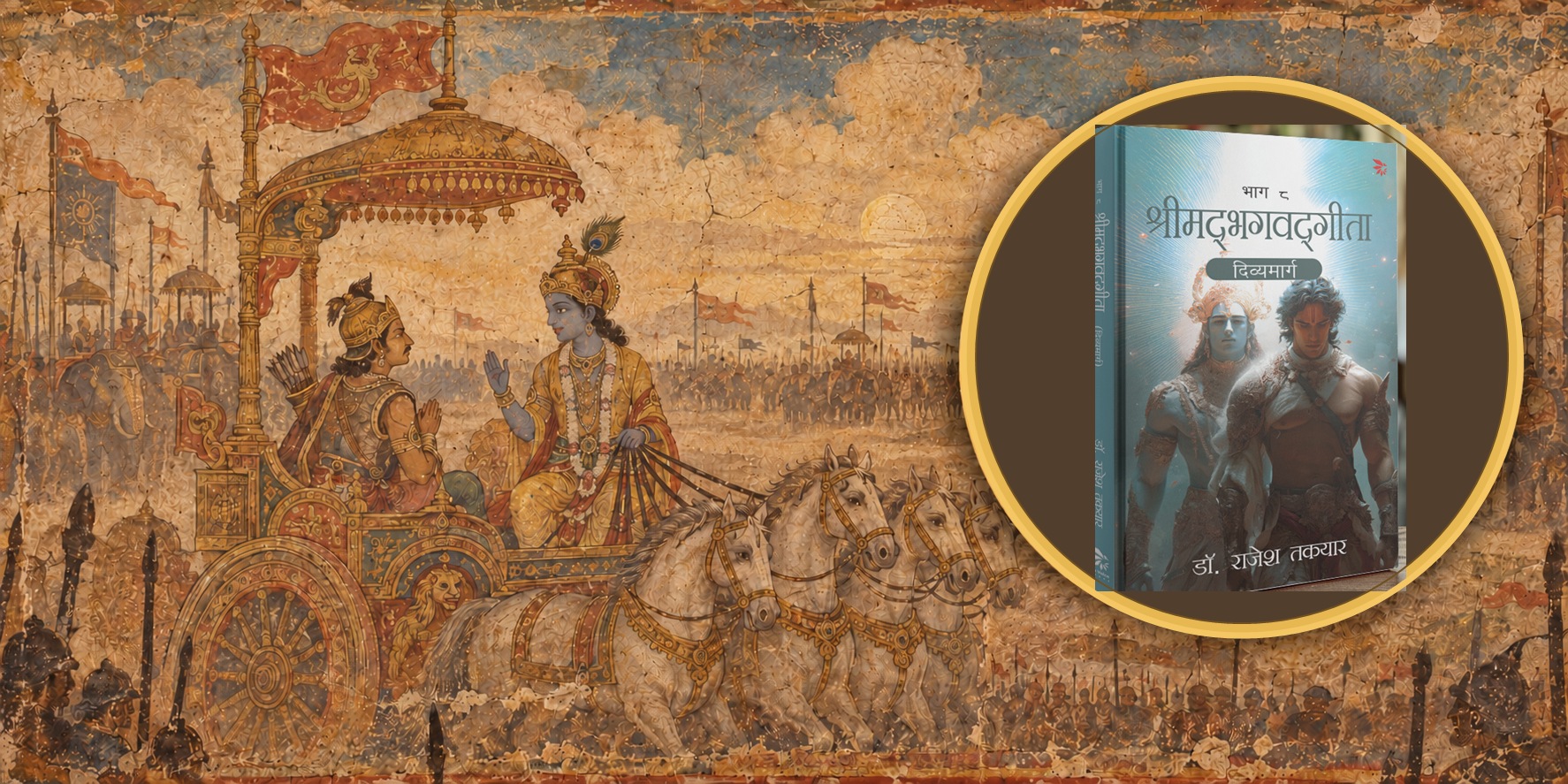
Arjuna asks Shri Krishna about Brahman, the self and action. He also wants to understand the material, divine and sacrificial dimensions of existence. An important part of his question is how a disciplined person knows the Divine at the final moment of life.
Shri Krishna leads him to the distinction between the perishable and the imperishable. What comes into being and then passes away belongs to the realm of change. The body and the visible world are subject to this law. The supreme Brahman is the imperishable truth beyond arising and dissolution.
People often identify their lives with the condition of the body, relationships and achievements. Yet all these change. Shri Krishna reminds Arjuna of the foundation that does not perish amid these changes.
He explains that the remembrance held at the final moment is connected with the soul’s onward journey. A person moves toward the state on which the mind is fixed when leaving the body. The direction toward which the mind has been turned throughout life therefore matters.
Preparation for the final moment takes place through the practice of an entire life. The subjects to which the mind repeatedly returns become deeply established within it. Remembrance of the Divine, too, becomes the mind’s nature through continual practice.
That is why Shri Krishna tells Arjuna to remember Him while also performing his duty. Remembrance and action can go together. Life’s necessary work can be completed while the mind and intellect remain offered to the Divine.
This practice consists of bringing the mind back repeatedly to one direction. When it begins to scatter among many desires, practice returns it. Through one-pointed contemplation, the seeker’s goal becomes clearer and inner restlessness diminishes.
Shri Krishna describes the Supreme Person as all-knowing, eternal and the sustainer of all. He is subtler than the atom, beyond the limits of thought and above the darkness of ignorance. The seeker steadies the mind on Him.
He speaks of restrained senses, a steady mind, devotion and the power of yoga. Fixing the mind on the Divine while remembering the sacred syllable Om is also part of this practice. At its centre are inward focus and dedication.
For one who remembers the Divine constantly, reaching Him becomes natural. This naturalness rests on a lifelong connection. Where the mind returns again and again with love and commitment, the sense of distance gradually diminishes.
Shri Krishna then describes the vast cycles of time in creation. Beings come into manifestation and then dissolve into an unmanifest state. The cycle repeats. Even realms that last for immense periods are not entirely outside this change.
Yet beyond this manifested and unmanifest nature is an eternal principle. It does not perish even when all beings perish. That imperishable state is called the supreme destination. Having reached it, the soul does not return to the same cycle of coming and going.
Shri Krishna also describes two paths: one leads beyond return, while the other leads back again. After this explanation, His instruction is that Arjuna remain joined to yoga at all times. Practice should not be limited to a single occasion.
The merit gained through study of the Vedas, yajna, austerity and charity has its own value. But the yogi who knows the nature of the Divine and abides in Him moves beyond these limited results. The search is for the supreme foundation itself.
The essence of the divine path lies in the direction of one’s life. The supreme truth one hopes to attain at the end must be established in life now. Each day lived through duty, practice, devotion and dedication becomes part of that journey. The author has expanded on this in his following book in 57,000 words. (Shrimad Bhagavad Gita — Part 8 — The Divine Path)