18 October 2026 · Dr. Rajesh Takyar
Seeing Beyond Circumstances
One journey, two intentions
When trying to understand someone, we often look only at where they have come from and whose company they keep. After that, we have no questions left about their heart. We assume that their feelings must resemble those of the person with whom they live. Akrura’s arrival in Vrindavan makes me pause before this haste. The instruction to travel comes from Kamsa, yet the traveller’s heart longs to see Shri Krishna. Two entirely different intentions accompany the same journey. Without understanding this difference, we cannot fully understand the welcome Akrura receives either.
When Kamsa learned about Shri Krishna and Balarama, he called Akrura and instructed him to bring the brothers to him. He did not even conceal his purpose. He intended to kill Shri Krishna and asked Akrura to entice them into coming. The episode begins harshly. While reading the loving encounter that follows, it would be wrong to forget that harshness. It is precisely this that deepens the question: how did Shri Krishna embrace Akrura when he had arrived carrying an instruction issued with such a corrupt purpose?
Akrura accepts Kamsa’s instruction and sets out, but on the way his heart is not celebrating Kamsa’s intention. He knows Shri Krishna to be God. He feels that some good deed has borne fruit, giving him the opportunity to see Balarama and Shri Krishna. At the same time, he regards this opportunity as Shri Krishna’s grace. Within him are praise, the joy of the anticipated meeting and a desire for their presence. Outwardly, this appears to be a messenger’s journey; inwardly, it is also a devotee’s journey. Only when we hold both aspects together does Akrura stand before us as a whole person.
I am not justifying a wrongful purpose here. Kamsa’s intention is clear. But with the same clarity, I also want to see the feeling within Akrura. If I judge the visitor solely by the person who sent him, I stop at half the truth of the story. If I forget Kamsa’s intention because of Akrura’s devotion, my reading is incomplete in another way. This episode requires both care and sensitivity. Understanding someone does not begin by treating our first impression of them as final.
Before the dust of his feet
As soon as Akrura reaches the boundary of Vrindavan, his feelings begin to reveal themselves in his actions. He bows to the ground where Shri Krishna’s footprints can be seen. Rolling upon the earth, he honours the dust that, for him, is connected with the Lord’s feet. Tears flow from his eyes and his body thrills with joy. Shri Krishna has not yet appeared before him or spoken to him. Yet the anticipation of meeting him is so strong that the earth along the way itself becomes a place of reverence.
What matters to me here is not merely the tears. Behind them is a recognition that has made the earth a medium of remembrance. Akrura is looking at the place where the one he worships has walked. His longing for a meeting now begins to experience nearness. His heart seems to reach beyond the circle of position, assignment and association within which someone else might place him. If someone understood him only as an acquaintance of Kamsa, where would the heart bowed upon this earth find a place in that judgement?
I do not want to turn this state of devotion into a method of outward performance. I do not conclude from this scene that rolling on the ground as Akrura did automatically makes anyone’s heart like his. What matters here is the feeling from which the action arises. Remembrance of Shri Krishna has already accompanied him throughout the journey; the dust of those feet deepens that remembrance. Reducing an action born of feeling to an act of imitation would diminish its meaning. This scene gives me an opportunity to reflect on the sincerity of my own remembrance.
I can ask myself how much my wish to meet the one I call dear is visible in my behaviour. Is his name merely a matter of acquaintance for me, or is my heart also attached to it? In Akrura’s episode, the answer does not come through a declaration. Praise along the way and humility upon reaching Vrindavan together reveal his feelings. He is not offering a lengthy defence of himself. The inward direction of his journey has begun to show itself in his conduct.
Raised into an embrace
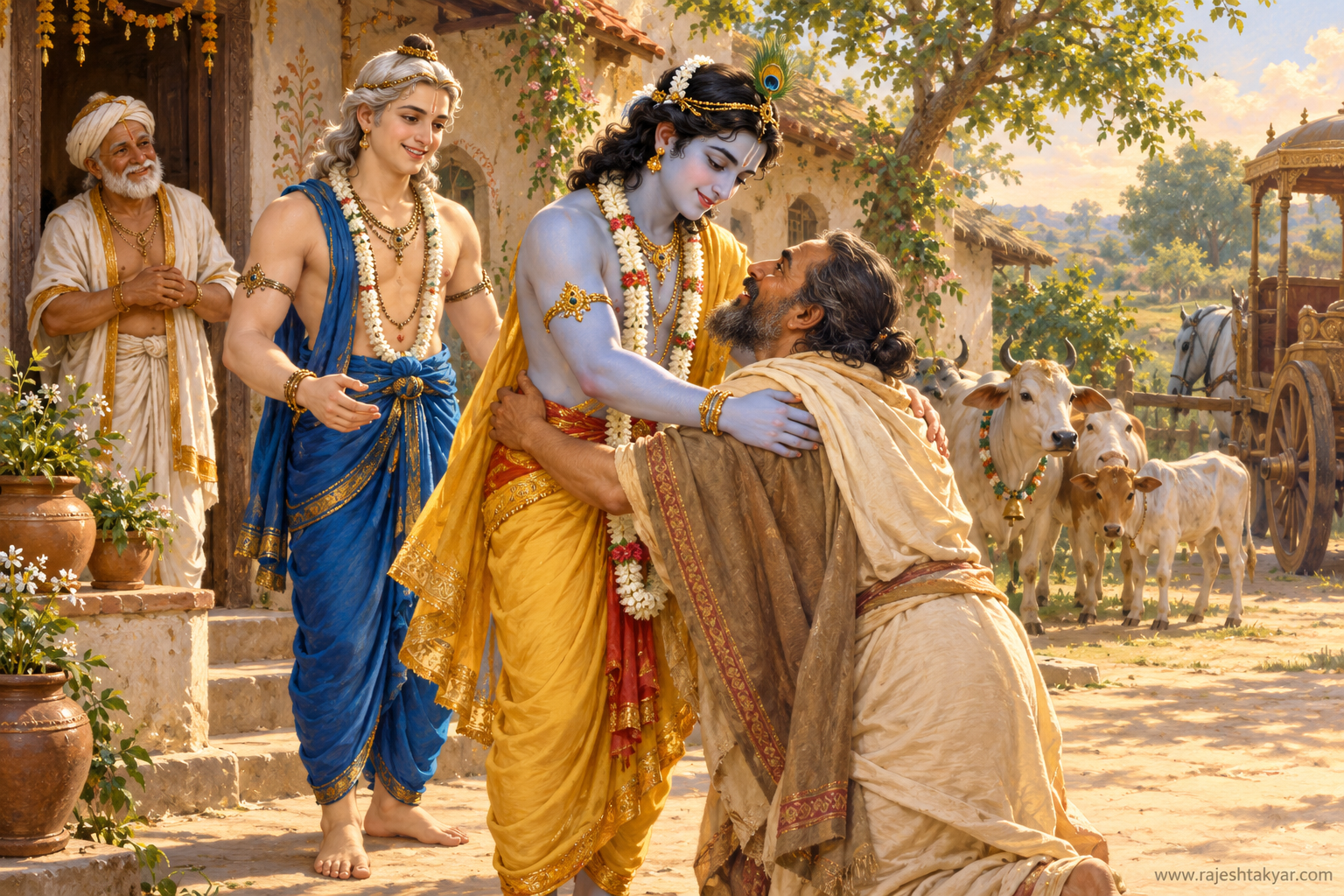
When Akrura reaches Shri Krishna and Balarama, they are occupied with milking the cows. On seeing them, he steps down from the chariot and bows in full prostration. Shri Krishna raises him and holds him to his heart. Balarama also embraces him. He is then taken inside and received with honour. The meal and the welcome complete the meeting whose anticipation Akrura has carried throughout the journey. His arrival is answered with more than a request for information or a question about his assignment; he is given a sense of belonging.
My mind pauses at this sequence of raising and embracing. Akrura is bowed down, and Shri Krishna does not leave him in that position. The response to his reverence becomes an embrace. The devotee who came longing for a meeting receives acceptance from the one before him. For me, this scene reveals the dignity of a relationship in which the person offering respect is not kept diminished. Akrura’s bow expresses his surrender, and Shri Krishna’s embrace expresses affection for him. Both feelings are present together; there is no need to place one against the other.
Balarama’s embrace and the hospitality that follows extend this acceptance. The welcome does not end as a momentary gesture. The guest is given a place inside, arrangements are made for him and his arrival is honoured. In this sequence, I see the practical language of love. There can be a distance between saying that we hold goodwill towards someone and making room for them in our conduct. Here that distance appears to diminish. This home does not open to Akrura as a place of unfamiliar suspicion.
Even so, the welcome does not imply approval of Kamsa’s purpose. Respecting a person and recognising the circumstances around them can exist together; Nanda’s words soon make this clearer. I see here a love that does not confine a visitor to a label. Akrura is more than a messenger sent by someone else. His own heart, his own relationship and his situation also matter. This belonging offered to him is one of the gentlest aspects of the story.
Reassurance through Nanda’s understanding
After the welcome, Nanda speaks to Akrura about his living under Kamsa’s protection. His words also expose the insecurity of that protection. He gives the example of an animal whose owner, though maintaining it, may one day kill it. The comparison suggests that living under a powerful person’s shelter need not be as secure within as it appears from outside. Nanda is not welcoming Akrura while pretending to know nothing of Kamsa’s nature. He recognises the difficulty of the circumstances in which Akrura lives.
Akrura feels reassured on hearing this. He feels that his situation has been understood and that this family does not hold a mistaken impression of him. I want to pay particular attention to that relief. He has already been honoured, but Nanda’s words touch another need—the need to be understood. Along with food, a place and a welcome, he now receives assurance that his outward association has not been mistaken for the whole of his heart. In the story, his relief becomes explicit after this understanding.
Sometimes, more than lavish praise, what supports a person may be the knowledge that we have listened to their actual situation. In Akrura’s episode, Nanda does not deliver a long sermon. He recognises the one thing necessary for understanding the circumstances of Akrura’s life. That is why his words reach him. I do not take this to mean an ability to know everything in every situation. For me, the lesson is simply that even after hearing the name of someone’s association, the work of understanding that person remains unfinished.
If my gaze stops at outward protection, I might imagine Akrura to be comfortably placed. Nanda’s gaze also sees the fear within that protection. His words therefore carry sensitivity as well as information. His affection for Akrura is not detached from the actual situation. While recognising Kamsa’s harshness, he sees and addresses Akrura separately from it. This distinction matters deeply to me: understanding a person’s situation does not mean declaring the power surrounding them to be good.
Pausing a little longer before judging
Within this short episode, Akrura’s journey, his bow, the embraces of Shri Krishna and Balarama, and Nanda’s reassurance unfold in sequence. At every stage, something more of his identity is revealed. First, he is the person summoned by Kamsa. On the road, he appears as a devotee longing for a meeting. In Vrindavan, his humility becomes visible. Through the welcome, his cherished relationship emerges, and through Nanda’s words, his circumstances are understood. Had I closed my judgement at the first stage, all these meanings that emerge later would have been lost.
Reading this story, I reflect on the speed of my own judgements. How easy it is to see someone and immediately claim to know their entire heart. Their position, associations or reason for arriving form an image, and then the desire to look beyond that image disappears. Akrura’s episode awakens that desire again. It reminds me that the visible relationship, though important, is not the only introduction to a person. Allowing room for their words, feelings, behaviour and actual circumstances can change the shape of our understanding.
Nor does this mean that I should remove responsibility for every action by attributing it to circumstances. That is precisely why Kamsa’s intention must remain clear as we read. Trying to understand and recognising what is wrong do not erase each other. I find this balance in Nanda’s words. He neither reduces Akrura to Kamsa’s shadow nor describes Kamsa’s protection as innocent. In his gaze, affection for the person and awareness of the circumstances both remain present.
In the end, what stays with me is Akrura’s relief that this home has not misunderstood him. Alongside the joy of seeing the Lord, there is the peace of being understood. I want to make room for this pause in my own relationships—to listen before forming an impression, to see the human being within the outward circumstances and to express respect through conduct. Shri Krishna’s embrace and Nanda’s understanding appear to me as two aspects of the same welcome. One held Akrura to his heart; the other recognised his circumstances and reassured his mind.