11 October 2026 · Dr. Rajesh Takyar
The Relationship Between the Self and the Supreme
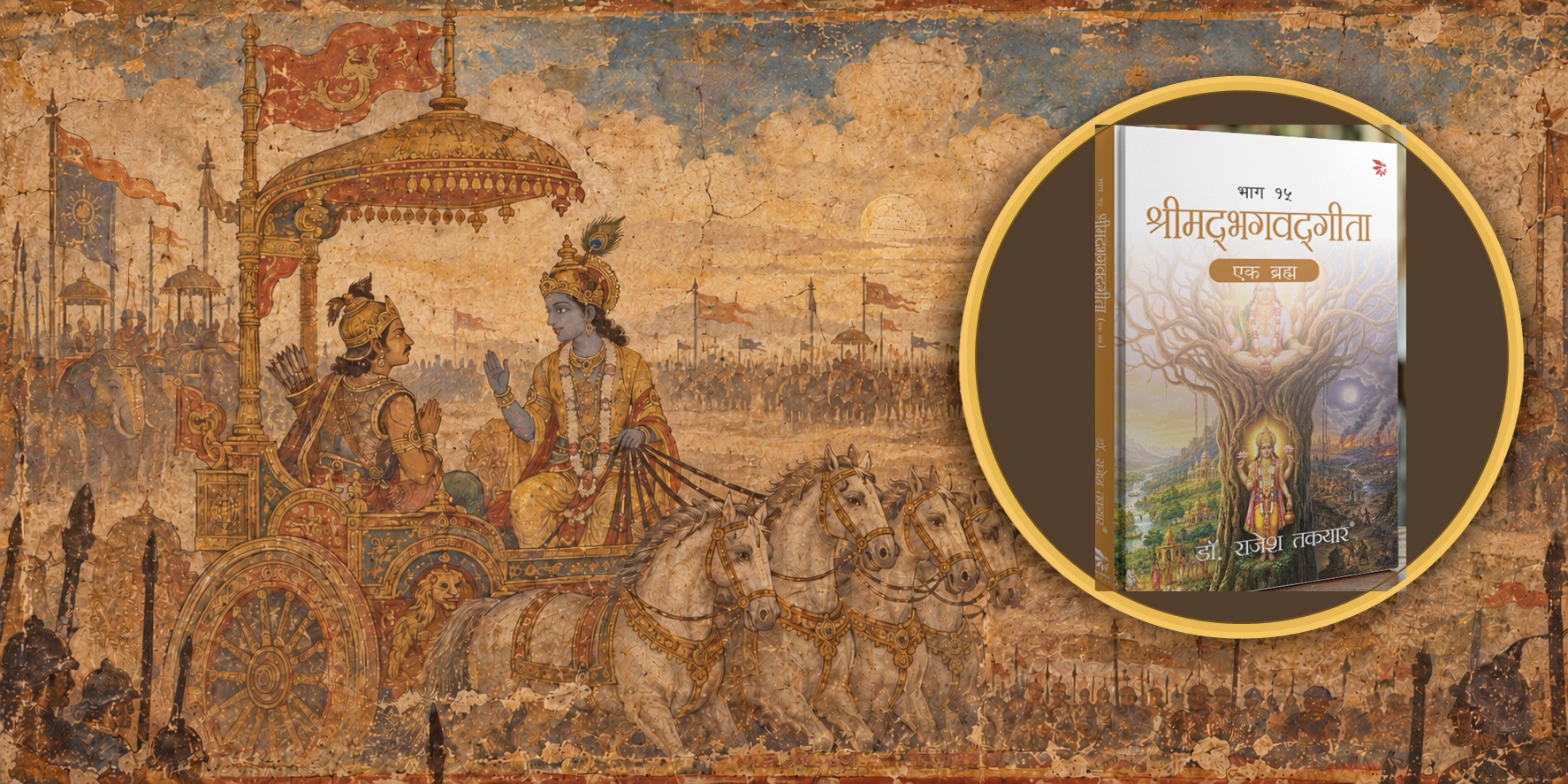
Shri Krishna presents Arjuna with a profound image of the world. He describes it as an ashvattha tree whose roots are above and whose branches spread below. Its growth appears in many forms, while its original foundation remains hidden from our ordinary sight.
Its branches are nourished by the qualities of nature. Sense objects are like its fresh shoots, while the bonds formed by actions are like roots that hold people fast. Desire leads to action, action to attachment, and attachment to new desire; the cycle keeps spreading.
A person can become so entangled in this growth that the direction of life is no longer clear. One moves from branch to branch, while the question of the root is left behind.
Shri Krishna says that this deep bond should be cut with the weapon of firm non-attachment. Non-attachment means letting go of the inner grip that makes every object and experience a foundation for lasting fulfilment.
Then one should seek the supreme state from which there is no return. The seeker takes refuge in the Primordial Person from whom this entire flow of creation has expanded.
To undertake this search, one must be free from pride and delusion. Recognising the fault in attachment, remaining steady in spiritual understanding, rising above the compulsion of desires and bearing the pairs of pleasure and pain are all parts of the practice.
Shri Krishna describes the supreme abode as a place that is not illumined by the Sun, the Moon or fire. Its existence does not depend on an external light. This imperishable attainment is the seeker’s final goal.
He then explains the nature of the living being. The living being in the world is His eternal portion. Joined with the mind and senses, it experiences nature. Its attraction toward sense objects repeatedly draws it to seek fulfilment in outward things.
Using the example of a change of body, Shri Krishna says that just as the wind carries fragrance, the living being carries the mind and senses from one body to another. The change of body is not the complete end of its journey.
A deluded vision does not recognise this subtle truth. Seekers with the vision of knowledge try to understand the principle of the self. This requires effort as well as purification of the inner being.
Shri Krishna again reminds Arjuna of Himself as he looks at the world. The light of the Sun, the sustaining power of the earth and the nourishment of plants all come from Him. His foundation is present in the order that allows life to continue.
He is also the power that digests food in the bodies of living beings. He dwells in the hearts of all. The source of memory, knowledge and forgetfulness is also in Him. Thus, the Divine is connected not only with some distant state but with every experience of being alive.
He explains the distinction between the perishable and imperishable. The entire changing world is perishable. The imperishable is the steady, undying principle. Higher than both is the Supreme Person who sustains all and is called the Supreme Self.
Shri Krishna asks Arjuna to know Him in that supreme-person form. One who understands this truth without delusion becomes wholly devoted. Such knowledge changes the direction of life.
Recognising the One Supreme Reality means seeing the source present behind diversity. When a person remembers the foundation while navigating the many branches, their relationship with the world begins to change. Attachment in their actions lessens, and dedication in their practice grows. The author has expanded on this in his following book in 58,776 words. (Shrimad Bhagavad Gita — Part 15 — The One Supreme Reality)