5 November 2026 · Dr. Rajesh Takyar
Freedom from the Need for Praise
Our Image and Our Ground
We enjoy hearing praise. Difficulty appears when someone’s view does not suit us: can we still see our work clearly? Madhavshiv contains an unusual episode. Shiva changes his appearance, visits Himavan’s home and criticizes his own outward form. The very words that might make an ordinary person rush to defend an image are spoken by Mahadeva himself. Reading this scene, I want to understand the difference between the pleasure of praise and the ground on which our actual worth rests.
The episode begins with discussion of Parvati’s marriage. Her austerity has been accepted, and Himavan and Mena’s reverence for Shiva is growing. The deities become concerned for another reason. Within the book’s account, they think that Himavan’s entirely selfless offering of Parvati to Shiva could bring him a high spiritual attainment. They wish him to remain on earth in his mountain form, and seek a way to introduce doubt into his single-hearted reverence.
In this introduction I also notice the self-interest mixed into the deities’ purpose. Concern for an order can carry a concern for one’s own needs. Even a reason that sounds good deserves an examination of personal attachment. I am not treating the episode as a physical description of mountains or the earth. Within the book’s divine lila, reverence, self-interest and perception become entangled. Reflecting on that can turn us toward our own motives: am I protecting my convenience in the name of someone else’s good?
The deities first ask Brihaspati for help, but he refuses to criticize Shiva. Brahma also will not undertake it himself. A different course is proposed: ask Shiva directly, and, if necessary, Mahadeva can describe his own apparent faults within his lila. The deities visit Kailasa and explain their concern. Shiva laughs and accepts their prayer. That untroubled laughter points toward the rest of the episode. He is not consumed by an anxiety to prove his own nature.
Judging the Outward Form
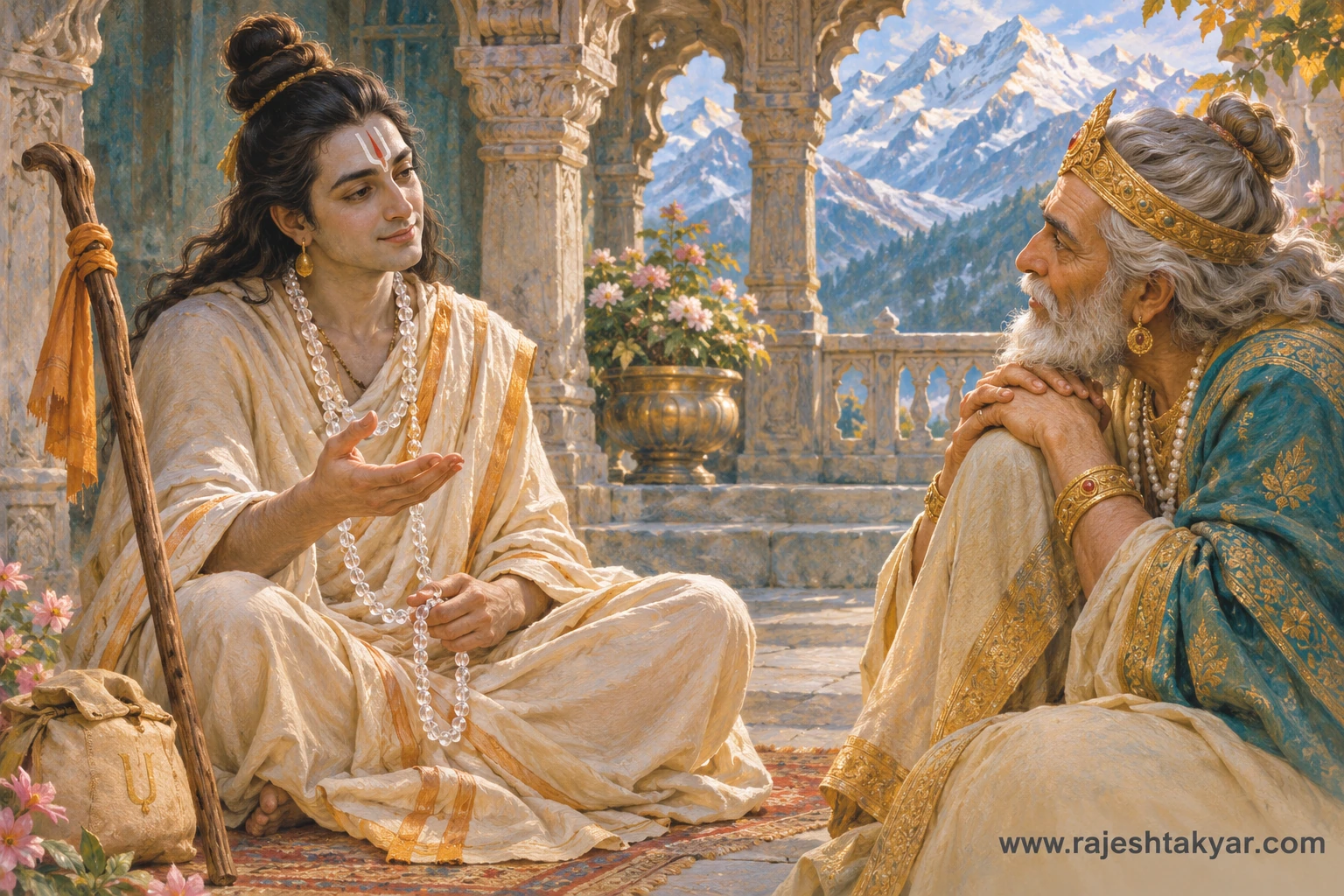
Shiva assumes the form of a devout Vaishnava Brahmin, carrying a staff, parasol and crystal prayer beads, with tilak on his forehead, a Shalagrama at his neck and Hari’s name on his lips. Himavan receives him respectfully. The credibility conveyed by appearance also draws attention here. A visitor’s outward form can establish an impression before we hear the argument, and we carry that impression into our listening. The scene makes the small distance between seeing and understanding especially striking.
In the sage’s guise, Shiva questions Himavan about the marriage. Parvati is a beautiful princess raised in a royal household. Where is the chosen bridegroom’s home? What ordinary family identity does he possess? How does he live, dress and deal with the world? One question after another measures Shiva’s outward form against familiar social expectations. Ash, serpents, the cremation ground and renunciation begin to occupy Himavan and Mena’s attention more than the divine principle they had revered.
The parents become anxious when an opposing description is applied to the form they had just honoured. The visitor also touches their concern about social laughter and family standing. The disturbance comes not simply from facts, but from the meaning assigned to familiar symbols. Ash can be presented as a sign of poverty or understood as a reminder of the impermanence of bodies and splendour. The symbol is the same; the direction of interpretation changes.
This makes it useful to examine our own haste. We see someone’s clothing, modest home or public identity; the work and commitment behind them are not immediately visible. Filling what we cannot see with assumptions can leave judgment incomplete. This is no reason to abandon caution or the need to understand a situation fully. Yet judging a life solely by the measure of our convenience is also inadequate. Understanding begins after seeing; it need not end at that moment.
Worth That Does Not Depend on Praise
Having accomplished his purpose, the mysterious visitor leaves. Himavan and Mena do not know that the person who criticized Shiva was Shiva himself. The unusual nature of the episode becomes fully visible here. Mahadeva has not come to diminish another deity. While repeating Hari’s name, he criticizes his own outward appearance. The book does not confine Shiva and Vishnu’s relationship within a small framework of rivalry. Shiva’s ease expresses a certainty in his own reality that does not need favourable opinions to sustain it.
Does mentioning the absence of a palace alter Shiva’s being? Does listing ash or serpents as defects reduce his divinity? Such questions direct us toward the underlying reality. Outward description and actual nature need not coincide. We cannot simply equate human life with this divinity. Yet it prompts a worthwhile question: do we locate the basis of our work entirely in praise received, or also in its actual qualities and purpose?
Praise has a place. It can recognize effort and express another person’s affection. Difficulty begins when external approval feels necessary for starting work, completing it and judging its value every time. The weight of our judgment then gradually passes into others’ hands. One response can overshadow an entire day’s work. From this lila I take a question: can I value appreciation while retaining an independent responsibility toward what I do?
This independence does not close the door to criticism. Hearing a real weakness in our work is part of learning. To dismiss every disagreement as someone’s failure to recognize our greatness would invert the lesson. Mahadeva’s divinity cannot become a shield for every human claim. One use of inward steadiness is the capacity to examine shortcomings without collapsing. Reduced dependence on praise should accompany a more honest examination of our work.
Let Understanding Do Its Work
Himavan and Mena’s doubt is not the episode’s final condition. The book explains that circumstances later take their proper course and Shiva and Parvati marry through the due rites. A moment of disturbance should therefore not be mistaken for the whole journey’s conclusion. Reverence can pass through a process of understanding its ground more deeply. What was first accepted with joy must be reconsidered before questions. With patience, every new account need not uproot us entirely.
In ordinary relationships we may hear different accounts of someone familiar. They need to be considered according to their basis: what was seen, what was merely heard and what interpretation was added. Clothing or social standing is insufficient as a final basis for acceptance. I do not treat this divine lila as permission to deceive in everyday life. I want to understand my responsibility in judging: avoiding a hasty conclusion and hearing a person fully are small expressions of that responsibility.
When a young reader begins studying or undertaking new work, praise need not accompany every step. Part of practice is quiet. Rereading, improving language or correcting unfinished work often offers little public display, yet that time can strengthen the foundations. If enthusiasm survives only for visible results, necessary preparation may be neglected. Giving effort its proper time can itself become a practice of some independence from praise.
This is no rigid demand never to present one’s effort. We can share work, learn from others and ask for suitable support. I simply value an order in which the purpose remains clear: what I am learning for, what responsibility I am fulfilling and where improvement is needed. External responses can then participate in a conversation rather than becoming the sole voice that judges our entire being.
Returning to the Work
The most useful touch of Shiva’s ease comes to me in returning to the work. I can receive praise humbly and attend to the next proper task, examine the basis of a question and try to understand a correction. If words have only wounded, I need not turn the wound into my whole identity. In this way I may return to responsibility. Shiva remains Shiva amid his own criticism. For human life, the question this raises concerns remaining with our purpose.
Returning requires some room for inward examination. The first feeling after a response need not become a final judgment. We can examine how much comes from wounded pride, how much from a real question, and how much offers useful information about the work. Distinguishing these can change the tone of our answer. The book supplies no mechanical method; it offers a scene of inward certainty amid outward criticism. My questions arise from that scene.
The visitor seated in Himavan’s home appears outwardly to be a critic and is inwardly Shiva himself. Forgetting this double situation would shrink the episode. Let the wonder of the lila remain, while practical reflection proceeds with its own responsibility. Dismissing others is not independence, and closing our eyes to shortcomings is not steadiness. I find greater meaning in the maturity to listen respectfully, examine with discernment and return to appropriate effort.
For me, freedom from the need for praise does not mean withdrawal from relationships. It means caring for the basis of our work within them. Affection from friends, questions from readers and corrections from a guide all deserve regard. Alongside them, we can retain clarity about the direction of our effort. This episode of Madhavshiv turns my attention a little away from image and toward conduct. Working on what can actually improve is more useful; our response about who we are can gradually become visible in that work. Verse 24 of Part 14 of the Shrimad Bhagavad Gita also considers equanimity toward criticism and praise. In explaining it, I attend to useful indications within criticism and to making corrections where it contains truth. Madhavshiv offers another view of this thought. Remaining available to learn with some freedom from concern for image is the question I bring to both sources.