11 October 2026 · Dr. Rajesh Takyar
Seeing the Supreme Through Its Splendours
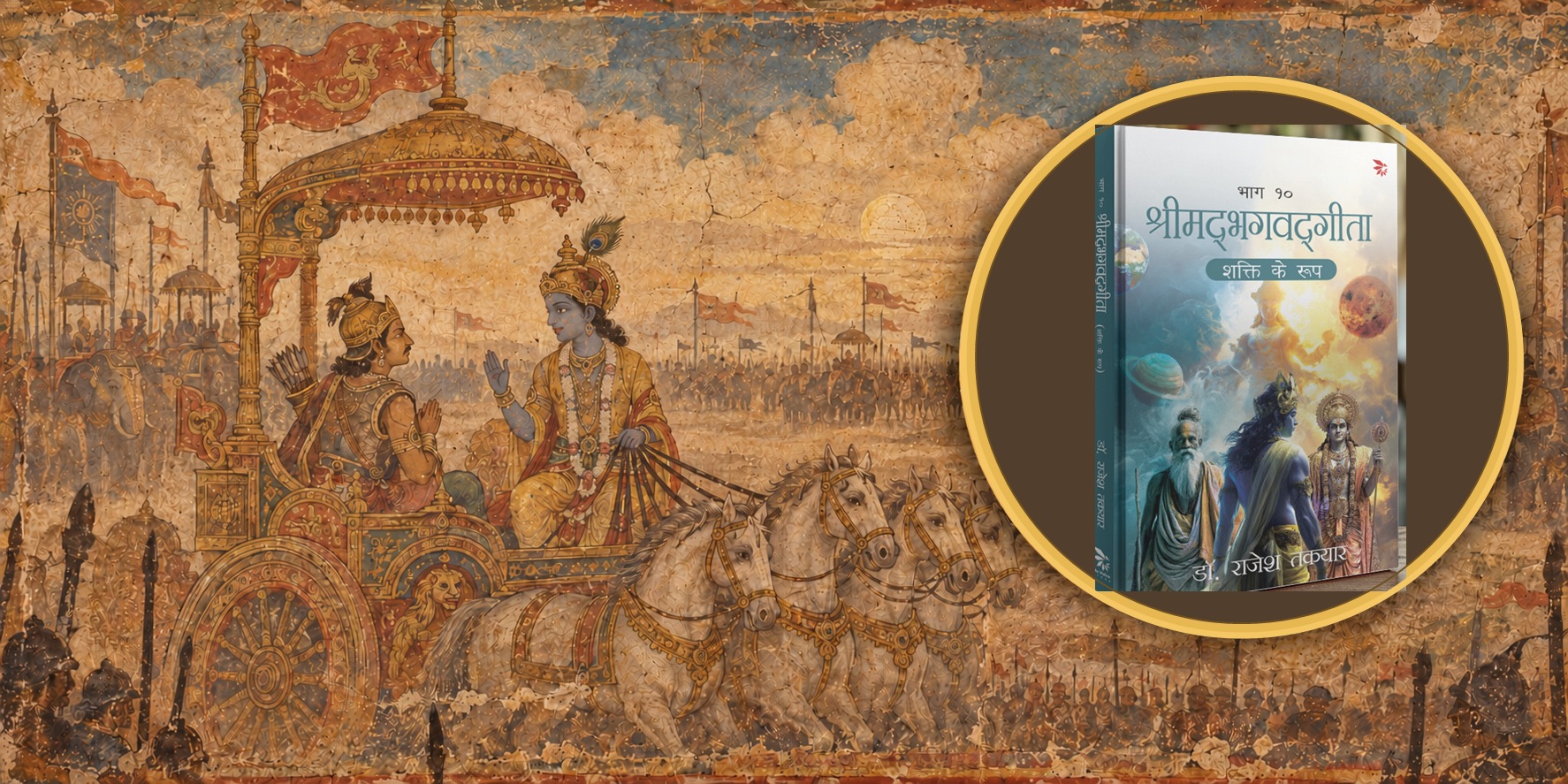
Wishing Arjuna well, Shri Krishna explains His nature more clearly. He says that He is unborn, without beginning and the supreme foundation of all worlds. One who knows this truth begins to become free from delusion.
Qualities such as intelligence, knowledge, forgiveness, truth, self-restraint and contentment also have their origin in Him. The many conditions of life arise within a wider order. When a person recognises this foundation, the insistence on treating every achievement as a product of personal power begins to diminish.
To those who remain lovingly connected with Him, He gives the understanding that enables them to move toward Him. Shri Krishna describes knowledge as a shining lamp that removes the darkness of ignorance within the heart.
Arjuna now expresses his faith. He accepts Shri Krishna as the supreme Brahman, the highest abode and the eternal Person. Yet his curiosity does not end. He wants to make this truth the basis of his constant contemplation.
He asks in which states and forms he should remember Shri Krishna. How can His presence be recognised while living in the world? Arjuna wants to hear about His divine manifestations in detail.
Shri Krishna says that His manifestations are without limit, so He will describe a few of the principal ones. First He turns Arjuna inward: He is the self dwelling in the hearts of all beings and the foundation of their beginning, middle and end.
Then He points to nature. Among sources of light, His splendour can be recognised in the Sun; among steady mountains, in the Himalayas; among bodies of water, in the ocean; and among rivers, in the Ganga. Greatness, vastness and life-giving power can turn the mind toward remembrance of Him.
The mind among the senses and consciousness among living beings are also His manifestations. Arjuna understands that the Divine’s glory is present not only in distant, vast forms but also in the essential powers of his own experience.
Shri Krishna names Om among expressions of speech and the repetition of sacred names among forms of yajna. Among fields of knowledge, spiritual knowledge is His; among forms of reasoning, so is thought that leads to truth. When knowledge leads toward the self and truth, it becomes a means of practice.
He also says that He is present in qualities such as fame, speech, memory, intelligence, steadfastness and forgiveness. The nature of power is not fully expressed through outward influence alone. Its light is also present in the ability to endure, in discernment and in forgiveness.
Time, too, is one of His manifestations. Both beginning and end belong to the order of existence. Whatever is born passes through change. Understanding this truth keeps one’s vision from being limited to immediate gain and loss.
Just punishment in discipline, sound policy in the desire for victory, and silence among secrets all have their importance. Power joined with discernment and proper limits provides a stable foundation for life.
As Arjuna hears of these manifestations, his vision expands in many directions. Whenever beauty, brilliance, steadfastness or a special ability appears, it can lead him to remember the Divine.
Shri Krishna says that wherever extraordinary brilliance, strength, prosperity or influence appears in the world, it should be understood as arising from a portion of His splendour. Each manifestation does not contain the whole truth; it is an indication pointing toward it.
Finally, He asks how much more there is to say about these countless forms. With just one part of Himself, He sustains the whole universe. Arjuna’s lesson is to recognise the one foundation within the world’s diversity and to let faith, rather than ego, arise before every radiant form of power. The author has expanded on this in his following book in 93,171 words. (Shrimad Bhagavad Gita — Part 10 — Forms of Divine Splendour)