11 October 2026 · Dr. Rajesh Takyar
Working Without Being Bound by Results
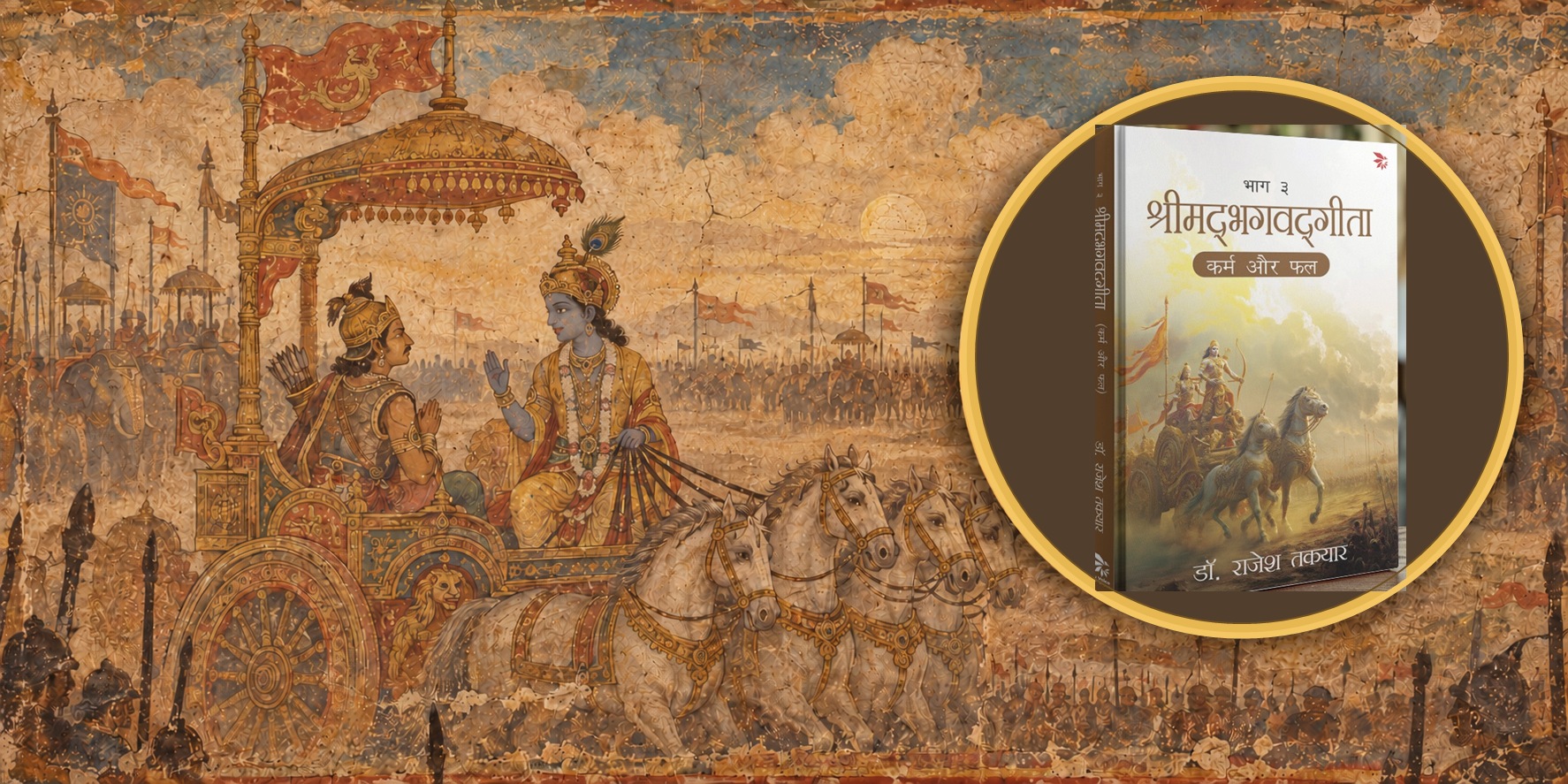
Arjuna says to Shri Krishna: if knowledge is superior to action, why is He urging him to undertake such a difficult action? Arjuna’s understanding is still unsettled. On the one hand, he hears about knowledge of the self and steady wisdom; on the other, he is being asked to engage in his duty. He wants Shri Krishna to show him a clear path that will lead to his well-being.
Shri Krishna explains that the paths of knowledge and action are both disciplines. But merely refraining from beginning an action does not free anyone from the bonds of action. Sitting idle and abandoning work is not, by itself, spiritual fulfilment. No one can remain entirely without action even for a moment. The qualities of nature keep each person engaged in one activity or another.
So the question is not simply whether to act. The question is: with what inner attitude is one acting?
Shri Krishna says that a person who restrains the organs of action but keeps dwelling on sense objects in the mind is not inwardly as restrained as he appears outwardly. By contrast, one who disciplines the senses with the mind and performs one’s duty without attachment follows the better path.
He tells Arjuna to carry out his prescribed duty. Action is better than inaction; even the body cannot be sustained without action. It is necessary to understand the responsibilities life has placed before us and fulfil them.
Shri Krishna then connects action with the spirit of yajna, or sacred offering. Action performed as an offering is rooted in dedication. A person does not limit all that he does to personal enjoyment and self-interest. Shri Krishna asks Arjuna to act in this spirit, letting go of attachment.
He explains the order of mutual nourishment. Through yajna, the divine powers are honoured, and the means necessary for life are received from them. In this way, mutual support becomes a path to well-being. A person who enjoys the resources he has received without offering anything in return is not contributing to this shared order.
Shri Krishna describes how living beings depend on food, food arises from rain, rain is connected with yajna, and yajna is connected with action. Through this cycle, Arjuna is shown the interdependence of life. Human life is sustained by more than one’s personal effort. What we receive also brings a responsibility to give and to fulfil our duty.
Shri Krishna then describes the person who is content in the self alone. Nothing remains for that person to acquire from outside in order to feel complete. But His instruction to Arjuna is clear: continue to perform your duty without attachment. By acting in this way, a person can reach the highest state.
Shri Krishna gives the example of royal sages such as Janaka, who attained fulfilment while continuing to act. He also asks Arjuna to care for lokasaṅgraha—the well-being and proper order of the world. A person’s conduct does not affect only that person. Others follow the example of those they regard as exemplary.
That is why Shri Krishna says of Himself that there is nothing He needs to gain in the three worlds, yet He continues to act. If He were to turn away from action, others would follow that path and the order of life would be disrupted.
The conduct of a wise person should not lead others to abandon their duties. While acting with restraint and dedication, the wise should also encourage others to act appropriately. The influence of knowledge should be visible in one’s conduct.
Shri Krishna also warns Arjuna against the ego that becomes attached to action. Actions arise through the qualities of nature, but a person deluded by ego assumes, “I alone am doing everything.” One who understands the truth recognises these processes and does not become attached to them.
He asks Arjuna to offer all his actions to Him, give up expectation of results and possessiveness, and carry out his duty free from anguish. The practice He describes is to be fully present in one’s work without claiming ownership over its result.
Shri Krishna next speaks of attraction and aversion. The senses draw a person toward what they like and push them away from what they dislike. One should not come under their sway. Following only what feels pleasant and avoiding everything unpleasant are not sufficient ways to recognise one’s duty.
He says that even an imperfect fulfilment of one’s own duty is better than performing another’s duty perfectly. It is necessary to recognise one’s responsibility and remain steady in it.
Arjuna then asks a searching question: why does a person commit a wrong action even when he does not wish to do so? What seems to drive him toward it by force?
Shri Krishna answers: desire and anger. Unfulfilled desire veils a person’s knowledge. Just as smoke covers fire and grime covers a mirror, the veil of desire obscures discernment. Continually feeding desire does not put an end to its hunger.
The senses, mind and intellect are the places where desire takes hold. Shri Krishna therefore first asks Arjuna to restrain the senses. He then explains the order of what is inwardly higher: the mind is higher than the senses, the intellect higher than the mind, and the self higher even than the intellect. Knowing the nature of the self, steadying the mind and overcoming desire—the inner enemy—are essential.
Chapter Three clarifies the direction of action: recognise one’s duty, perform it with dedication, care for the well-being of the world, and avoid attachment to results and the ego of authorship. In this path of karma yoga, outward action and inward restraint go together. Arjuna must not flee from his work; he must transform the awareness from which he acts. The author has expanded on this in his following book in 46,000 words. (Shrimad Bhagavad Gita — Part 3 — Karma and Results)