11 October 2026 · Dr. Rajesh Takyar
Nidhivan: Where Nature Joins the Devotion
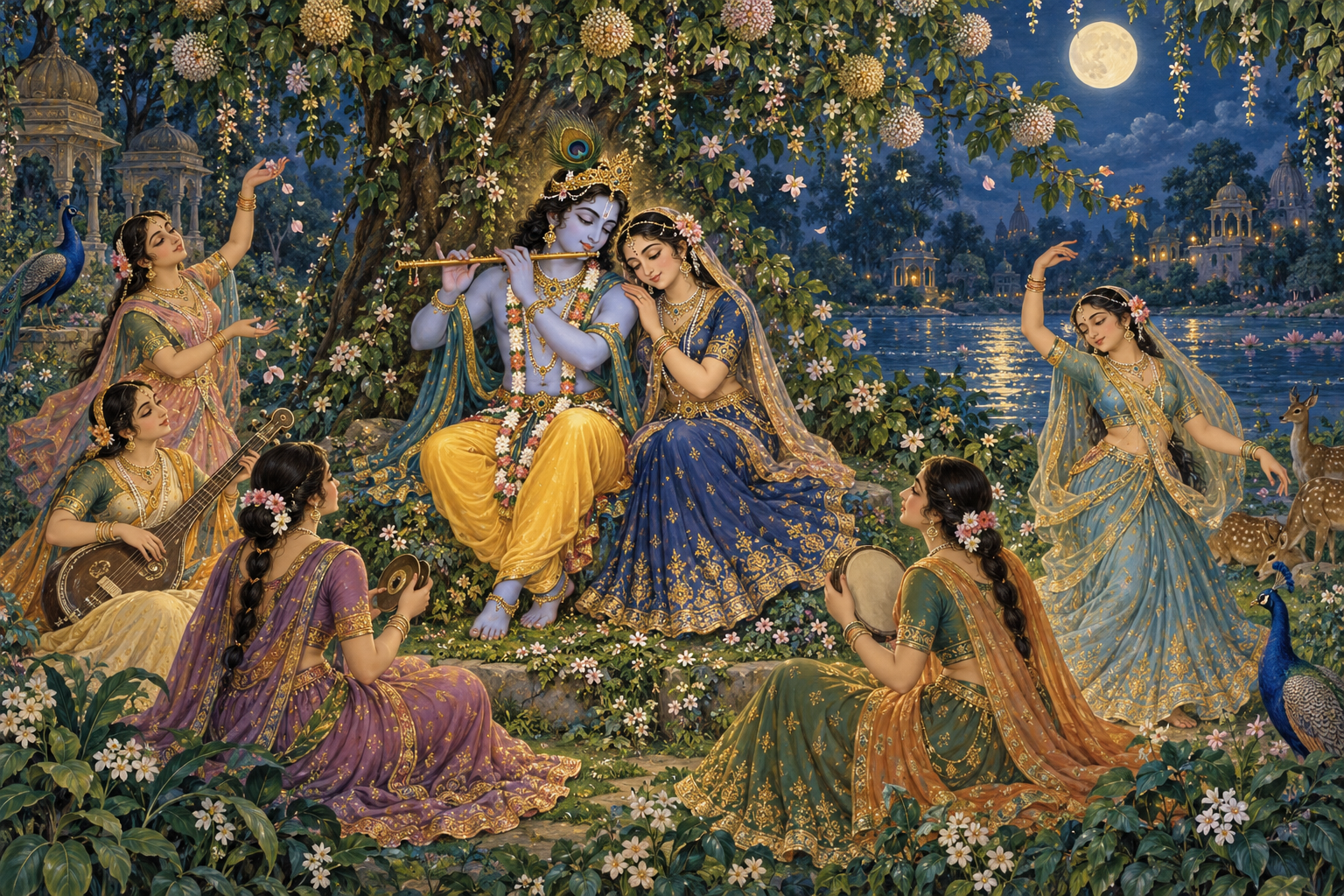
When we imagine Vrindavan, the Yamuna’s bank, the shade of kadamba trees and the sound of a flute often come to mind. Yet in Shri Krishna’s lila, the forest is not merely a backdrop; it becomes a participant in the story. In the “Nidhivan Lila” episode of Dr. Rajesh Takyar’s book Krishna Ki Radha, trees, vines, music, dance and silence together create a many-coloured scene of devotion.
The episode is based on Shri Garga Samhita, Vrindavan Khanda, Chapter 24. According to Narada’s narration in the book, Shri Krishna comes to Vrindavan with the gopis to enjoy the beautiful bank of the Yamuna. The herbs and plants seem to leave their former forms, assume feminine forms and appear there in groups. This description invites us to see nature not as lifeless decoration, but as a presence participating in the lila.
The Forest of the Story, and Our Way of Seeing
It is useful to hold two things together when reading a sacred story: what the text actually says, and what thought awakens within us through it. The original episode poetically describes the lila of Vrindavan. When we reflect on nature, love and devotion through it, that is our contemplative perspective; it should not be mistaken for a separate quotation from the source.
The scene of Nidhivan opens beside the Yamuna. It is a sacred place covered by kadamba trees, with gentle fragrant breezes, and Shri Krishna sits with Radha near Vamshivata. After the rasa, the sounds of the veena, cymbals, mridanga and flute arise. The gods shower flowers, and the gopis sing, transforming the scene into a celebration. The story does not leave the place as a mere geographical point; it becomes a world of memory, sound and feeling.
We often turn a sacred place into something to see: where to go, what to look at, which photograph to take. In this description, the experience of a place arises through listening and participation. The fragrance of the air, the shade of leaves, the riverbank and the music come together. The text suggests that attentive seeing can itself be the beginning of devotion: not treating the creation around us merely as something to use, but regarding its existence with respect.
The Transformation of Vines: A Sign of Participation
The episode’s image of herbs and plants assuming feminine forms is wondrous. It is easy to take it only as a report of a miracle and move on, but the story can also suggest that, in the presence of the Divine, every part of nature becomes meaningful. A vine is no longer only a vine; it finds its place in a celebration of joy. A tree is more than material that provides shade; it becomes the setting and witness of the lila.
A humble lesson follows for us. The world is not an inert storehouse that exists only for our purposes. Trees, water, land and living beings each participate in the wider fabric of life in their own ways. If devotion remains enclosed within the human heart, its relationship with the world remains incomplete. Sensitivity towards nature is not a modern environmental claim made by the story; it is our ethical reflection today, inspired by it: one who sees life as the creation of the Divine cannot easily destroy it carelessly.
In the story, the vines of Vrindavan arrive in groups. The idea of a group is also worth considering. Devotion can be personal, but it does not have to be complete only by cutting oneself off from others. The presence of many voices and forms together creates collective joy. The main point is not to erase each participant’s identity and make everyone alike; diversity remains, yet all turn towards a shared celebration.
Many Paths in Music
The gopis’ singing includes several ragas—Megh Mallar, Deepak, Malkauns, Bhairav, Shri Raga and Hindol. The instruments include the veena, mridanga, cymbals and flute. The author’s account does not confine music to one melody or one performer. Different ragas, rhythms and instruments join in a shared joy.
This diversity suggests that devotion need not have one outward form for everyone. For one person, voice may be a means of closeness; for another, playing an instrument, dancing or silent meditation may serve that purpose. In the story, some gopis sing, some play instruments, some play and dance, and some remain silent, seeing Shri Krishna within. Their outward activities differ, but the episode places them on a shared emotional ground.
Even today, people follow paths of prayer, bhajan, study, service or quiet remembrance. It is not right to judge another person’s practice as inferior because its form differs from our own. Still, the story does not say that every desire or behaviour automatically becomes spiritual. Its centre is love for Shri Krishna and heartfelt participation in the lila. An outward form gains value when it is connected with an inner feeling.
Play and Simplicity in the Lila
Some gopis play ball with Shri Krishna, some play with flowers, and some run among the vines. This scene does not place devotion only in a solemn posture. Joy, laughter, music and play also appear within the story. This matters because we sometimes separate spirituality from the natural ease of life, as though devotion meant only a stern expression and unbroken seriousness.
In play, the centre is not the display of ego, but the gladness of participation. The joyful atmosphere of the story shows that the human heart can also become light in love. When an activity is not done solely to win praise, achieve victory or assert one’s importance, a natural ease appears. This is a life lesson drawn by us; the episode itself does not express it in the language of modern psychology, but its joy leaves room for this reflection.
Ease does not mean forgetting boundaries. The sanctity of the lila, its spirit of participation and its Krishna-centredness remain intact in the episode. Therefore, it cannot be used as an excuse to justify any personal desire. The love in the story is not a tool for self-interest; it is a feeling of setting the ego aside and sharing in the joy of the Beloved.
The Distinct Feeling of Each Participant
In Narada’s narration, the gopis are not all in the same state. Some are deeply absorbed in love, some in music, some in dance, some in a closeness resembling service, and some are immersed in supreme joy, standing still like yogis. Some see Shri Krishna before them; others experience him within and fall silent. The story makes room for both outward activity and inner experience.
Silence is not treated here as lesser participation. In a group, the person who speaks most is not necessarily the one most deeply involved. Listening attentively, remaining quiet or making room for others can also be profound participation. In the same way, the person playing music or dancing is not merely performing; the story describes them as sharing in the joy of devotion. The truth of feeling is not measured by outward noise.
Radha’s presence in this picture is also important. She is not set apart as a mere observer; she is at the centre of the lila with Krishna. The book itself is titled Krishna Ki Radha; therefore, it would not be right to remove the Radha-Krishna relationship from the centre of this episode. The celebration of Vrindavan takes shape with them and around them.
The Question of Grace and Achievement
At the end of the episode, Narada says that the gopis attained Govinda, Lord of all, through his grace; such fortune does not readily come from action alone. The intention should not be to disparage “action.” The central point is that closeness to the Divine cannot be viewed merely as one’s own achievement, calculation or entitlement. Devotion also carries a sense of grace and surrender.
People make efforts: they learn, practise and maintain discipline. But if someone treats every spiritual experience as their own achievement and becomes superior to others, effort may feed ego. Remembering grace keeps the heart humble. This does not mean giving up effort; it means recognising that the fruit of effort is not the result of my private strength alone. Countless relationships, opportunities and supportive circumstances also sustain us.
It is not enough to keep the gopis’ episode at a distance as a story of rare fortune. A reader can ask: whom does love connect me with in my life? Does my practice make me more humble, attentive and compassionate? Can I make room for nature and for other people? These questions are self-examination arising from the story, not direct quotations from the book.
The Silence After the Celebration
There is music, dance, laughter and a shower of flowers in the story; alongside them is the still, silent meditation of some gopis. A beautiful balance appears in this companionship. Devotion is neither intensity of emotion alone nor dry rules alone. It can move among joy and awareness, expression and silence, group participation and intimacy.
When a song ends, its effect may remain in the mind. The test of a sacred experience is not only the joy of that moment; it is also worth seeing what changes in our lives afterwards. If remembrance makes us more patient, generous and attentive, the experience becomes connected with life. If it remains only a momentary excitement, we should reflect again on its deeper meaning.
The Nidhivan lila can still be read today because it offers an image of a world in which nature, art, love and meditation are not locked into separate compartments. The story does not demand that everyone’s experience be identical; it places diverse forms in one shared devotional setting. That is part of its beauty.
How to See This Feeling in Our Lives
Inspired by this episode, we can ask ourselves a few simple questions. Do I see nature only in terms of convenience, or do I also respect its existence? Do I consider someone else’s devotion lesser because of its outward form? Is there room for others in my joy? Do I treat success as my entitlement alone, or do I also acknowledge the help I received?
These questions are not meant to be answered for display. They are tools for looking at our inner direction. A discussion of devotion becomes meaningful when it increases sensitivity and humility in conduct. If the story sees even plants as participants, where is our right to remain insensitive towards the living world around us? If different musical notes can meet in a celebration, why should our hearts be narrow towards human diversity?
It would not be right to impose these reflections as the literal message of the original text; they are lessons for today that arise from contemplating the episode. The original story has its own poetic world. A reader can enter it, respect its feelings and then carefully connect it with questions from their own life. This is reverent study: neither dismissing the story as mere imagination nor turning every personal thought into a scriptural statement.
Conclusion: Participation as a Path to Closeness
In the Nidhivan lila, the plants of Vrindavan, the Yamuna’s bank, the kadamba shade, musical ragas, the gopis’ play, Radha’s presence and the silence of some participants all form parts of a wider scene. Devotion in the story does not become the possession of one skill or posture. One sings, another plays an instrument, another dances, another plays, and someone else sees inwardly. Their participation centres on love for Shri Krishna.
The contemporary reader may find lessons in this episode in respect for nature, diversity in art, natural joy, humility and inner attentiveness. These lessons are not declarations imposed upon the original account; they are questions that arise as we sit with it. Maintaining this distinction allows reverence and discernment to walk together.
This image of Vrindavan reminds us that devotion does not mean escaping life; it can also mean becoming more sensitive towards life. When we do not see a tree merely as timber, a river merely as a resource, art merely as performance or a person merely as a means, a spirit of participation awakens within us. This may be one humble way to keep the feeling of that forest lila alive in our own time.