11 October 2026 · Dr. Rajesh Takyar
Arjuna’s Question Before the Universal Form
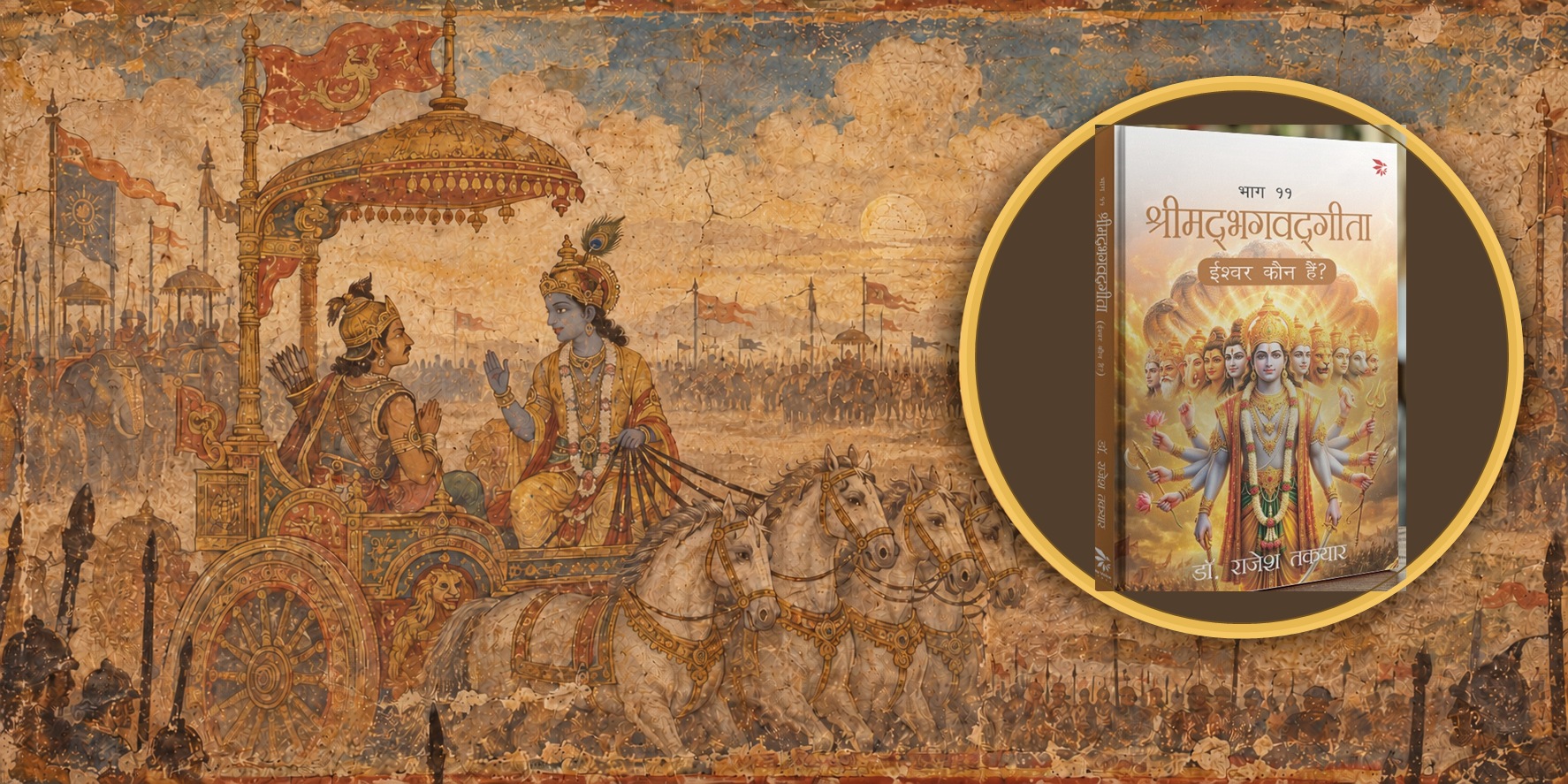
After hearing about Shri Krishna’s glory and the foundation of creation, a new question arises in Arjuna. He says that Shri Krishna’s grace has removed his delusion. Now he wants to behold directly the divine form he has heard described.
Arjuna makes his request humbly. If Shri Krishna considers him worthy of this vision, may He show him His imperishable form. The desire to know now becomes a longing for direct experience.
Shri Krishna explains that this form cannot be seen with ordinary eyes. He gives Arjuna divine sight. Through it, Arjuna beholds an expanse in which countless forms and directions, and the whole universe, are held together at once.
The form has countless faces, eyes and arms. Its radiance is immeasurable. No clear beginning, middle or end can be seen. The world that seemed divided among separate objects and beings now appears within one vast foundation.
Arjuna is filled with wonder and folds his hands in reverence. Before him is no longer just an idea he has heard about God, but an experience far greater than his limited understanding.
He calls Shri Krishna the imperishable truth, the supreme refuge of the universe and the protector of eternal dharma. All directions are pervaded by this form. No place appears to lie beyond it.
Yet this vision is not only an experience of gentleness and beauty. Arjuna also sees its fierce and destructive aspect. His composure begins to falter. Seeing all that has come into being moving toward its end, he becomes distressed.
He asks who Shri Krishna is in this terrible form. He wants to understand His purpose. For Arjuna, the question of God is now connected with the mystery of destruction as well as creation.
Shri Krishna identifies Himself as Time, the destroyer of worlds. The order of time does not depend on the wishes of any one person. A person may imagine that he alone creates events, while before him a much wider order of existence is unfolding.
Arjuna is instructed to become an instrument. He must fulfil his duty, but without the ego that claims to accomplish everything alone. The universal vision reveals both his responsibility to act and the limits of his belief that he is the sole doer.
Arjuna’s mind fills with deep humility. He remembers that, in familiarity and affection, he sometimes treated Shri Krishna merely as a friend and addressed Him casually. Now, recognising His immeasurable glory, he asks forgiveness.
He prays that Shri Krishna forgive his mistakes as a father forgives a son, a friend a friend and a beloved one their dear companion. His prayer holds both reverence and intimacy.
Arjuna is joyful and afraid as he beholds the universal form. He pleads with Shri Krishna to show His gentle form again. Shri Krishna reassures him and appears in the familiar, peaceful form. Arjuna’s mind begins to grow steady again.
Shri Krishna then explains that His true nature can be known and attained through undivided devotion. Along with the completeness of outward disciplines, loving dedication of the inner being is necessary.
The final teaching must enter one’s conduct. One who works for Him, makes Him the highest goal, remains free from attachment and bears ill will toward no being attains Him. The fruit of the universal vision is a devotion in which humility, duty and freedom from hostility toward all beings are present together. The author has expanded on this in his following book in 92,496 words. (Shrimad Bhagavad Gita — Part 11 — Who Is God?)