11 October 2026 · Dr. Rajesh Takyar
Who Will Teach Us to Decide?
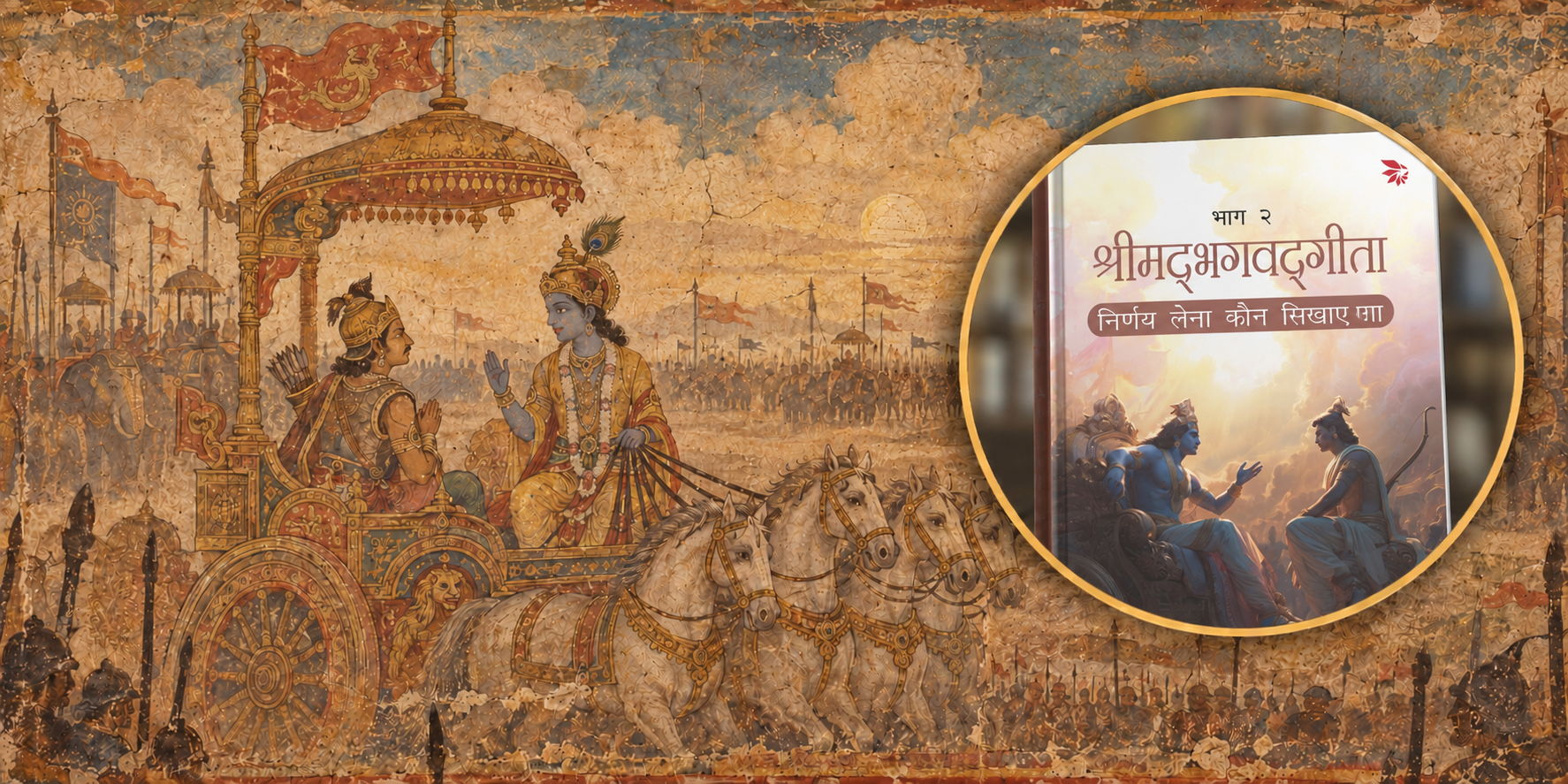
Arjuna tells Shri Krishna that he cannot understand what it would be right for him to do. On one side is his duty; on the other are relationships whose loss even in imagination overwhelms him. He is also unsure whether victory or defeat would be better for him. He has had to stand before the very people he does not wish to kill in order to live.
Arjuna feels that even if he gained a prosperous kingdom on earth, or even dominion over the gods, this grief within him would not go away. At last, he admits his helplessness. He tells Shri Krishna that his mind is confused about dharma. He is now Shri Krishna's disciple and has taken refuge in him. Shri Krishna should teach him what will certainly be for his good.
Here the direction of the dialogue changes. Arjuna is now ready not only to express what is on his mind, but also to learn.
Shri Krishna first directs him towards the truth he has lost sight of in his grief. He explains that the body and the soul dwelling within it are not one and the same. The body changes. Childhood comes, then youth, and later old age. Through these changes, the inner self continues to exist. In the same way, the soul does not come to an end when the body ends.
The soul is neither born nor does it die. It is not destroyed even when the body perishes. Just as a person discards old clothes and puts on new ones, the soul leaves an old body and takes another. No weapon can cut it; fire cannot burn it; water cannot wet it; and wind cannot dry it.
Shri Krishna does not only explain the meaning of death to Arjuna; he also gives him a way to view life's changing experiences. Cold and heat, pleasure and pain come and go. They do not last. A person who does not break down or get swept away by every change, but remains patient, begins to develop a steady understanding.
Shri Krishna then turns Arjuna's attention to his duty. He says that Arjuna should not be shaken even when he considers his own dharma. In this situation, abandoning his duty out of attachment is not a solution. Arjuna must fulfil his dharma while maintaining balance amid pleasure and pain, gain and loss, victory and defeat.
But how can the mind maintain this balance? Hope of gaining something and fear of losing something keep making it waver.
Shri Krishna answers by clarifying the relationship between action and its result. Arjuna has a right to perform his action, but not to its fruits. He should not act while bound by attachment to the results, nor should he become attached to inaction. Fear of the outcome should not make him inactive, and desire for the outcome should not take his understanding captive.
Shri Krishna tells Arjuna to act with equanimity in success and failure. This is the yoga of evenness. While acting, the mind should not be caught up only in calculating what it will get. Understanding should be clear enough for a person to recognise the right action and carry it out wholeheartedly. In this context, Shri Krishna describes yoga as skill in action.
Firm resolve also matters on this path. An understanding with a clear goal moves in one direction. But when the mind keeps chasing many desires and attractions, its understanding branches out in many directions. When the pursuit of enjoyment, splendour and pleasure becomes everything, inner steadiness does not arise.
Hearing this, Arjuna asks Shri Krishna another question. What is the mark of a person whose understanding has become steady? How does such a person speak, sit and walk?
Shri Krishna describes the inner state of such a person. Having let go of the mind's desires, that person remains content in the self. Sorrow does not unsettle them, and longing for pleasure does not make them run after it. They are free from attachment, fear and anger. A favourable situation does not bind them through attachment, and an unfavourable one does not drown them in aversion.
Shri Krishna gives the example of a tortoise. Just as a tortoise draws in its limbs when needed, a self-controlled person can withdraw the senses from their objects. But keeping one's distance outwardly is not enough. Even when kept away from an object, its attraction may remain in the mind. Therefore, along with self-restraint, it is necessary to turn inward and become established in the Supreme Truth.
He also explains the sequence by which the mind wanders. Repeatedly dwelling on an object creates attachment to it. Attachment gives rise to desire, and desire gives rise to anger. Anger obscures discernment. Memory becomes confused, and understanding begins to be lost. A person then moves towards decline through their own decisions.
By contrast, one who lives with controlled senses, free from attachment and aversion, attains inner gladness. In a cheerful mind, understanding becomes steady. How can happiness remain in an agitated mind?
At the end, Shri Krishna gives the example of the ocean. Many rivers flow into it, yet it remains steady within its bounds. In the same way, a person in whom desires arise and then settle, without becoming their servant, finds peace. One who lives by letting go of the hold of “I” and “mine” reaches the steady state that Shri Krishna calls the state of Brahman.
In the second chapter, a direction for decision-making opens before Arjuna. Knowing the truth of the soul, bearing change with patience, recognising one's duty, and acting without attachment to results are all connected. Self-restraint and a steady understanding make that direction clearer. A decision then arises not merely from fear, attachment or the desire for gain, but from discernment.
The author has explained and expanded on its meaning in 60,500 words in this book.