5 November 2026 · Dr. Rajesh Takyar
Pride Before a Blade of Grass
A Question After Victory
Success brings pleasure. It is satisfying to see effort bear fruit, whether a difficult task is finished, an examination passed or a skill developed over years. The question concerns the outlook that follows this natural joy. How do I understand my achievement? Do I remember my companions, opportunities to learn and the abilities available to me? Or do I quietly conclude that everything happened through me alone? Pride begins to find a place in this small change of outlook.
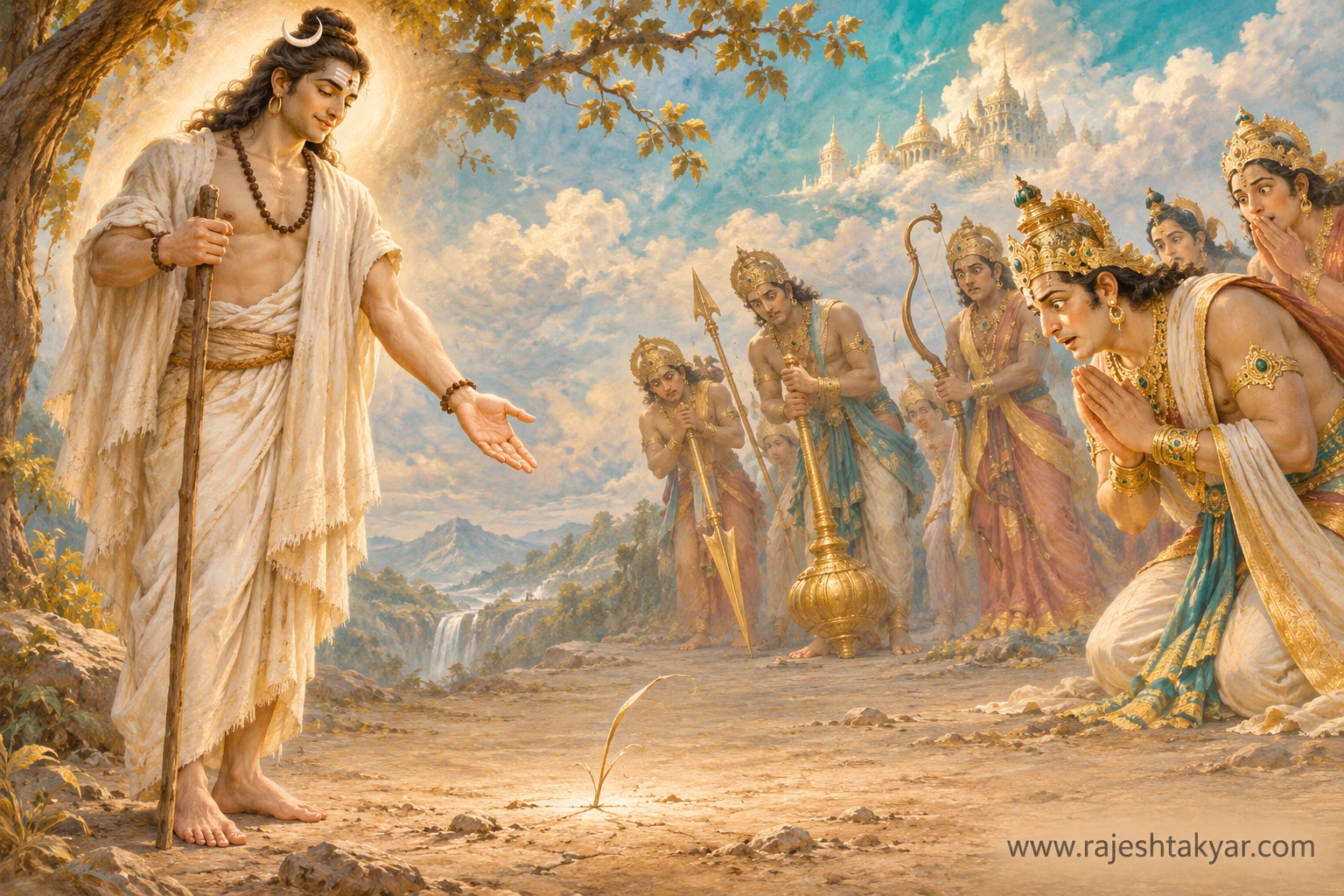
The episode of the gods’ humbled pride in Madhavshiv presents this situation. The ocean has been churned. Shiva has borne the poison that emerged and protected the world from danger. Nectar follows, and the gods gain victory. During their celebration, praise of their weapons and prowess grows. They recognize their own exertion but begin to lose sight of the wider foundation supporting their strength. Reading this episode, I am drawn less to the scale of the battle than to the error arising immediately after victory.
Shiva does not come to take away their victory or deny their effort. Appearing as a yaksha, he places their claim to strength before a simple question: does the possessor of power recognize its foundation? When achievement retains this question, joy can remain humble. Without it, celebration can become an occasion to diminish others. The episode therefore begins with victorious beings rather than defeated ones. The work of examining ourselves remains even after success.
We need to distinguish recognizing ability from treating ourselves as everything. Denying our capacity would also depart from truth. A person’s contribution deserves recognition. Recognizing it, however, does not erase everyone else’s contribution. Satisfaction in our work differs from believing that our work places us beyond learning or assistance. This episode invites me to retain the value of achievement while noticing the truths left outside its celebratory account.
A Blade of Grass Changes the View
The yaksha places a small blade of grass on the ground and asks the gods to cut it with their weapons. At first, the challenge seems trivial beside their great victory. Yet their weapons do not cut it. Repeated attempts leave it unchanged. This small scene turns the episode. Those absorbed in their prowess encounter a limit they had not imagined. The grass no longer appears insignificant: it has revealed the boundary of their claim.
The grass gives no speech and insults nobody. Its remaining intact is enough. Laughter subsides, and astonishment becomes a question. The gods begin to look seriously at the yaksha they had considered ordinary. I see the beginning of learning in this change. If I am completely occupied by my own answer, where is the room to hear what stands before me? Encountering a limit can make the mind harder, or it can make it curious. Here it turns toward inquiry.
A heavenly announcement reveals that the yaksha is Shiva himself. The gods remember their earlier claims. Their weapons, positions and victory remain. The change is within: what they had treated as separately possessed power is now recognized in relation to its source. Bowing does not mean they have become incapable of action. It expresses acceptance of their true position. When outward respect is joined to inward recognition, humility becomes more than a formality.
I do not want to use the grass merely as evidence of someone else’s pride. That would move the lesson outside me again. In present life, a small difficulty, inability in a new task or an unanswered ordinary question can reveal a limit. These are contemporary illustrations, not further events from the original episode. They prompt a question: do I conceal a limit as soon as I meet it, or prepare to understand it? The mirror of the grass matters when I can see myself in it.
Gratitude Alongside Strength
Pride separates an achievement from its supports. It keeps the result while forgetting the conditions that made it possible. The gods remember victory but lose sight of Shiva’s bearing of the poison. I can examine a similar forgetting in my own life. When I gain a skill, do I remember the teacher’s patience? When a responsibility is fulfilled, do I notice those who quietly helped? Gratitude does not require exaggerating their contribution. It prevents an actual contribution from disappearing.
Humility brings further questions to the use of strength. It is no longer enough to ask what I can do; I must consider whose good it serves and whose dignity it respects. The discussion of divine and contrary tendencies in the Shrimad Bhagavad Gita similarly asks us to recognize pretence, arrogance and pride. Outward position does not automatically prove inward purity. The value of capacity also appears in its use and the disposition accompanying it.
It is easy to finish gratitude with a spoken thank-you while retaining a sense of superiority. If I truly acknowledge assistance, there should also be room to hear another person. If I learned from someone, why should further learning embarrass me? If I recognize my colleagues’ contributions, their dignity should remain when I suggest corrections. Humility is tested in these small situations. It must move beyond a bowed head on a platform into everyday conduct.
Humility does not mean leaving our responsibilities to others. The gods’ error is not that they struggled but that they later considered themselves wholly independent. The practical lesson therefore cannot be withdrawal from action. I should work, develop ability and accept responsibility while remembering that ability does not make me the owner of final truth. Respect for effort and remembrance of its foundation can keep success open to learning rather than turning it into an inward wall.
What Follows a Young Person’s Achievement
Imagine students completing a small study project together. The student who presents it receives praise and might immediately attribute the whole success to speaking ability. Remembering the others’ questions, preparation and help during practice can give that praise a different direction. The student values the entire learning process rather than merely advancing a name. This imagined example shows that education continues after achievement. A result has arrived, but the outlook still needs to mature.
Valuing time in youth also means keeping the rhythm of learning after success. If the mind remains occupied with displaying an achievement, the next task finds no space. Clarifying what we learned, recognizing remaining gaps and allowing time for further effort honour the achievement itself. Rest and celebration are not being condemned. Celebration can bring joy and rest can support renewed preparation. The concern begins when joy gives way to the endless management of one’s image.
New learning naturally reveals what we do not know. Success in one subject does not confer competence in every subject. Recognizing this need not destroy confidence; it gives confidence a sound basis. A learner who can distinguish what is understood from what remains unclear can see the task more clearly. Pride makes this simple admission difficult because it must display completeness everywhere. The grass suggests that recognizing a small limit and moving forward is itself a use of strength.
I do not wish to diminish youthful enthusiasm; it carries considerable possibility. That possibility flourishes when receptiveness accompanies it. Someone who treats every correction as an insult may come to experience assistance as a challenge. Someone who can listen can direct energy toward learning and work instead of continual self-defence. Humility is therefore more than an ornament. It protects the space in life where something new can still be understood and worthwhile work continued.
Remaining Capable While Bowing
The gods bow, but the episode does not announce the end of their capability. It restores a right relationship with strength. This distinction matters to me. A person who recognizes an error and declares the self worthless has exchanged one exaggeration for another. Considering ourselves everything or nothing can equally obscure our actual position. Shiva’s grass reveals the truth between them: capacity and its limit, effort and its supports. Accepting that truth can make subsequent action more attentive.
Everyday practice appears in ordinary situations: hearing someone fully, acknowledging assistance in its proper place and withholding a final opinion on an unfamiliar subject. These are reflections arising from the episode, not a separate method or guaranteed formula for achievement. Their purpose is to give inward recognition a place in conduct. If humility remains a beautiful thought while superiority continues to govern behaviour, have we truly looked into the mirror of the grass?
When success comes again, I want to notice more than the result. What assistance was present? Where am I still learning? How will this ability be used next? Such questions need not take colour from celebration. They can make it truer by allowing others to appear alongside the self. The gods’ first view contained only victors; their changed view included the foundation of power. The episode helps me recognize forgetting amid success and carry gratitude into my next action.
A blade of grass fights no weapon, yet changes the gods’ outlook. Its quiet presence stays with me. A real lesson need not arrive through grand words or a great blow. A small limit can show that more remains to be seen. The response is to stand humbly with our ability rather than flee it. Let effort, time for learning and respect for others remain. Such success preserves our dignity while keeping the mind open to a truth greater than itself.